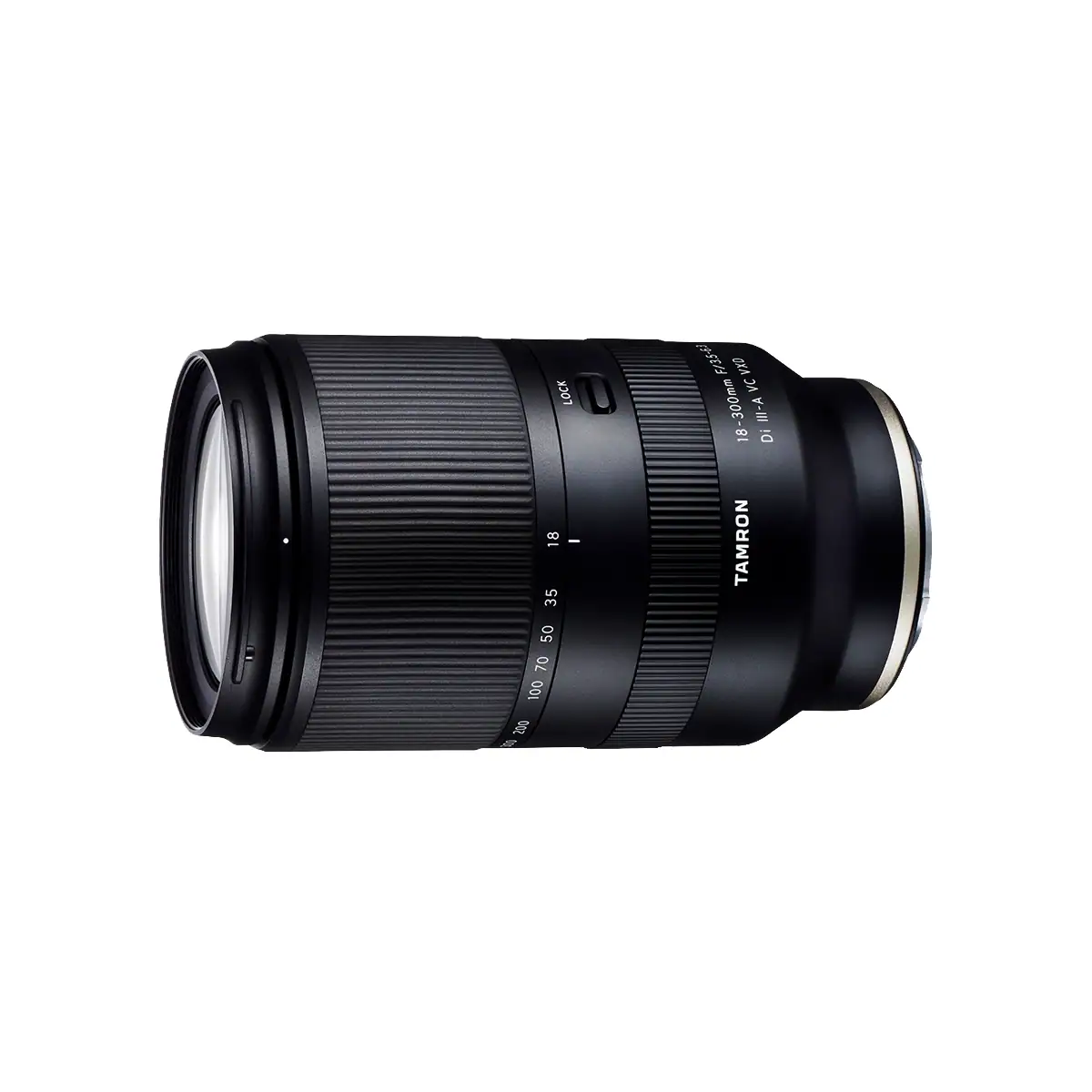
Instant Savings
 Rebate Claims
 Support
 Find a Dealer
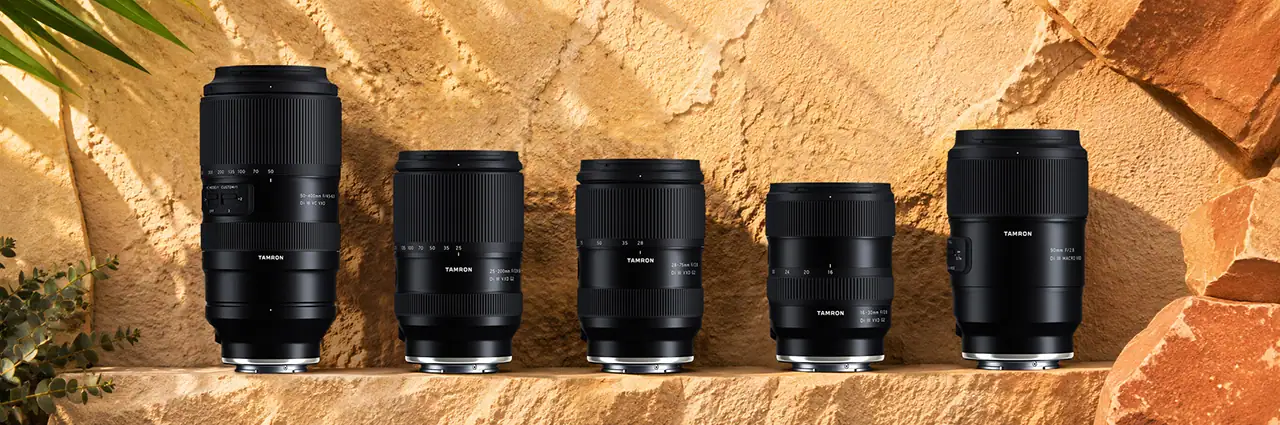
Camera lenses focus light onto the camera’s sensor to form an image. They use groups of glass elements to bend, direct, and correct that light. Three core specifications determine the perspective, light-gathering ability, and camera compatibility of each lens: focal length, maximum aperture, and mount type. This guide breaks down how lenses work, the parts and specs printed on the barrel, and how to choose the right lens for your camera and the subjects you shoot most.
Table of Contents
- How Do Camera Lenses Work?
- The Parts of a Camera Lens
- Understanding Focal Length
- Understanding Aperture and F-Stops
- Lens Features and Technology Explained
- How to Read a Lens Name
- Types of Camera Lenses
- Prime vs. Zoom Lenses
- How to Choose the Right Lens
- Find the Right Lens for the Way You Shoot
- Camera Lens FAQs
How Do Camera Lenses Work?
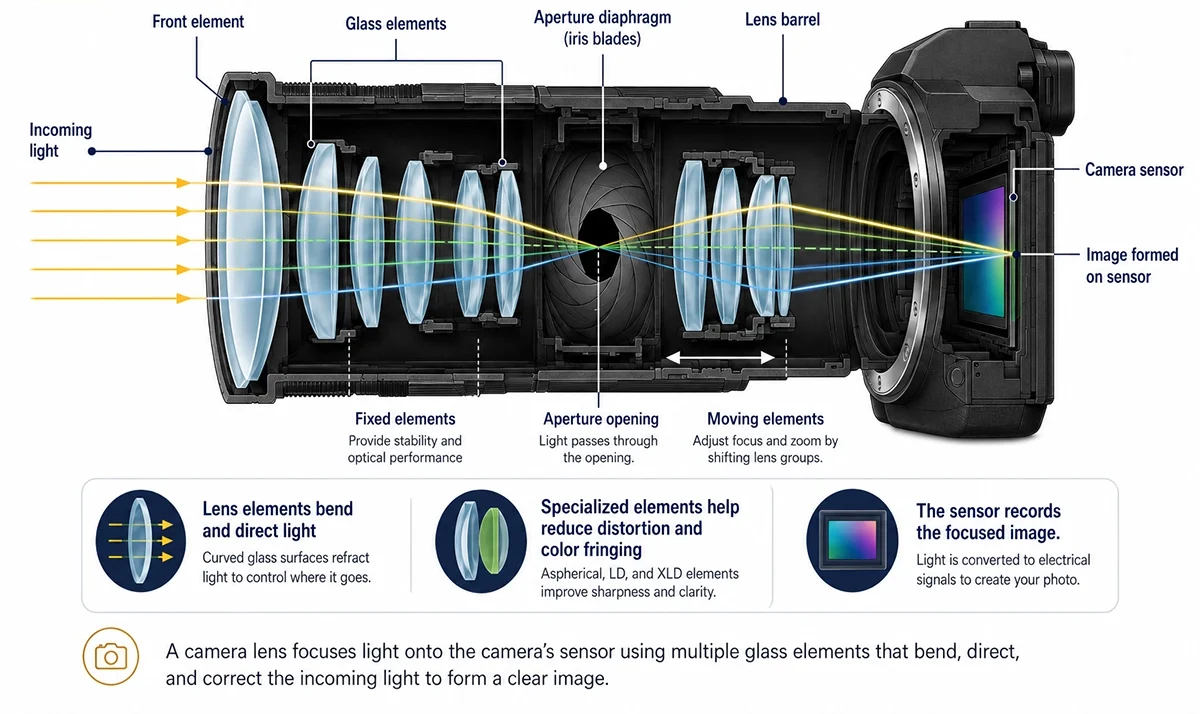
A camera lens focuses light onto the camera’s sensor to form an image, using multiple glass elements to bend and direct the incoming light. The elements also help correct distortion, color fringing, softness, and other optical issues so the sensor receives a clear, accurately rendered image.
When light enters the front of a lens, each optical element changes the direction of the light rays slightly. The combined effect brings the rays together at the sensor plane, where the camera records the image. The shape, position, coating, and movement of those elements influence sharpness, contrast, color, distortion, and focusing performance.
Some lens elements remain fixed, while others move when the photographer focuses or changes focal length. Modern lens designs contain numerous elements arranged in groups, including specialized glass that helps control chromatic aberration and maintain detail across the frame.
Understanding camera lenses becomes much easier when you separate the subject into three areas: the physical parts of the lens, the specifications printed on the barrel, and the lens type best suited to the subject you want to photograph.
The Parts of a Camera Lens
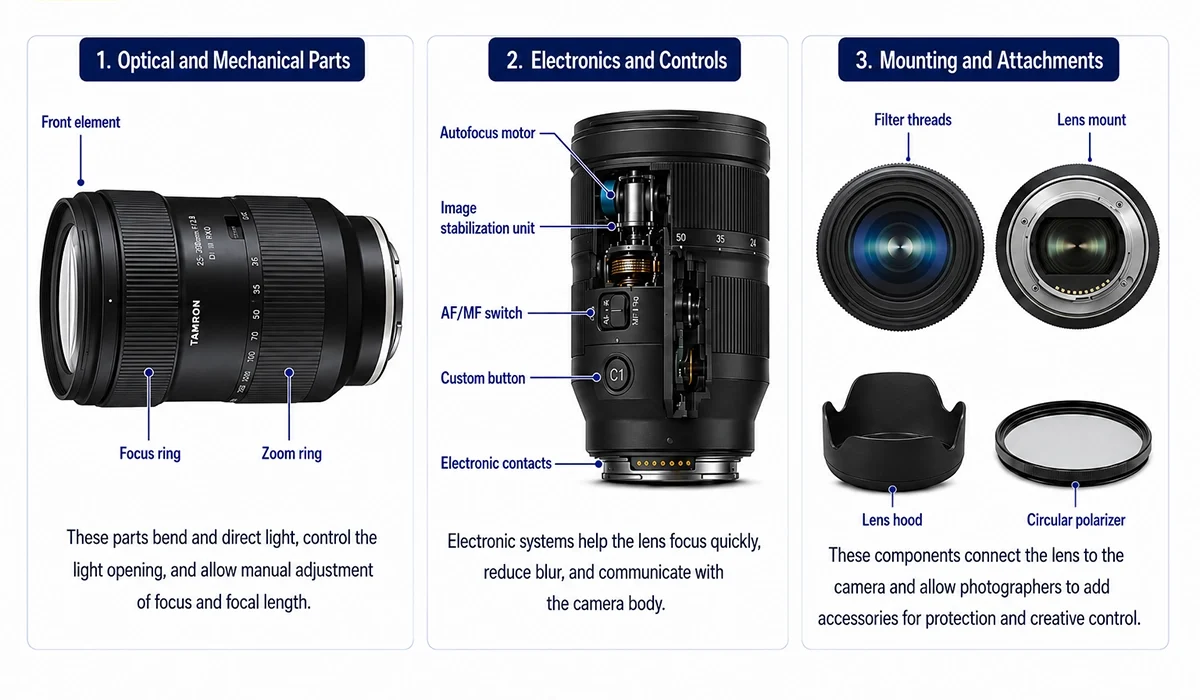
A camera lens consists of external and internal parts that work together to focus light, including glass elements, an aperture diaphragm, focus and zoom rings, the lens mount, filter threads, and electronic controls. These components can be divided into optical and mechanical parts, electronics and controls, and mounting and attachment points.
Optical and Mechanical Parts
The main optical and mechanical parts of a lens are the glass elements, aperture diaphragm, focus ring, and, on a zoom lens, the zoom ring. The elements form and correct the image, the diaphragm controls the amount of light, and the rings let photographers change focus or focal length.
- Lens elements are shaped pieces of optical glass arranged inside the barrel. Their job is not only to focus light but also to reduce problems such as distortion, flare, color fringing, and softness near the edges of the frame.
- The aperture diaphragm is a set of overlapping blades that creates an adjustable opening inside the lens. The opening expands or contracts when the aperture setting changes, controlling how much light reaches the sensor.
- The focus ring allows the photographer to change the focus distance manually. On many autofocus lenses, turning the ring sends an electronic instruction to the focusing system rather than physically moving the elements.
- The zoom ring changes the focal length of a zoom lens. Turning it alters the lens’s angle of view and magnification, allowing the photographer to move from a wider composition to a tighter one without changing lenses.
Electronics and Controls
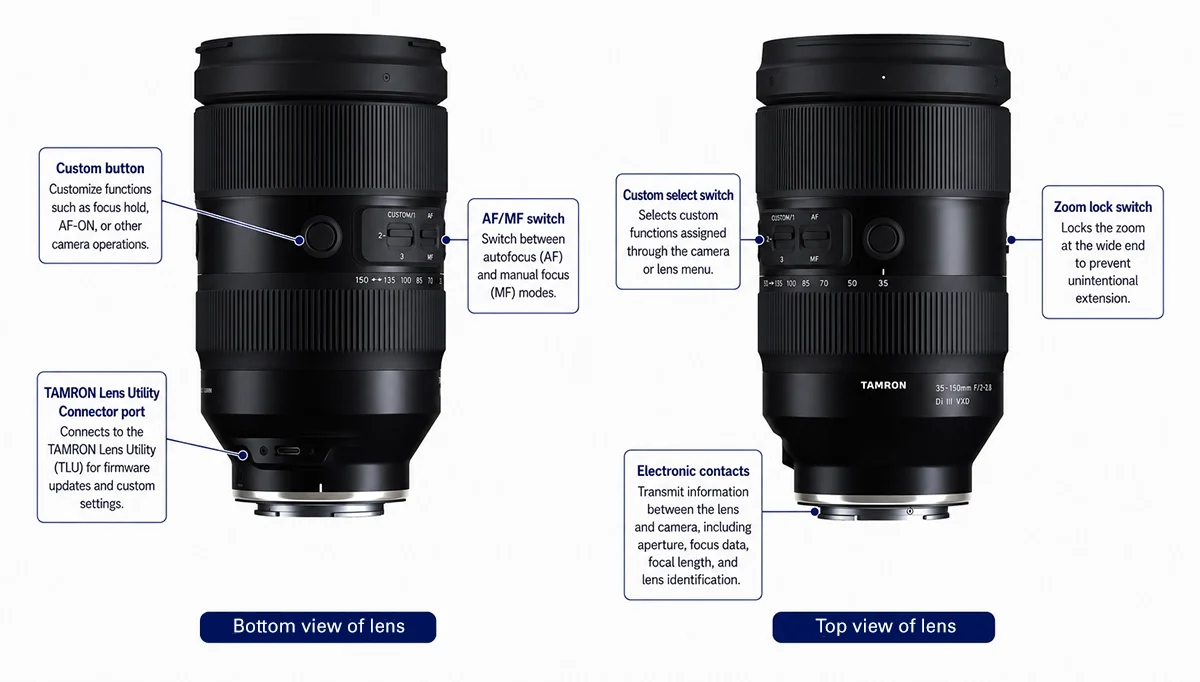
Modern lenses include an autofocus motor, optical image stabilization, electronic contacts, customizable buttons, and switches for functions such as AF/MF selection. These systems communicate with the camera, move internal lens groups, compensate for camera shake, and give photographers faster control over important shooting functions.
The autofocus motor moves one or more internal lens groups until the subject reaches focus. Motor design affects focusing speed, accuracy, operating sound, and the smoothness of transitions during video.
Learn more about Tamron’s VXD linear autofocus motor technology and how it supports fast, precise, and quiet focusing.
Lens-based stabilization detects camera movement and shifts a lens group in the opposite direction to reduce visible blur. Tamron calls its proprietary optical stabilization system Vibration Compensation, or VC.
Read more about optical image stabilization and how image stabilization works.
Electronic contacts at the rear of the lens transmit information between the lens and camera, including aperture settings, focus data, focal length, and lens identification.
Mounting and Attachments
The lens mount connects the lens securely to the camera and determines compatibility. Filter threads at the front hold accessories such as circular polarizers, while a lens hood attaches around the front element to block unwanted light and provide added protection from fingerprints, bumps, rain, and airborne debris.
- The lens mount includes the physical connection and electronic interface between the camera and lens. Mount systems are not interchangeable, so a Sony E-mount lens cannot be attached directly to a Nikon Z, Canon RF, or Fujifilm X-mount camera.
- The filter threads are the grooves around the front of the lens. The thread diameter is usually marked with a symbol resembling a circle crossed by a line, followed by a number such as 67mm.
- A circular polarizer filter can reduce reflections on water, glass, foliage, and other nonmetallic surfaces while increasing visible color saturation.
- A camera lens hood helps prevent stray light from reaching the front element and causing flare or reduced contrast.
Understanding Focal Length
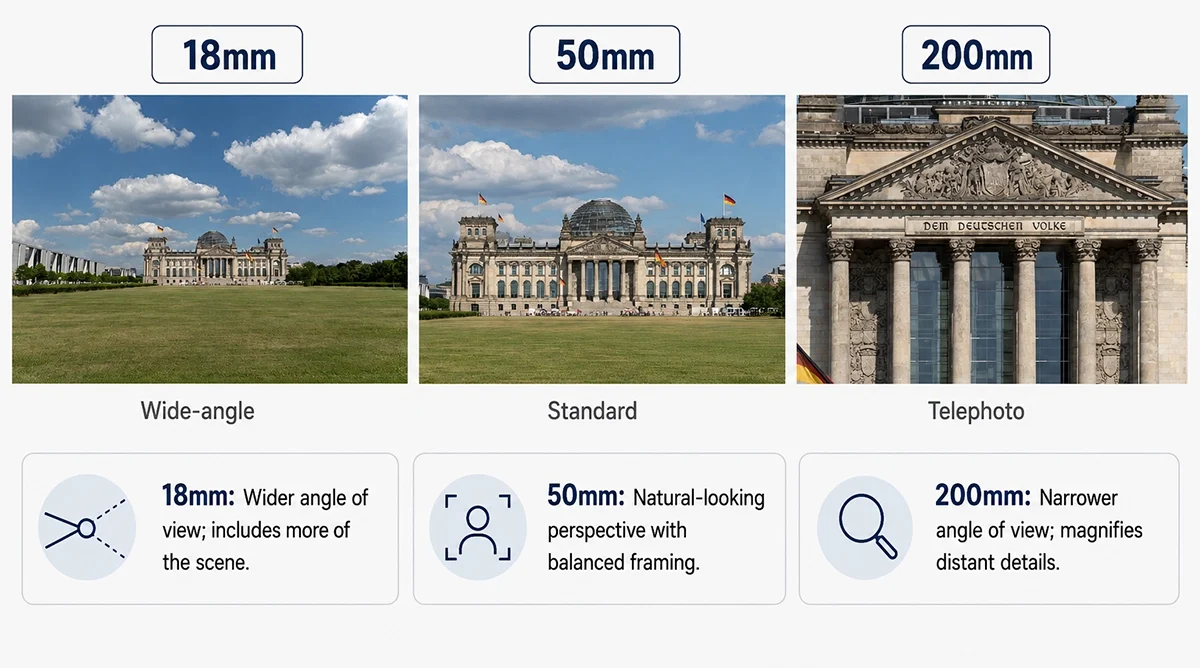
Focal length, measured in millimeters, determines a lens’s angle of view and magnification. Lower numbers such as 18mm capture a wider view, while higher numbers such as 200mm show a narrower view and make distant subjects appear larger, creating an effect similar to looking through a telescope.
- A wide-angle focal length includes more of the scene and is useful for landscapes, architecture, interiors, travel, and astrophotography.
- A standard focal length produces a natural-looking perspective suited to everyday photography, portraits, street scenes, and documentary work.
- A telephoto focal length narrows the frame and magnifies distant subjects such as athletes, wildlife, birds, and stage performers.
Focal length also influences how photographers frame relationships between foregrounds, subjects, and backgrounds. A wider focal length can exaggerate the size of nearby objects, while a telephoto lens can create the appearance of compressed distance between objects.
Photographers beginning with wide perspectives can also review this Beginner’s Guide to Using Wide-angle Zoom Lenses.
For a deeper explanation of millimeter markings, angle of view, magnification, and sensor size, read Understanding Focal Length in Photography.
Understanding Aperture and F-Stops
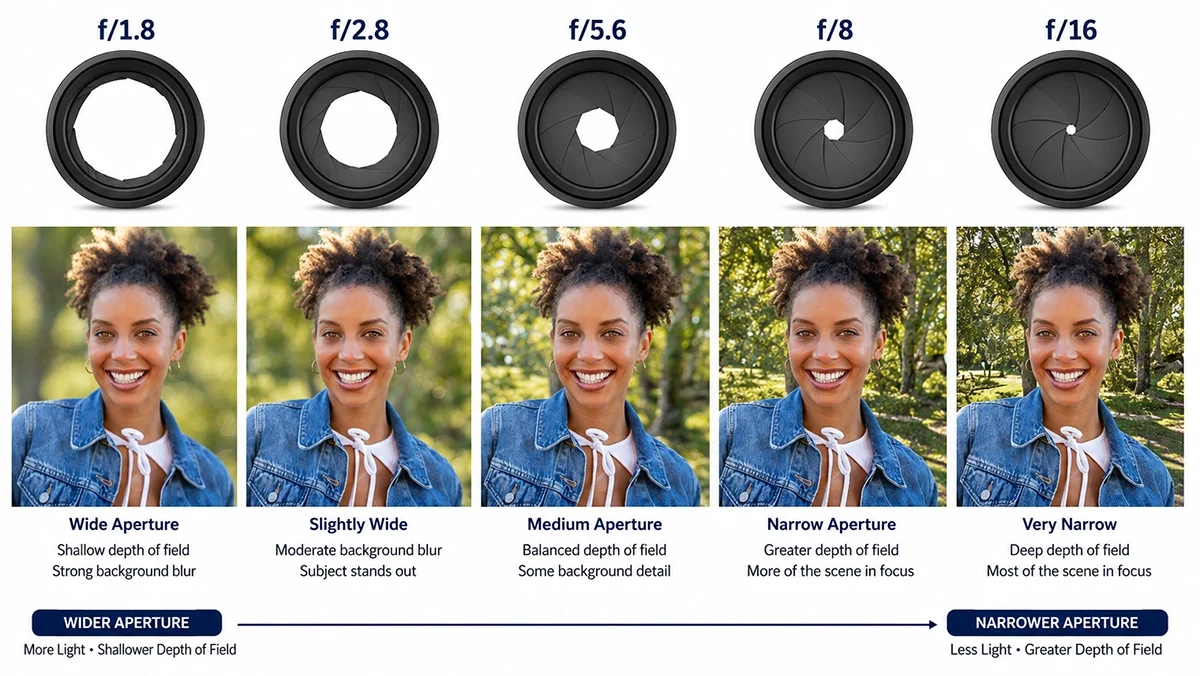
Aperture is the adjustable opening inside a lens that controls how much light reaches the sensor, and it is measured in f-stops. A small f-number such as f/1.8 creates a wide opening and shallow depth of field, while f/16 creates a smaller opening that keeps more of the scene in focus.
The f-stop scale can seem counterintuitive because smaller numbers represent larger openings. Moving from f/4 to f/2.8 opens the aperture and allows more light to reach the sensor. Moving from f/4 to f/5.6 closes the aperture and reduces the amount of light.
Aperture affects both exposure and depth of field. A wide aperture can support faster shutter speeds in low light and create stronger subject separation. A narrow aperture can increase the area that appears acceptably sharp, which is often useful for landscapes, architecture, and detailed scenes.
The soft, out-of-focus areas created outside the depth of field are known as bokeh. Explore how to create beautiful bokeh effects and learn more about aperture, maximum aperture, and f-numbers.
Lens Features and Technology Explained
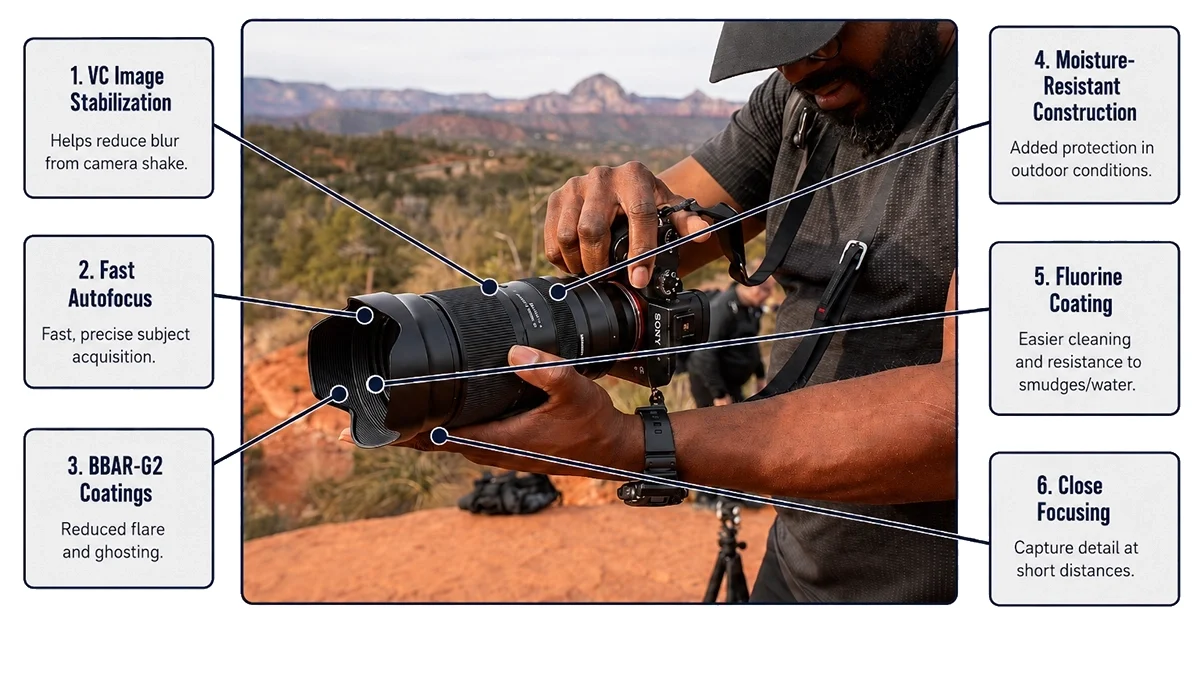
Modern lens features such as image stabilization, fast autofocus motors, anti-reflection coatings, customizable controls, and moisture-resistant construction improve sharpness, speed, handling, and image quality under real shooting conditions. The most valuable features depend on whether you photograph moving subjects, handheld scenes, video, low light, or challenging outdoor environments.
Image Stabilization
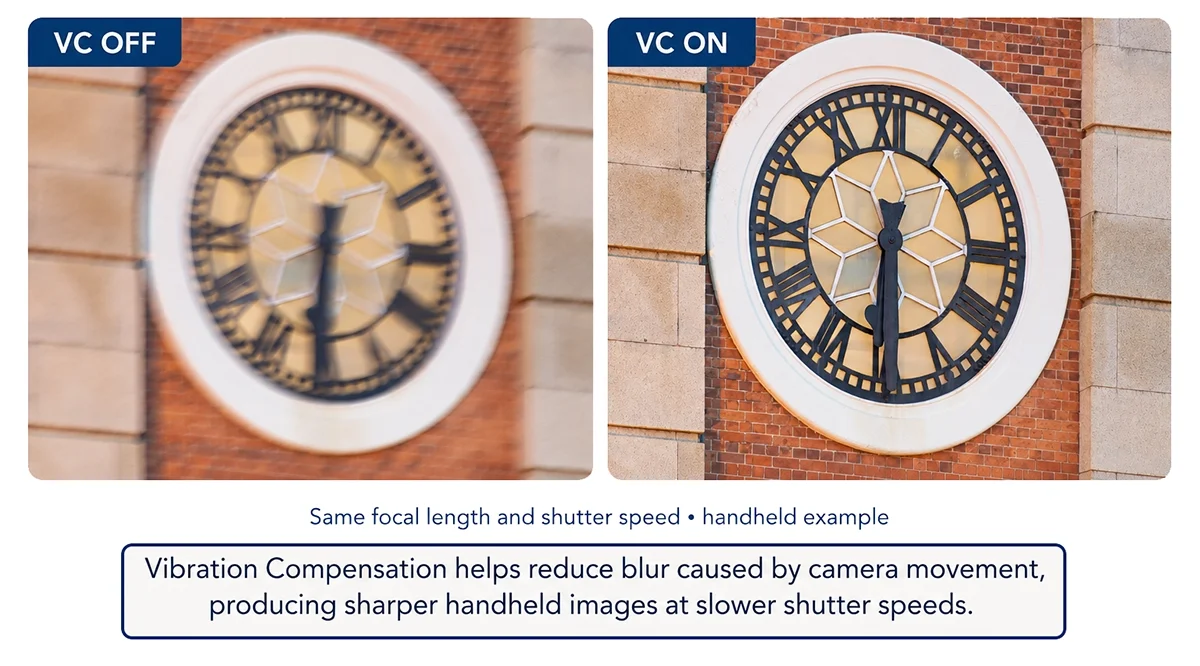
Optical image stabilization detects unintended camera movement and shifts an internal lens group to counteract it. The system can reduce blur caused by hand movement, making it especially useful at slower shutter speeds, longer focal lengths, close focusing distances, and during handheld video recording.
Image stabilization does not freeze subject movement. If a bird, athlete, child, or vehicle is moving quickly, the photographer still needs a sufficiently fast shutter speed. Stabilization primarily corrects movement created by the camera and photographer.
Its benefits become more noticeable as focal length increases because small camera movements create more visible image movement at telephoto focal lengths. Review Tamron’s guide to what optical image stabilization does for a more detailed explanation.
Autofocus Motors
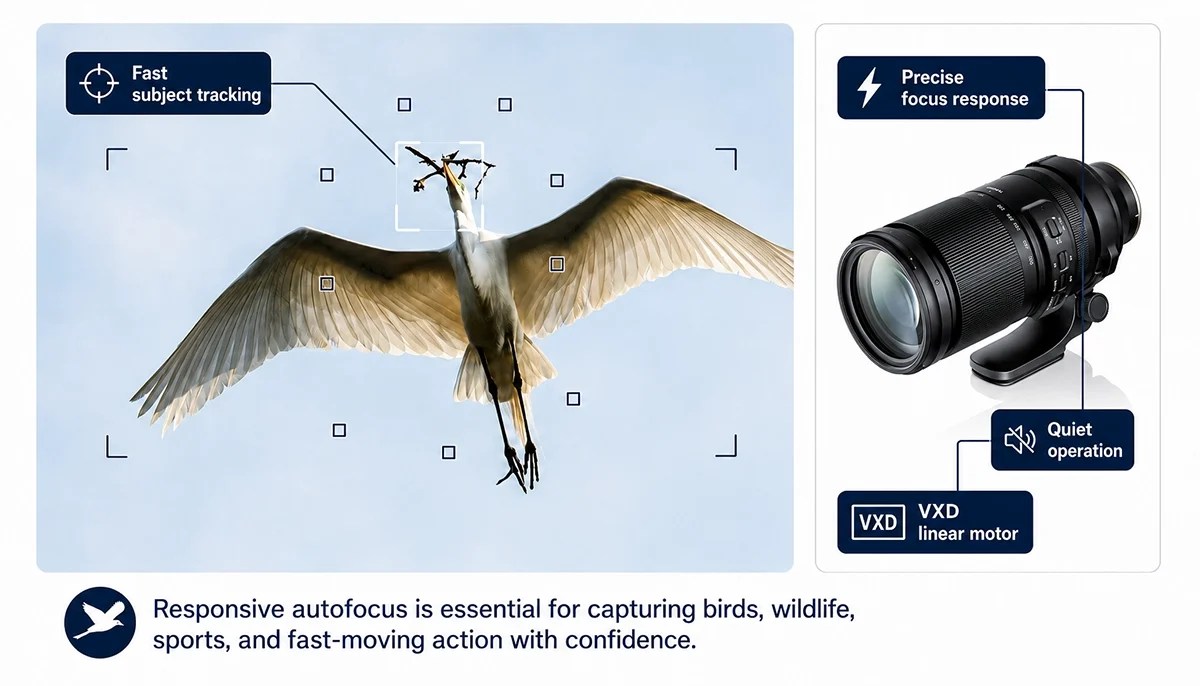
An autofocus motor moves internal lens elements until the subject reaches focus. Linear motors are designed for fast, precise response, while stepping motors are often valued for smooth and quiet operation. Motor performance can influence subject tracking, still-photo responsiveness, video transitions, and focusing reliability in rapidly changing situations.
A responsive autofocus motor is especially important for wildlife, bird, sports, event, and action photography. Quiet and controlled focusing also matters when recording video, where sudden movements or audible motor noise can be distracting.
Tamron’s VXD technology uses a linear motor to support fast, accurate, and quiet autofocus. Explore VXD linear autofocus motors for a closer look at how the technology works.
Filters and Lens Hoods

Lens hoods and filters serve different purposes. A hood blocks stray light and helps protect the front element, while a circular polarizer controls reflections and glare. Other filters protect the lens, reduce the amount of incoming light, or create specialized effects for photography and video.
A hood is most effective when it is designed for the exact lens because its shape must block light without appearing in the image. Read what a camera lens hood is and when to use one.
A circular polarizer is particularly useful for landscapes, coastlines, waterfalls, vehicles, windows, and foliage. Learn how to use a circular polarizer filter to control the strength of the effect and avoid uneven polarization in wide-angle skies.
How to Read a Lens Name
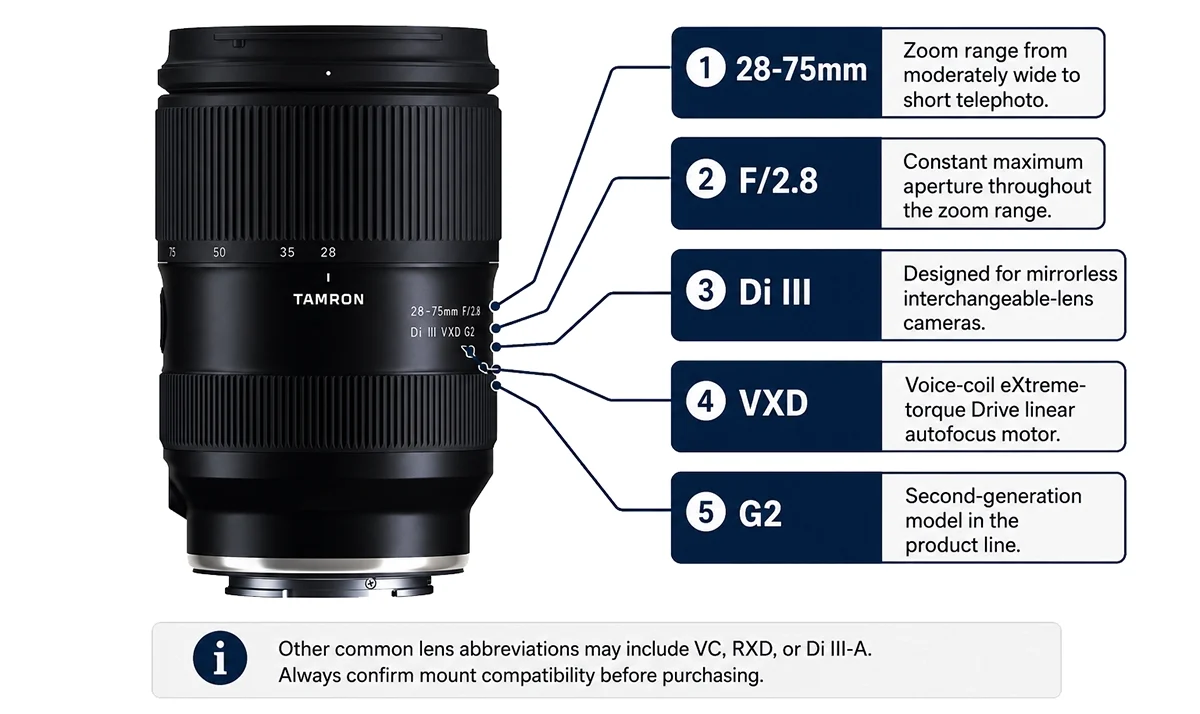
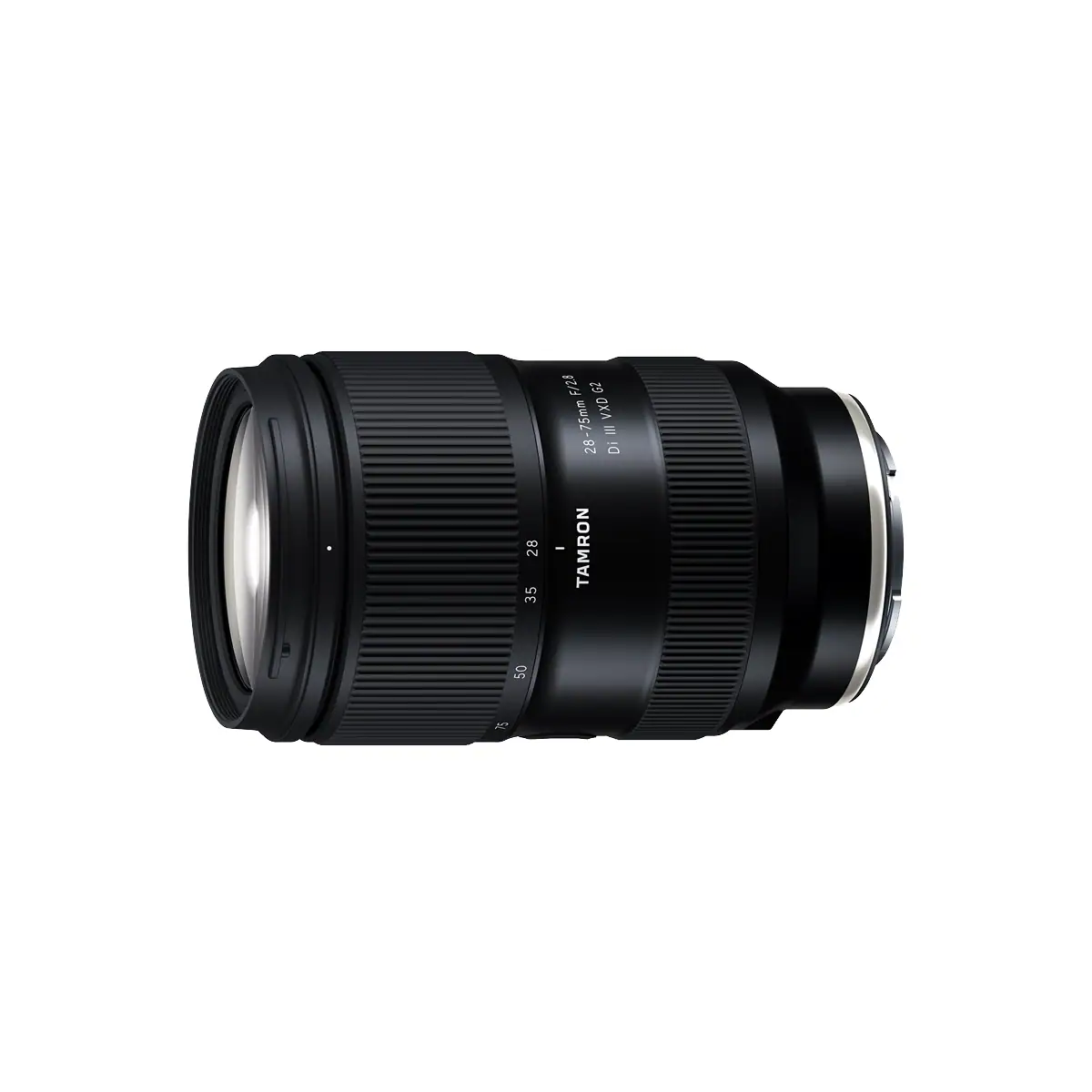
A lens name decodes its key specifications in a consistent order, typically showing the focal length range, maximum aperture, camera format, autofocus system, stabilization technology, and product generation. For example, 28-75mm F/2.8 Di III VXD G2 reveals the lens’s zoom range and major features at a glance.
Here is how to decode the Tamron 28-75mm F/2.8 Di III VXD G2:
- 28-75mm: The lens is a zoom covering focal lengths from 28mm to 75mm. It moves from a moderately wide view through standard and short-telephoto perspectives.
- F/2.8: The maximum aperture is f/2.8 throughout the zoom range. This is known as a constant maximum aperture.
- Di III: The lens is designed for mirrorless interchangeable-lens cameras.
- VXD: The lens uses Tamron’s Voice-coil eXtreme-torque Drive linear autofocus motor.
- G2: This identifies the lens as a second-generation model within its product line.
Other lens names include VC for Vibration Compensation, RXD for Rapid eXtra-silent stepping Drive, or Di III-A for lenses designed specifically for APS-C mirrorless cameras.
The mount may appear in the product listing rather than the formal lens name. Always confirm whether the version you are viewing is made for Sony E, Nikon Z, Canon RF, or Fujifilm X before purchasing.
Types of Camera Lenses
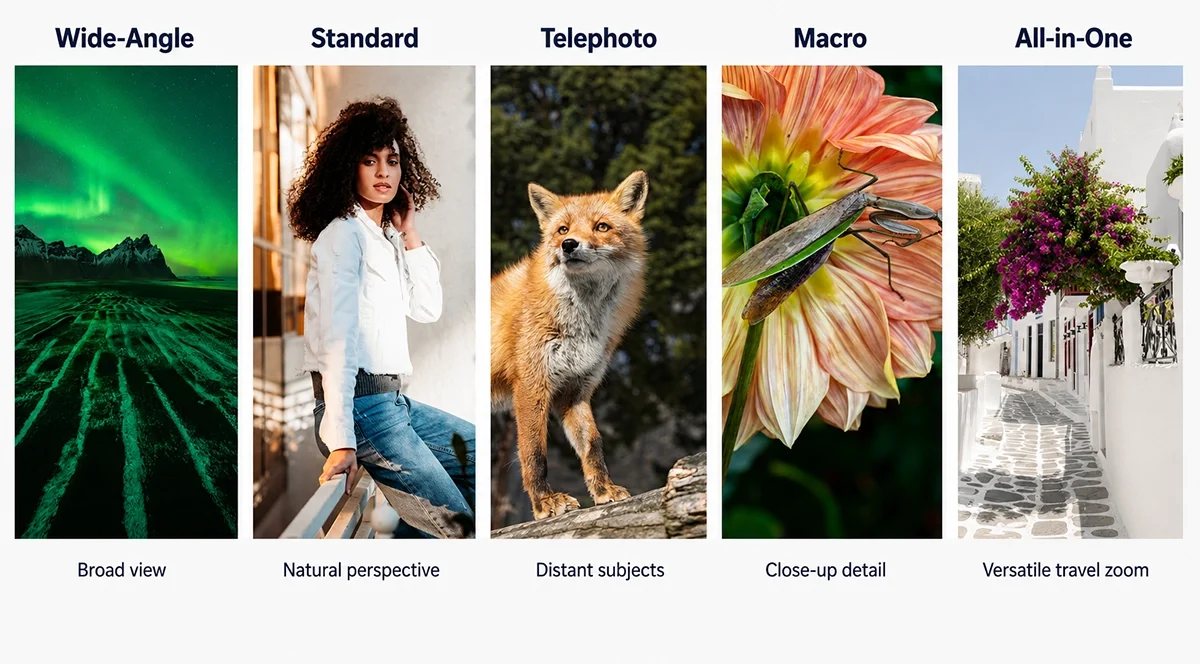
The main types of camera lenses are wide-angle, standard, and telephoto lenses, along with specialized categories such as macro and all-in-one zooms. Each type is defined primarily by focal length and angle of view, which determine how much of a scene is included and how large subjects appear.
- Wide-angle lenses capture a broad view and can emphasize foreground-to-background depth. They are commonly used for landscapes, architecture, interiors, travel, real estate, and night skies. Compare Tamron’s best wide-angle lenses, or explore the beginner’s guide to wide-angle zoom lenses for composition and handling tips.
- Standard lenses create natural-looking perspectives that suit portraits, street photography, events, travel, food, and everyday subjects. Learn about what a standard lens is.
- Telephoto lenses magnify distant subjects and create a narrower angle of view. They are popular for sports, wildlife, bird photography, portraits, performances, and compressed landscapes. Learn what a telephoto lens is and review these tips for holding a telephoto lens.
- All-in-one zoom lenses cover a wide focal length range in a single lens, reducing the need to change equipment. They are practical for travel, family photography, outdoor adventures, and situations where carrying a small kit matters. Explore what an all-in-one zoom lens is.
- Macro lenses are designed for close focusing and high magnification. They are used for flowers, insects, textures, jewelry, collectibles, food, and other small details. See our macro photography guide for tips, techniques, and settings.
For a broader comparison, visit the ultimate guide to the different types of camera lenses.
Prime vs. Zoom Lenses
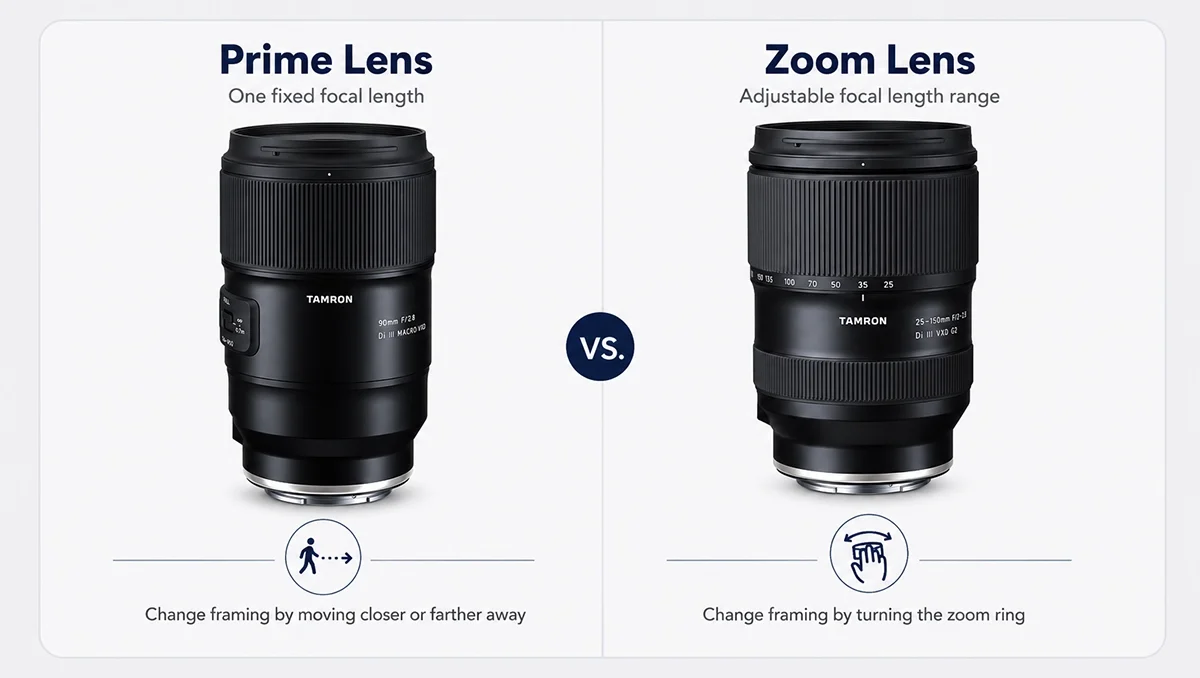
Prime lenses use one fixed focal length and are often compact, sharp, and available with wide apertures. Zoom lenses cover a range of focal lengths, allowing photographers to change framing quickly without moving or switching lenses. The right choice depends on whether optical specialization or compositional flexibility matters more.
A prime lens can encourage deliberate composition because the photographer must move or reposition to alter framing. A zoom lens helps the photographer react quickly when the subject, shooting distance, or available position changes.
Modern premium zoom lenses have narrowed many traditional differences in sharpness and low-light performance. The decision is therefore less about one design being universally better and more about which design fits the way you work.
Read the complete prime vs. zoom lens comparison for additional examples, tradeoffs, and focal-length recommendations.
How to Choose the Right Lens
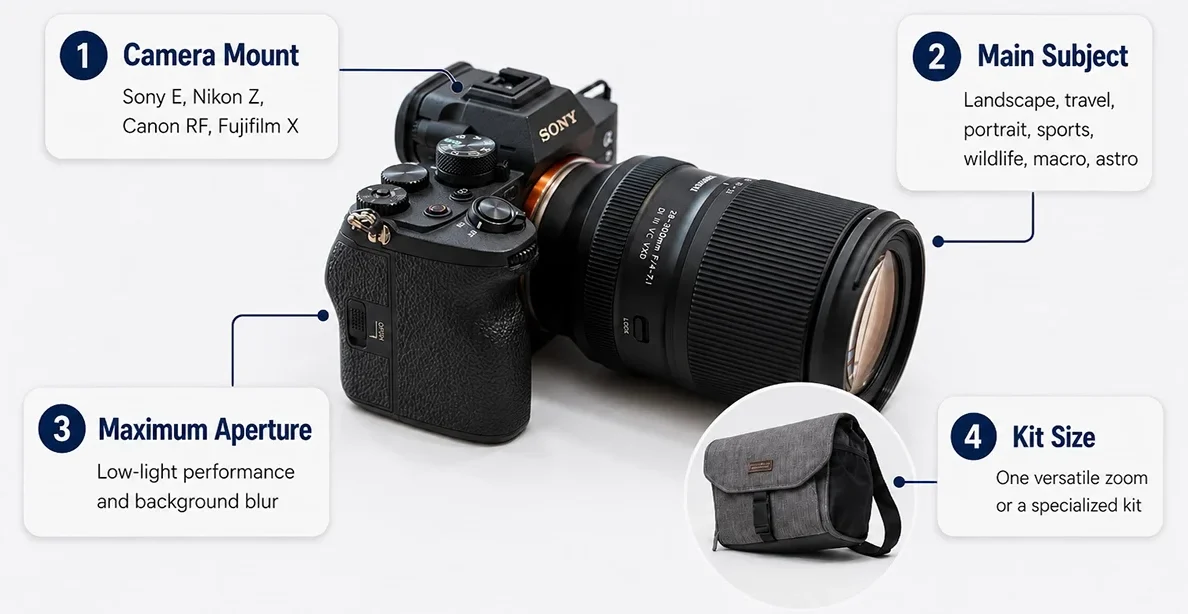
Choose a lens by matching its focal length and aperture to the subjects you photograph most, then confirm that the lens mount fits your camera. Versatile zooms suit photographers who cover changing subjects, while primes and specialized zooms reward photographers with clearly defined creative or technical needs.
Start by answering four questions:
- What camera mount do you use?
Confirm whether your camera requires Sony E, Nikon Z, Canon RF, Fujifilm X, or another mount. Even lenses with identical focal lengths cannot be used if the mount is incompatible. - What subjects do you photograph most?
Wide-angle lenses support landscape, architecture, interior, and astrophotography compositions. Standard zooms work well for portraits, events, street scenes, and everyday photography. Telephoto lenses provide the reach needed for sports, wildlife, birds, and distant details. - How important is low-light performance?
A lens with an f/2.8 or wider maximum aperture can help maintain faster shutter speeds and lower ISO settings in dim conditions. It can also create shallower depth of field and stronger background separation. - How much equipment do you want to carry?
A wide-ranging all-in-one zoom can replace multiple lenses for travel and everyday use. A specialized two- or three-lens kit (holy trinity) may offer greater aperture, focal-length coverage, or optical control for demanding work.
Photographers deciding between very different perspectives can review wide-angle lenses vs. telephoto lenses before making a purchase.
Browse Tamron lenses by camera system:
- Tamron lenses for Sony E-mount cameras
- Tamron lenses for Nikon Z-mount cameras
- Tamron lenses for Canon RF-mount cameras
- Tamron lenses for Fujifilm X-mount cameras
You can also use the Tamron Lens Finder to narrow the selection by mount, focal length, format, and lens category.
For subject-specific guidance, explore Tamron’s guides by genre:
- Wildlife Photography
- Portrait Photography
- Travel Photography
- Landscape Photography
- Astrophotography
- Sports/Action Photography
- Macro Photography
Find the Right Lens for the Way You Shoot

Understanding how lenses work and what their specifications mean turns lens shopping from guesswork into a confident decision. Once you know which focal length, aperture, lens type, and features suit your subjects, the next step is finding a compatible lens that supports your creative goals, practical needs, and budget.
A wide-angle lens can reveal an expansive environment. A standard zoom can cover everyday subjects and quickly changing scenes. A telephoto lens can isolate distant action, while a macro lens can reveal details that are difficult to see with the unaided eye. The right lens is ultimately the one that helps you capture the images you want without getting in the way of the experience.
Explore Tamron’s camera lenses for Sony, Nikon, Canon, and Fujifilm, browse by photography type, or use the Tamron Lens Finder to find the right fit for the way you shoot.
Where to Buy Tamron Lenses
Learn more about Tamron lenses at an authorized Tamron dealer near you or shop directly at the official TAMRON Store.
Camera Lens FAQs
Camera lens questions usually focus on the numbers printed on the barrel, differences between prime and zoom designs, third-party lens quality, and mount compatibility. Learning to interpret these details helps photographers compare lenses accurately and avoid buying equipment that does not fit their camera or shooting needs.
What Do the Numbers on a Camera Lens Mean?
The numbers on a camera lens usually identify its focal length in millimeters and maximum aperture as an f-stop. For example, 28-75mm F2.8 means the lens zooms from 28mm to 75mm and maintains a widest available aperture of f/2.8 throughout that focal-length range.
A single number such as 90mm normally indicates a prime lens. Two focal-length numbers separated by a dash indicate a zoom. A variable aperture such as F/3.5-6.3 means the widest available aperture becomes smaller as the lens zooms toward the telephoto end.
What Is the Difference Between a Prime and a Zoom Lens?
A prime lens has one fixed focal length and is often compact, sharp, and available with a wide maximum aperture. A zoom lens covers multiple focal lengths, giving photographers more flexibility to change compositions quickly without switching lenses or moving closer to or farther from the subject.
Neither design is automatically better for every photographer. Choose a prime for a specific perspective, wide aperture, or compact kit. Choose a zoom when the subject or shooting distance changes frequently. See the complete prime vs. zoom lens guide.
Are Third-Party Lenses as Good as Camera-Brand Lenses?
Yes, modern third-party lenses can match or exceed first-party options in optical quality, autofocus performance, build, and practical features while often offering distinctive focal-length ranges or more accessible pricing. Independent labs measure sharpness and resolution using standards such as ISO 12233, giving photographers an objective way to compare optical quality across brands rather than relying on brand reputation alone. Quality varies by individual model, so compare specifications, compatibility, sample images, reviews, and warranty support rather than judging only by brand.
Tamron designs lenses specifically for major mirrorless mounts, including Sony E, Nikon Z, Canon RF, and Fujifilm X. Always verify the exact camera model and mount before making a purchase.
How Do I Know If a Lens Fits My Camera?
A lens fits your camera when its mount matches the mount built into the camera body. A Sony E-mount camera requires a compatible E-mount lens, while Nikon Z, Canon RF, and Fujifilm X cameras require lenses made for their respective mounting systems.
Also confirm whether the lens is designed for full-frame or APS-C cameras. A full-frame lens can generally be used on a compatible APS-C body, but an APS-C lens may crop the image area when used on a full-frame camera. Check the manufacturer’s compatibility information before purchasing.
About the Author
 Stacie Errera is Vice President of Marketing and Communications for Tamron Americas, where she has been with Tamron for more than 36 years. She is also a photography educator who teaches new camera users how to better understand their cameras and photography basics. She leads weekend photography workshops for women. Read Stacie’s full bio >>