Instant Savings
 Rebate Claims
 Support
 Find a Dealer


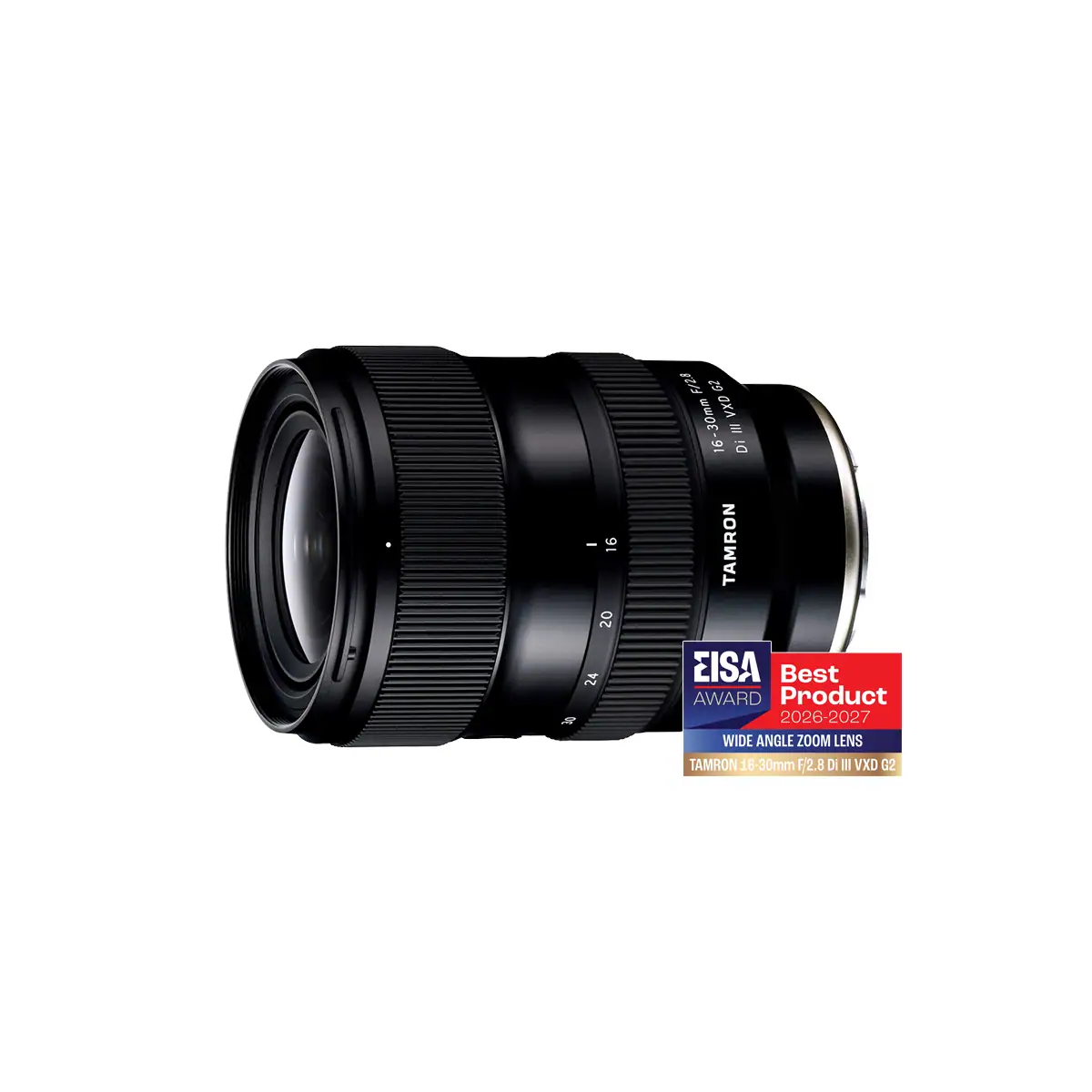
The Tamron 16-30mm F/2.8 Di III VXD G2 expands the Tamron 17-28mm F/2.8 Di III RXD range at both ends, adds VXD autofocus and customizable lens controls, and comes in Sony E and Nikon Z mounts. The 17-28mm is Sony E-only and was discontinued in July 2026, so it’s now a used or clearance purchase. For Sony shooters, the choice comes down to range, handling, and price.
Both lenses deliver a constant F2.8 maximum aperture, compact dimensions, and the expansive field of view that makes ultra-wide zooms popular for landscapes, architecture, astrophotography, travel, and video.
But does the newer G2 offer enough improvements to justify upgrading from the original 17-28mm?
This comparison examines the specifications, practical advantages, shared features, and trade-offs to help you determine which Tamron ultra-wide zoom best fits your photography.
Table of Contents
- Which Lens Fits Your Camera?
- What the G2 Changed: The Range
- 16-30mm G2 vs 17-28mm: Full Specifications
- What the G2 Adds Beyond the Range
- What Carries Over Unchanged
- The Honest Trade: Size, Weight and Price
- Should You Upgrade?
- Where This Sits in the Tamron G2 Trinity
- Spec-Sheet Traps to Avoid
- Find the Tamron 16-30mm G2 for Your Camera
- Frequently Asked Questions
Which Lens Fits Your Camera?
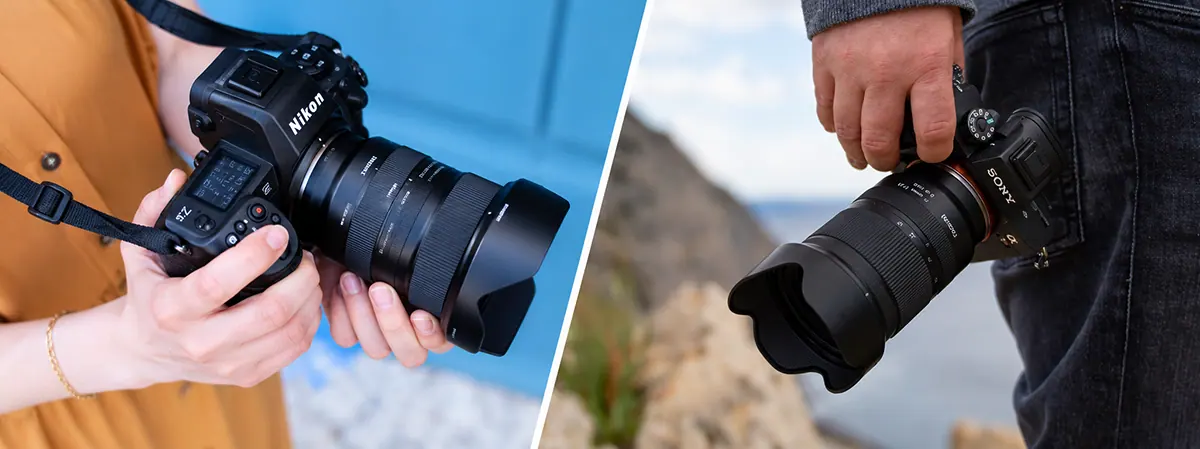
Camera mount compatibility is the first consideration when comparing the Tamron 16-30mm G2 and 17-28mm. The 16-30mm G2 is available for both Sony E and Nikon Z full-frame mirrorless cameras, while the 17-28mm was produced exclusively for Sony E-mount. That difference immediately determines which lenses are available to you.
If You Shoot Nikon Z
The Tamron 16-30mm F2.8 G2 is the only one of these two lenses available in a native Nikon Z mount. The original 17-28mm was not produced for Nikon Z, so Nikon photographers choosing between these models can focus directly on the G2’s specifications and features.
Designed for Nikon Z full-frame mirrorless cameras, the G2 provides a constant F2.8 aperture, VXD autofocus, a compact design, and support for TAMRON Lens Utility customization.
If You Shoot Sony E
Sony E photographers can buy the 16-30mm G2 new or find the 17-28mm used or on clearance, since Tamron discontinued it in July 2026. Both are full-frame lenses with a constant F2.8 aperture. Choose the G2 for wider range and VXD autofocus. Choose the 17-28mm if you want the lowest cost and lightest weight.
For existing 17-28mm owners, the question is whether the G2’s expanded range and updated technology address limitations they encounter in everyday shooting.
What the G2 Changed: The Range
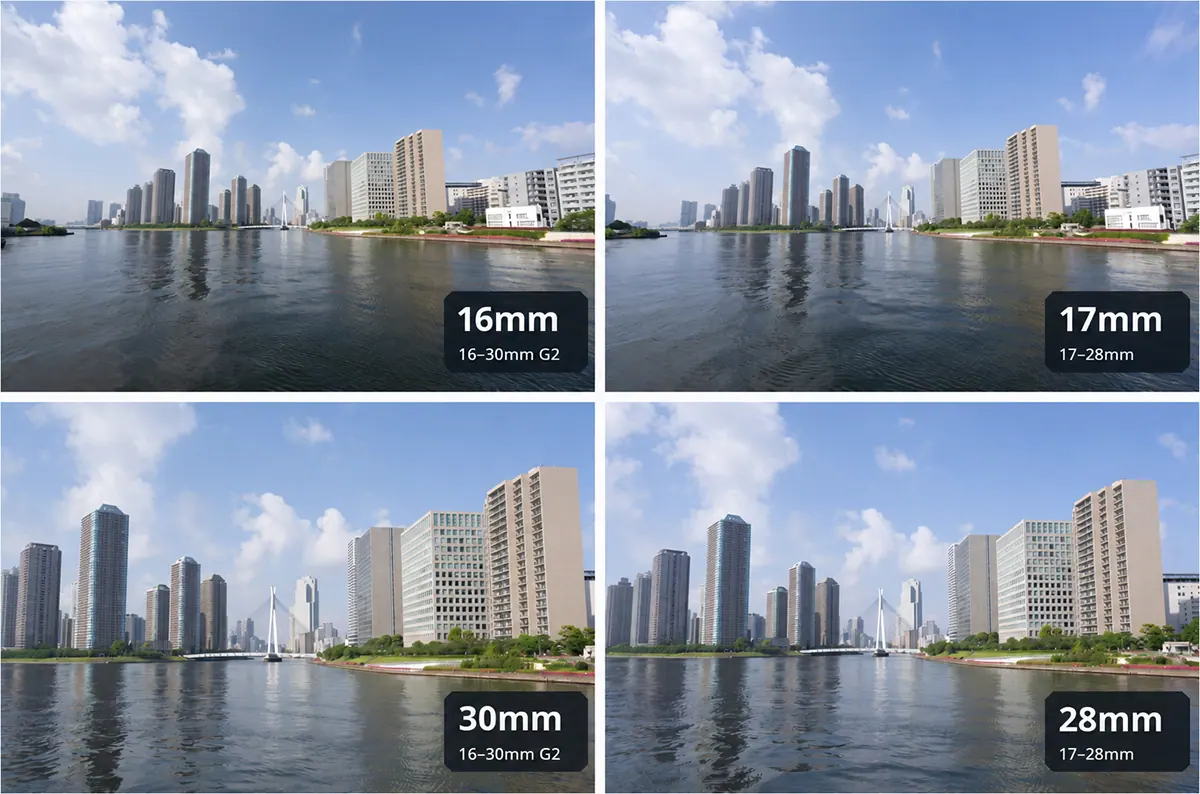
The most significant change in the Tamron 16-30mm G2 is its expanded focal range. The original 17-28mm covers a diagonal angle of view from 103°41′ to 75°23′, while the G2 extends from 107°2′ to 71°35′. This gives photographers wider coverage at 16mm and tighter framing at 30mm.
Unlike some second-generation lenses that retain their original focal range, the 16-30mm G2 changes the framing possibilities at both ends of the zoom.
16mm at the Wide End: More Space in Every Frame
The difference between 16mm and 17mm looks small on paper, but it matters at ultra-wide focal lengths. The 16-30mm G2 delivers a diagonal angle of view of 107°2′ at 16mm, compared with 103°41′ at 17mm on the original lens, allowing more of the scene into the composition.
That extra coverage is especially useful when photographing subjects that cannot be approached from a greater distance.
For example:
- Landscape photography: Include more foreground, dramatic skies, and expansive scenery.
- Architectural photography: Fit more of a large building or interior into the frame when space is limited.
- Astrophotography: Capture a broader section of the night sky while keeping a dramatic landscape foreground.
- Interior photography: Photograph rooms and confined spaces without needing to back farther away.
The 17mm focal length already provides an expansive view, but the additional coverage at 16mm offers more compositional flexibility.
For photographers who regularly work in tight interiors or compose dramatic ultra-wide landscapes, that small numerical difference shows up in the final image.
30mm at the Long End: Greater Everyday Versatility
The move from 28mm to 30mm gives the Tamron 16-30mm G2 a slightly tighter field of view at its longest setting. Its diagonal angle of view narrows to 71°35′ at 30mm, compared with 75°23′ at 28mm on the original lens, providing more flexibility for everyday compositions.
This makes the G2 particularly appealing to photographers who want to keep an ultra-wide lens attached while traveling or exploring a city.
At 30mm, the lens works well for:
- Street photography that balances people with their surroundings.
- Environmental portraits that include meaningful background details.
- Family and travel photographs with a more natural-looking composition.
- Architectural details and everyday subjects that benefit from tighter framing.
While 30mm does not replace a traditional standard zoom, it moves the ultra-wide zoom closer to everyday shooting territory.
The biggest advantage is the combination of focal lengths expanding wider and at the tele end: the 16-30mm G2 stretches farther in both directions, giving photographers more compositional possibilities without changing lenses.
16-30mm G2 vs 17-28mm: Full Specifications
The 16-30mm G2 reaches 1mm wider and 2mm longer than the 17-28mm, and it adds VXD autofocus, TAMRON Lens Utility support, and a Nikon Z version. The 17-28mm is 0.7 oz (20g) lighter and $130 cheaper at reference prices. It also focuses closer at the long end and stops down to F22. Both share F2.8, 67mm filters, and internal zoom. The comparison below uses Tamron’s published specifications for the A064 and A046 models, including mount-specific measurements for the newer G2 lens.
*Prices represent published U.S. reference prices rather than guaranteed current selling prices. Check availability and applicable promotions before purchasing at Tamron Americas.
Specification sources: Tamron 16-30mm F2.8 G2 and Tamron 17-28mm F2.8 technical specifications.
The specifications illustrate an important distinction: the G2 delivers additional focal-length coverage and updated technology while remaining close to the original lens in size and weight.
What the G2 Adds Beyond the Range
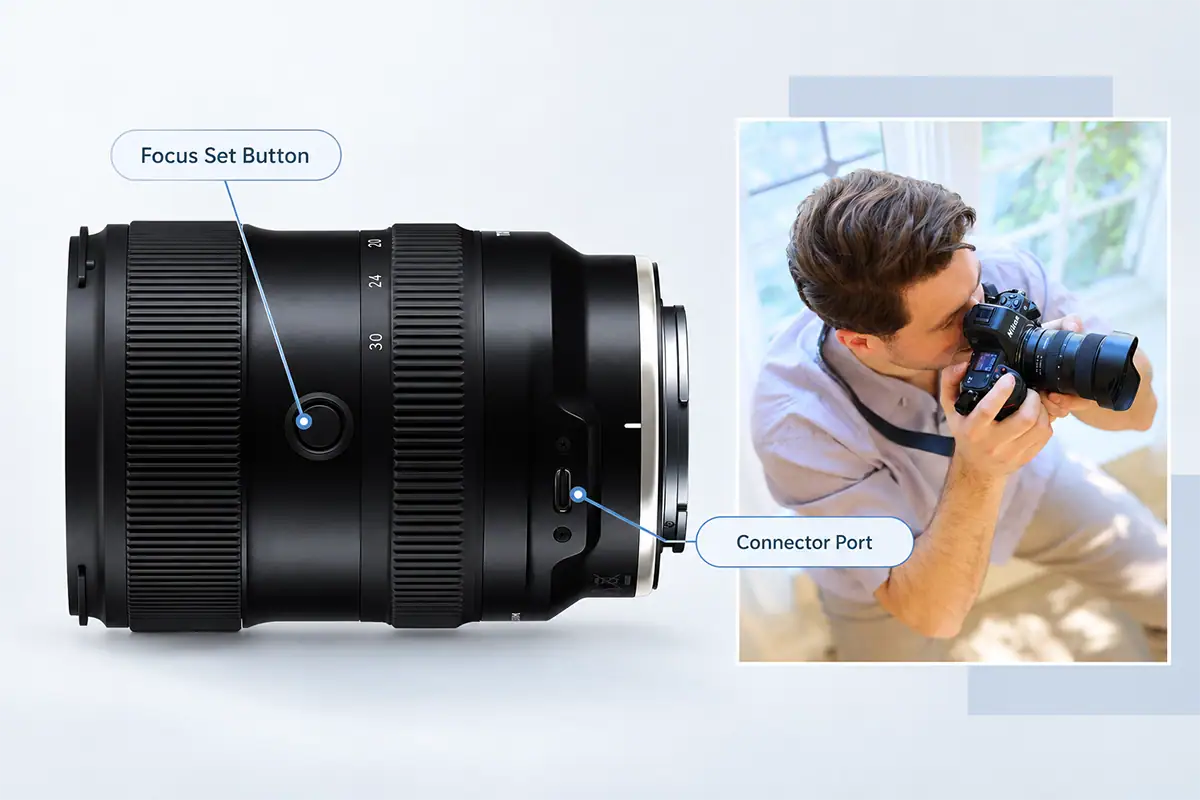
Beyond its expanded focal range, the Tamron 16-30mm G2 introduces VXD linear motor autofocus, a revised optical design, compatibility with TAMRON Lens Utility, and a refined Toned Profile exterior. These updates improve focusing performance, customization, ergonomics, and handling for photographers and videographers.
VXD Autofocus for Fast, Precise Subject Tracking
The Tamron 16-30mm G2 uses a VXD (Voice-coil eXtreme-torque Drive) linear motor autofocus system, replacing the RXD (Rapid eXtra-silent stepping Drive) motor found in the 17-28mm. Tamron’s VXD system is engineered for high-speed, high-precision focusing and quiet operation, particularly useful when following moving subjects or recording video.
- For photographers, the updated focus drive helps when capturing action, moving people, pets, and spontaneous moments.
- Videographers also benefit from responsive, quiet autofocus when tracking subjects or transitioning focus during recording.
The original 17-28mm’s RXD system remains capable of fast, accurate, and quiet focusing. The G2’s VXD system represents an advancement in autofocus technology rather than a correction of an inadequate earlier design.
Learn more about the differences between these technologies in our guide to VXD and RXD autofocus explained. this is new Nov article: 28-75 G1/G2
Connector Port, Focus Set Button and TAMRON Lens Utility

One of the most practical upgrades on the Tamron 16-30mm G2 is compatibility with the TAMRON Lens Utility™. The G2 includes a Connector Port and Focus Set Button, allowing photographers and videographers to customize selected lens functions and adapt their controls to different shooting situations.
Through TAMRON Lens Utility, compatible functions include:
- Assigning functions to the Focus Set Button.
- Customizing manual focus ring operation.
- Programming focus-related functions for still photography and video
- Practical settings for enhanced workflow including time lapse setting, astrophotography stetting, and focus pull settings.
- Updating lens firmware using the computer version of the software.
The G2 also supports TAMRON-LINK, which enables wireless communication with compatible iPhone and Android smartphones for supported mobile lens-control functions.
Firmware updates are performed through the computer software, not wirelessly through the mobile app.
These customization options matter most to video creators who want repeatable focus movements or greater control over manual focusing.
The original 17-28mm does not include the Connector Port or Focus Set Button and is not compatible with TAMRON Lens Utility. However, it supports camera-based firmware updates through compatible Sony cameras.
For a closer look at available functions, explore TAMRON Lens Utility features and customization options.
Updated Optical Design for the Expanded Zoom Range
The Tamron 16-30mm G2 features a redesigned optical construction with 16 elements in 12 groups, compared with 13 elements in 11 groups in the original 17-28mm. The revised design supports the broader zoom range while controlling optical aberrations and maintaining the compact dimensions associated with Tamron’s fast mirrorless zooms.
The G2 incorporates:
- One XLD (eXtra Low Dispersion) lens element.
- Two LD (Low Dispersion) lens elements.
- Three glass-molded aspherical lens elements.
- BBAR-G2 coating to reduce ghosting and flare.
Together, these technologies help maintain image quality across the expanded focal range, particularly when photographing scenes with strong contrast, bright light sources, and fine detail.
The original 17-28mm also features specialized optical elements and anti-reflection coating designed to produce excellent image quality.
The significance of the G2 redesign is not simply that it contains more optical elements. Its revised construction allows Tamron to extend coverage to 16mm and 30mm while maintaining the performance expected from a compact F2.8 ultra-wide zoom.
Internal Zoom for Consistent Balance and Handling
The Tamron 16-30mm G2 features an internal zoom mechanism that keeps the lens barrel from extending as the focal length changes. This helps maintain consistent handling and a stable center of gravity, making the lens especially convenient for handheld photography, vlogging, and shooting with a camera stabilizer.
Importantly, the original 17-28mm also uses a non-extending or internal zoom design.
For photographers already familiar with the handling advantages of the 17-28mm, the G2 preserves this benefit while expanding its range.
Both designs suit gimbal work because changing focal length does not physically extend the lens barrel, although rebalancing may still be required when changing equipment or accessories.
Refined Exterior Design: Toned Profile vs Minimal Skin
The Tamron 16-30mm F2.8 G2 adopts Tamron’s Toned Profile design, evolving from the Minimal Skin design featured on early Tamron mirrorless lenses like the 17-28mm F2.8. While Minimal Skin emphasized clean lines, simplicity, and compact construction, Toned Profile introduces more sculpted contours and refined ergonomic details that enhance grip, handling, and overall appearance.
The G2 features deeper grooves on the zoom and focus rings for a more secure grip, along with smoother ring operation and carefully adjusted resistance for precise control. Its updated glossy black exterior offers improved scratch resistance and helps make fingerprints less noticeable, while the gently curved, glossy brand ring adds a premium finishing touch.
These refinements give the 16-30mm G2 a more sophisticated look and improved tactile experience while preserving the lightweight, compact design that made the original 17-28mm so popular.
What Carries Over Unchanged
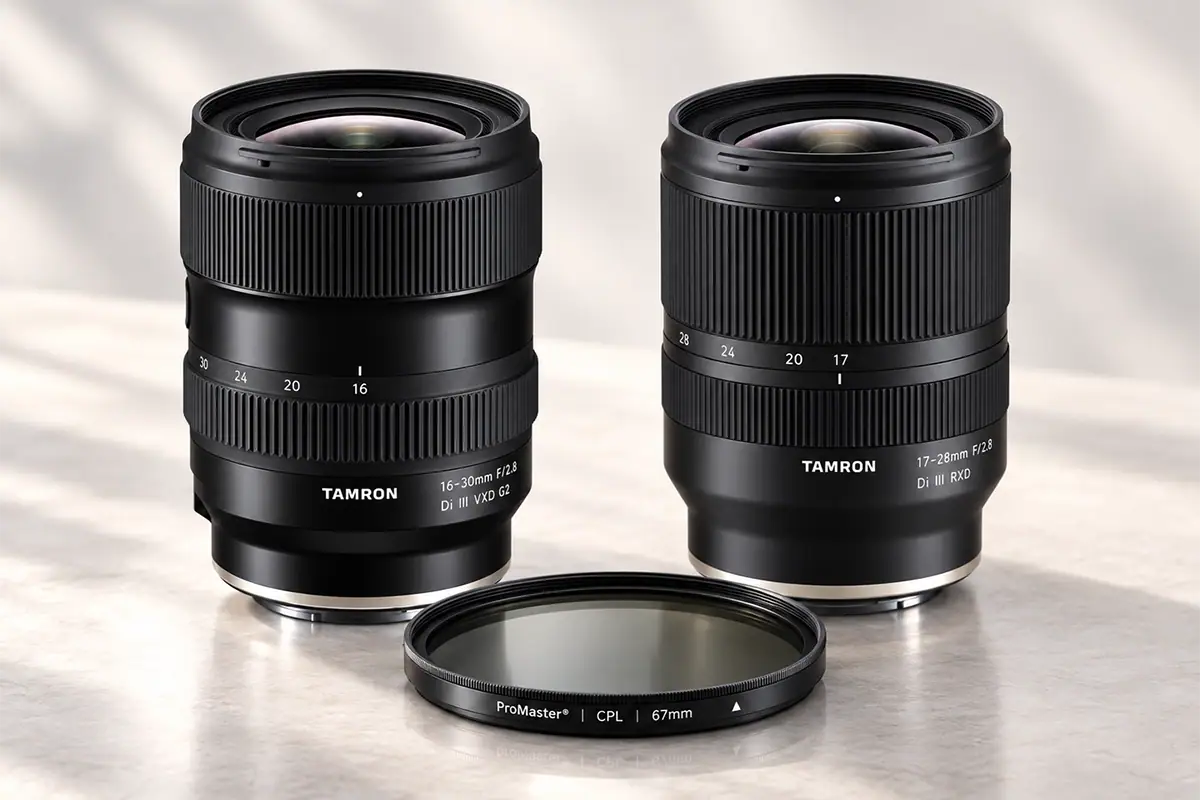
Although the Tamron 16-30mm G2 introduces several advancements, important characteristics remain unchanged from the original 17-28mm. Both lenses provide a constant F2.8 maximum aperture, compact ultra-wide zoom design, 67mm filter compatibility, and useful close-focusing capabilities, allowing existing owners to retain familiar advantages when upgrading.
- 67mm filter size: Both lenses accept the same 67mm screw-in filters, including circular polarizers and ND filters.
- Constant F2.8 maximum aperture: Both maintain F2.8 throughout their zoom ranges, supporting low-light photography and consistent maximum-aperture settings while zooming.
- Nine circular aperture blades: Both use a nine-blade circular diaphragm designed to produce attractive background blur.
- 5″ (0.19m) minimum focus distance at the wide end: Both allow dramatic wide-angle close-up compositions.
- No built-in optical image stabilization: Neither includes Tamron’s VC stabilization system; cameras with in-body stabilization provide it instead.
- Internal (non-extending) zoom design: Both maintain a consistent overall length while zooming.
The shared 67mm filter size is especially valuable for existing 17-28mm owners. Photographers who have invested in quality ND filters, polarizers, filter adapters, and compatible front caps can continue using them with the G2.
For video creators who regularly use ND filters to control exposure, keeping an existing filter kit lowers the real cost of upgrading.
The Honest Trade: Size, Weight and Price
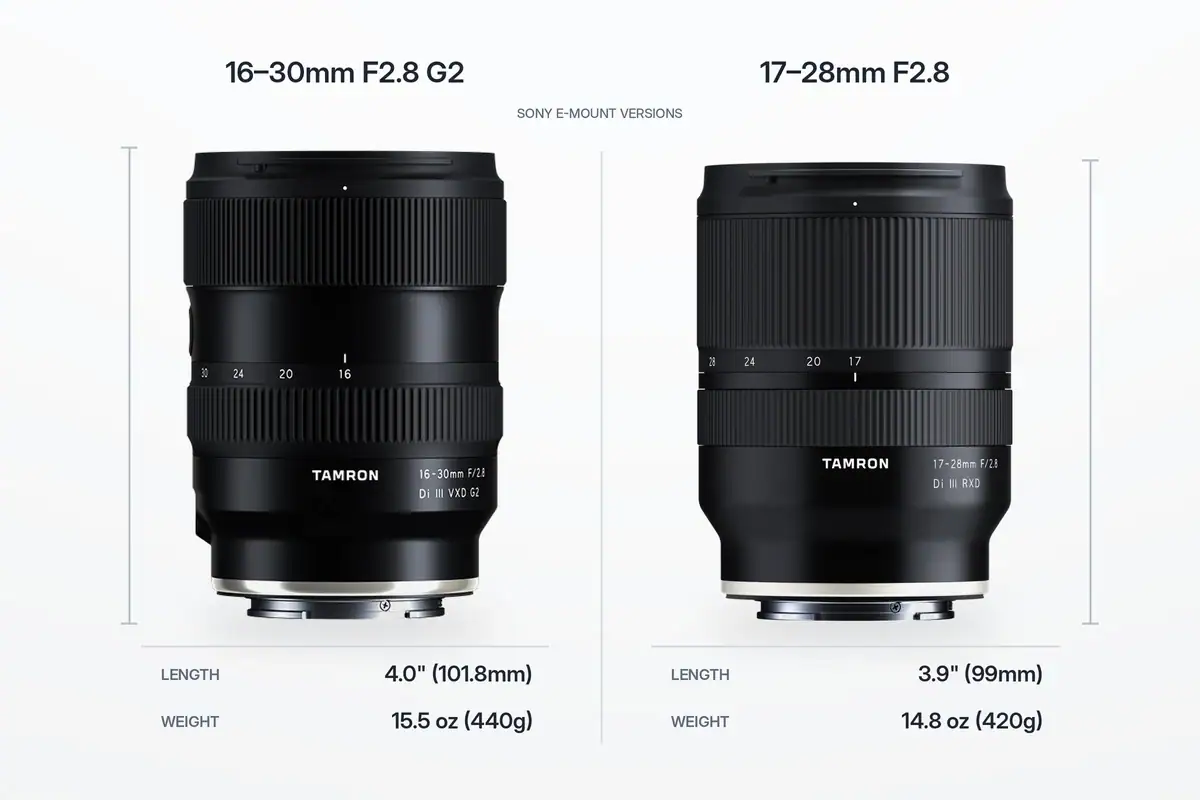
The Tamron 16-30mm G2 delivers more focal-length coverage and updated technology, but it is slightly larger, heavier, and more expensive than the original 17-28mm. For Sony E-mount photographers, these differences are modest enough that the newer lens remains a portable choice, although the original retains an advantage for minimizing weight and cost.
Weight
The Sony E-mount 16-30mm G2 weighs 15.5 oz (440g), compared with 14.8 oz (420g) for the 17-28mm.
That is a difference of just 0.7 oz (20g).
Length
The G2 measures 4.0″ (101.8mm) long, compared with 3.9″ (99mm) for the original. Its maximum diameter is also slightly larger at 2.94″ (74.8mm), versus 2.87″ (73mm).
The Nikon Z version of the G2 is marginally longer and heavier at 4.1″ (103.9mm) and 15.9 oz (450g).
In practice, these are small differences for a fast, full-frame ultra-wide-angle zoom. The G2 retains the compact portability that made the original lens appealing, while offering additional focal-length coverage and a more advanced autofocus system.
Price Is the More Meaningful Consideration for Many Photographers
At published U.S. reference prices, the 16-30mm G2 is $929, compared with $799 for the 17-28mm, a $130 difference. Because Tamron discontinued the 17-28mm in July 2026, new copies are limited to remaining retailer stock, and used prices vary.
For someone purchasing a new ultra-wide lens, the added range, VXD autofocus, and customizable controls justify that premium.
For an existing 17-28mm owner who rarely needs anything wider than 17mm or longer than 28mm, however, the cost of replacing a lens they already own is harder to justify.
The original remains a capable option, particularly for photographers who value its lighter weight, familiar handling, and proven performance.
Should You Upgrade?
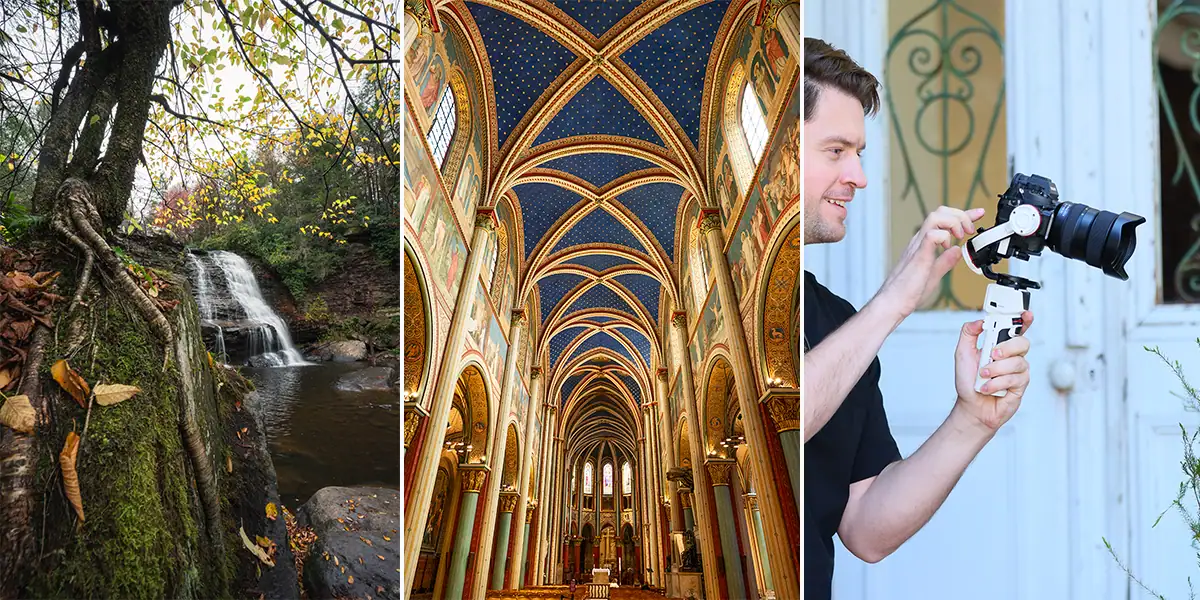
Upgrading from the Tamron 17-28mm to the 16-30mm G2 makes the most sense when you regularly need wider framing, greater everyday flexibility, or the newer autofocus and customization features. If your existing lens already covers your preferred compositions and handles your subjects well, keep it.
The 16-30mm G2 Is Worth It If
The Tamron 16-30mm G2 is the stronger choice for photographers who want expanded ultra-wide coverage and more advanced lens controls. Its advantages are particularly relevant to Nikon Z users, landscape and architectural photographers, hybrid creators, and anyone who wants greater framing flexibility without significantly increasing lens size.
Consider the G2 if:
- You shoot Nikon Z: It is the only model of these two with a native Nikon Z mount.
- You photograph architecture, interiors, or astrophotography: The wider 16mm field of view includes more of the scene.
- You frequently photograph travel, family, or street scenes: The extended 30mm end offers additional everyday versatility.
- You create video content: The Focus Set Button and TAMRON Lens Utility compatibility provide additional control options.
- You photograph moving subjects: The VXD linear motor supports responsive, precise autofocus and subject tracking.
The strongest reason to upgrade is when several of these advantages match your shooting style.
For example, a photographer who captures landscapes on weekend trips, records travel videos, and frequently photographs people in tight city environments gets the most from both ends of the expanded zoom range.
The 17-28mm Still Makes Sense If
The Tamron 17-28mm still makes sense if you already own one, or if you shoot Sony E and find it used or on clearance below the G2’s $929 reference price. It keeps a constant F2.8 aperture, internal zoom, and 67mm filters in a lighter 14.8 oz (420g) body.
Keeping or choosing the original used or on clearance can make sense if:
- You already own the Sony E-mount 17-28mm: Its focal range continues to suit your photography.
- You prioritize the lightest possible equipment: Its 0.7 oz (20g) weight advantage matters more than additional range.
- You prefer to spend your budget elsewhere: The money saved can go toward another lens, filters, or accessories.
The 17-28mm’s combination of a constant F2.8 aperture, RXD autofocus, close-focusing performance, and compact construction continues to make it useful for landscapes, travel, architecture, and video.
For photographers who regularly use both 17mm and 28mm but seldom feel restricted by those limits, there is no compelling reason to replace a lens that continues to meet their needs.
Where This Sits in the Tamron G2 Trinity
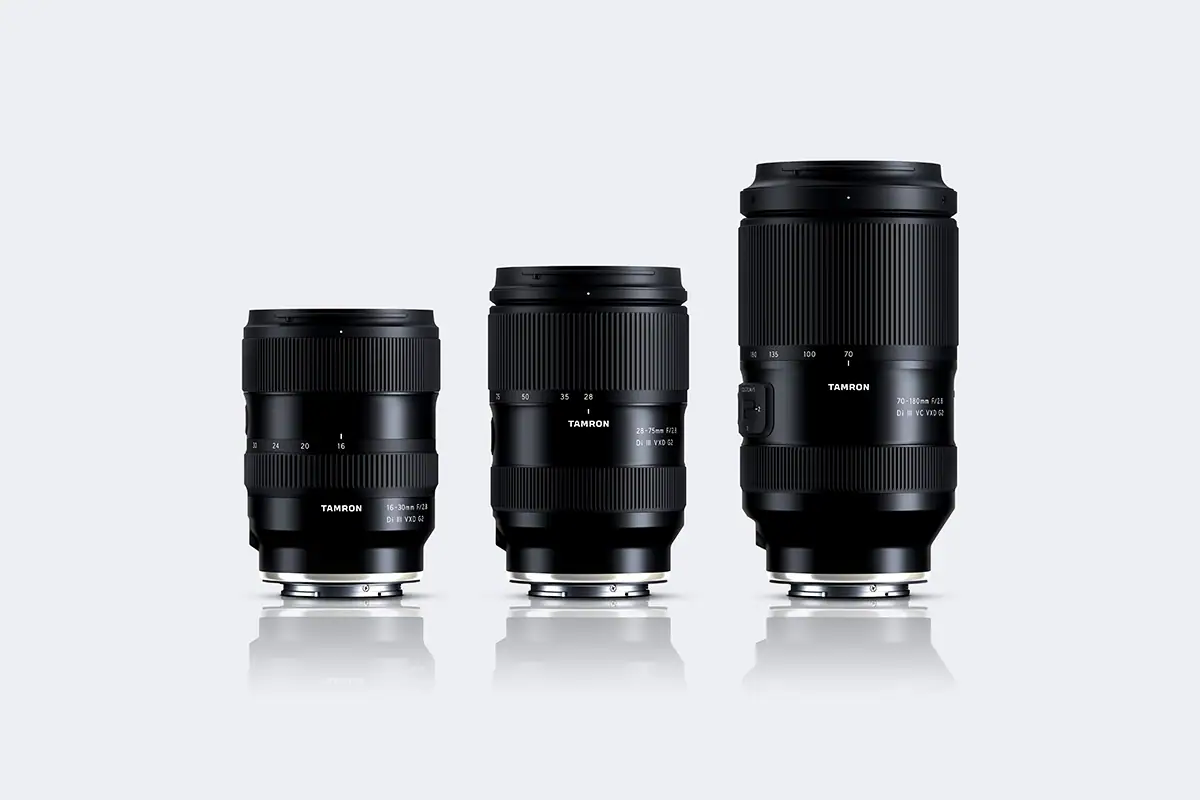
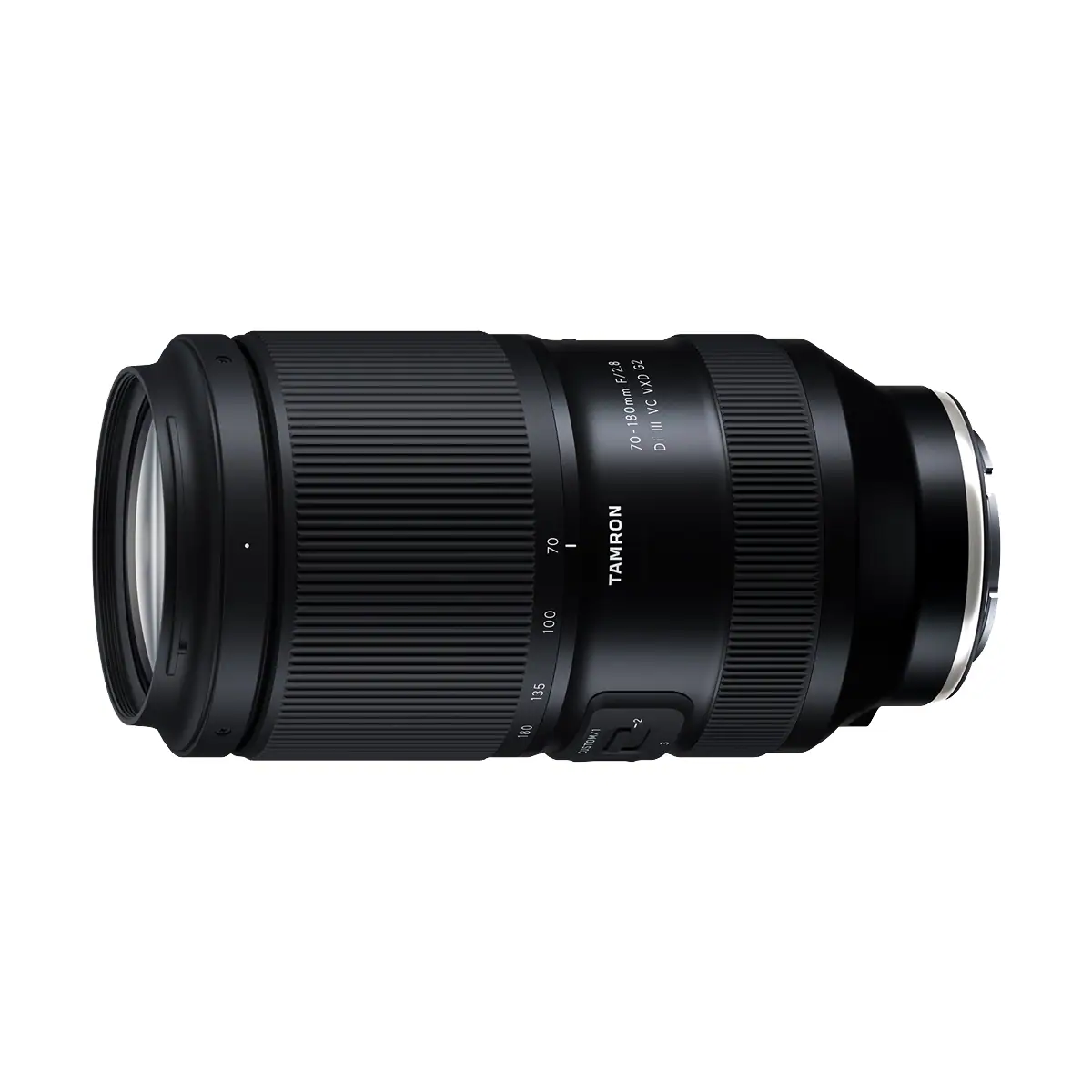
The Tamron 16-30mm F2.8 G2 completes Tamron’s second-generation F2.8 zoom trinity for Sony E and Nikon Z full-frame mirrorless cameras. Together with the 28-75mm F2.8 G2 and 70-180mm F2.8 VC G2, it provides continuous focal-length coverage from ultra-wide 16mm through telephoto 180mm.
Tamron’s G2 trinity includes:
- 16-30mm F/2.8 Di III VXD G2: Ultra-wide zoom for landscapes, architecture, astrophotography, interiors, and video.
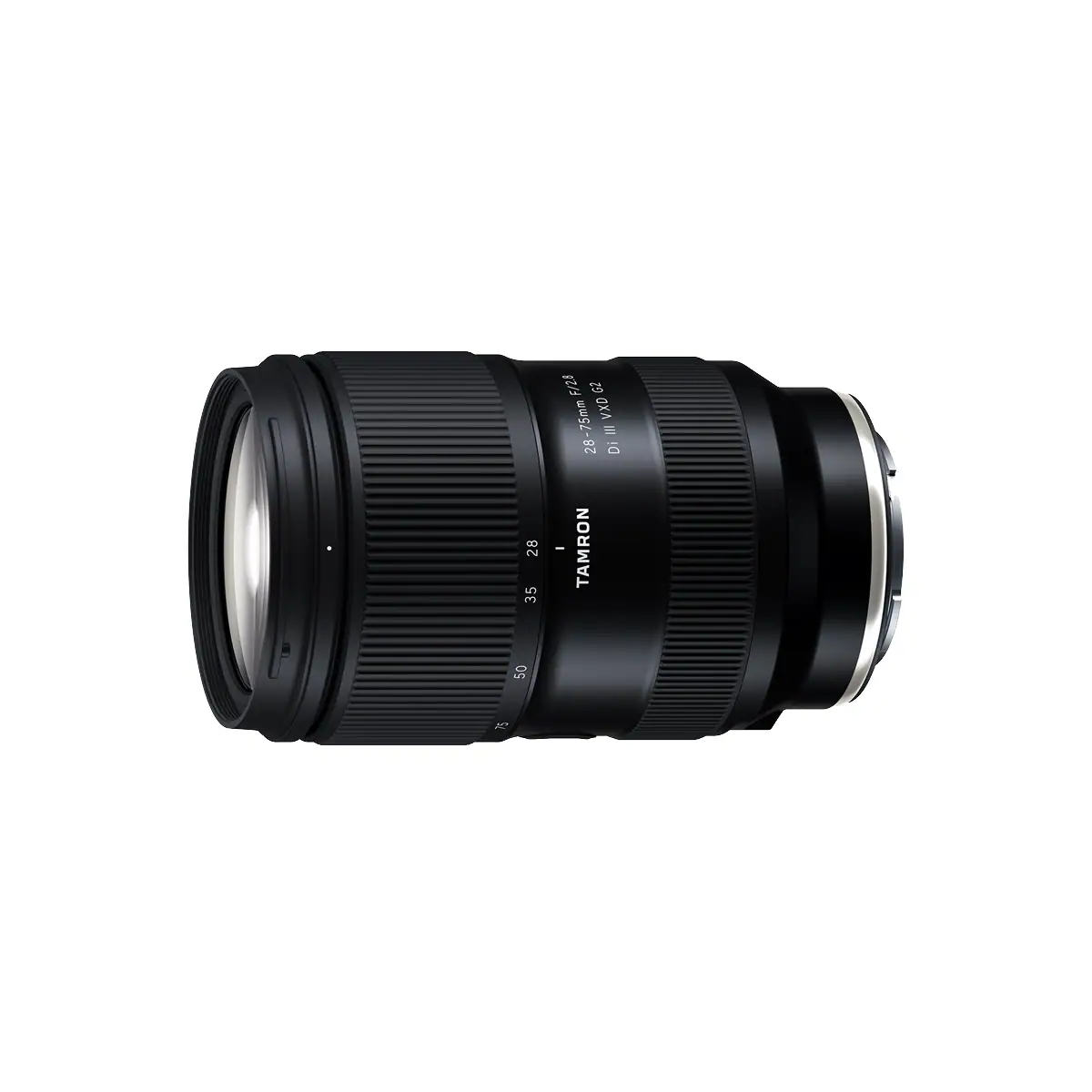
- 28-75mm F/2.8 Di III VXD G2: Standard zoom for portraits, travel, events, weddings, and everyday photography.
- 70-180mm F/2.8 Di III VC VXD G2: Telephoto zoom for portraits, action, events, sports, and distant subjects.
All three feature a constant F2.8 maximum aperture, VXD autofocus technology, a shared 67mm filter size, and the Toned Profile lens design.
The 16-30mm is distinctive within this second-generation series because Tamron changed the focal range itself. The 28-75mm G2 and 70-180mm G2 retained their original focal ranges while introducing other optical, autofocus, and handling improvements.
For photographers building a coordinated three-lens kit, the 16-30mm G2 provides a compact ultra-wide starting point that pairs naturally with Tamron’s standard and telephoto G2 zooms.
Learn more about the advantages of this three-lens system in Tamron’s G2 Trinity Lens Guide.
Spec-Sheet Traps to Avoid
Two specs favor the original 17-28mm, and one is unchanged. The 17-28mm has stronger maximum magnification: 1:5.2 versus 1:5.4 at the wide end and 1:6 versus 1:7 at the long end. It also stops down to F22 instead of F16. Neither lens has built-in stabilization. Close-up photographers should weigh these before upgrading.
The Magnification Figures Favor the Older Lens
The Tamron 17-28mm offers slightly greater maximum magnification than the 16-30mm G2. At the wide end, the original reaches 1:5.2 versus 1:5.4 for the G2. At the long end, the difference is 1:6 versus 1:7, giving the original an advantage for photographing small subjects at close range.
The 17-28mm also focuses slightly closer at its longest focal length, with a minimum distance of 10.2″ (0.26m) compared with 11.8″ (0.30m) for the G2.
These differences are real, although modest for most everyday photography.
The G2 still provides useful close-focusing capabilities, allowing photographers to create dramatic wide-angle perspectives of food, flowers, textures, and other nearby subjects.
Photographers who regularly use the original lens for close-up photography should consider these measurements alongside the benefits of the G2’s expanded range.
The G2 Stops Down Less Far
The Tamron 16-30mm G2 has a minimum aperture of F16, while the 17-28mm can stop down to F22. This means the original provides an additional smaller-aperture setting, which helps when maximizing depth of field or reducing the light reaching the sensor.
For most landscape, travel, and architectural photography, however, photographers typically use apertures such as F8 or F11 when balancing depth of field and sharpness.
Extremely small apertures cause diffraction that softens fine detail, particularly on high-resolution cameras.
When slower shutter speeds are needed, an ND filter can often provide a better alternative than stopping down to the smallest available aperture.
Neither Lens Has Built-In Image Stabilization
Neither the Tamron 16-30mm G2 nor the 17-28mm includes built-in optical image stabilization. Both rely on in-body image stabilization when the camera provides it. Photographers using cameras without stabilization must rely on appropriate shutter speeds, steady technique, or external support.
This is a shared characteristic, not a disadvantage unique to the original model.
For landscape photography, use a tripod for long exposures. For video, add a gimbal or other support when the shot calls for it.
Stabilization does not freeze moving subjects, so shutter-speed selection remains important for action photography.
Which Is Better, the Tamron 16-30mm G2 or 17-28mm?
The Tamron 16-30mm G2 offers meaningful improvements in focal-length coverage, autofocus technology, and customization, while preserving many of the original lens’s most useful characteristics. Buy the 16-30mm G2 if you shoot Nikon Z, need 16mm or 30mm, or want VXD autofocus and Lens Utility controls. Keep your 17-28mm if its range already covers how you shoot, since the G2’s gains are refinements rather than fixes. If you’re buying new, the G2 is the only one of the two still in production.
Find the Tamron 16-30mm G2 for Your Camera

The Tamron 16-30mm F2.8 G2 is available for Sony E and Nikon Z full-frame mirrorless cameras. If its expanded zoom range, VXD autofocus, and customizable controls match your needs, review the complete specifications and compatibility information before choosing the version designed for your camera.
Where to Buy Tamron Lenses
Explore the Tamron 16-30mm F2.8 Di III VXD G2 to learn more about its features, performance, and available mounts. When you are ready to purchase, find an authorized retailer near you or shop directly on the TAMRON Store.
Frequently Asked Questions
These frequently asked questions address the most common considerations when comparing the Tamron 16-30mm G2 and 17-28mm, including upgrade value, camera compatibility, focal-length differences, and shared features.
Is the Tamron 16-30mm G2 Worth Upgrading From the 17-28mm?
Yes, if you need 16mm or 30mm, shoot Nikon Z, or want VXD linear motor autofocus and TAMRON Lens Utility controls. If your 17-28mm already covers the focal lengths you use, keep it. Its constant F2.8 aperture, internal zoom, and 67mm filters match the G2, and it’s 0.7 oz (20g) lighter.
Can I Use the Tamron 17-28mm on a Nikon Z Camera?
The Tamron 17-28mm F2.8 Di III RXD was designed for Sony E-mount cameras and is not available in a native Nikon Z mount. The 16-30mm F2.8 G2 is available in Nikon Z mount, making it the appropriate choice between these two models for photographers using Nikon Z full-frame cameras.
How Much Wider Is 16mm Than 17mm on a Full-Frame Camera?
At 16mm, the Tamron 16-30mm G2 provides a 107°2′ diagonal angle of view, compared with 103°41′ at 17mm on the original lens. The difference is 3°21′ in diagonal coverage. That additional width can be particularly useful for interiors, architecture, landscapes, and astrophotography when camera position is restricted.
Is the Tamron 16-30mm G2 Better for Astrophotography?
The Tamron 16-30mm G2 offers an advantage for astrophotography when a wider field of view is desired. Its 16mm setting captures more of the night sky than the original 17-28mm at 17mm, while both maintain a constant F2.8 maximum aperture. Actual results also depend on optical performance, camera settings, and shooting technique.
Do the Tamron 16-30mm G2 and 17-28mm Use the Same Filters?
Yes. Both lenses use a 67mm filter thread, making it possible to share compatible circular polarizers, ND filters, and other screw-in accessories. Photographers upgrading from the 17-28mm can retain their existing 67mm filters rather than purchasing a new set, reducing the additional cost of changing lenses.
Does the Tamron 16-30mm G2 Have Image Stabilization?
No. The Tamron 16-30mm F2.8 G2 does not include built-in VC optical image stabilization, and neither does the original 17-28mm. Both can take advantage of in-body image stabilization when used with compatible cameras. A tripod, gimbal, or other support may be helpful for longer exposures or smoother video.
Can I Use TAMRON Lens Utility With the 17-28mm?
No. The original Tamron 17-28mm F2.8 is not compatible with TAMRON Lens Utility because it does not include the necessary Connector Port. The 16-30mm G2 supports compatible customization features through the software. The original 17-28mm can still receive camera-based firmware updates through compatible Sony cameras.
Do Both Tamron Ultra-Wide Zoom Lenses Have Internal Zoom?
Yes. Both the Tamron 16-30mm G2 and 17-28mm feature internal (non-extending) zoom mechanisms that maintain a consistent overall lens length while changing focal lengths. This supports stable handling and makes both lenses practical for handheld photography and gimbal work. The G2 preserves this characteristic while offering an expanded focal range.
About the Author
 Stacie Errera is Vice President of Marketing and Communications for Tamron Americas, where she has been with Tamron for more than 36 years. She is also a photography educator who teaches new camera users how to better understand their cameras and photography basics. She leads weekend photography workshops for women. Read Stacie’s full bio >>