Instant Savings
 Rebate Claims
 Support
 Find a Dealer

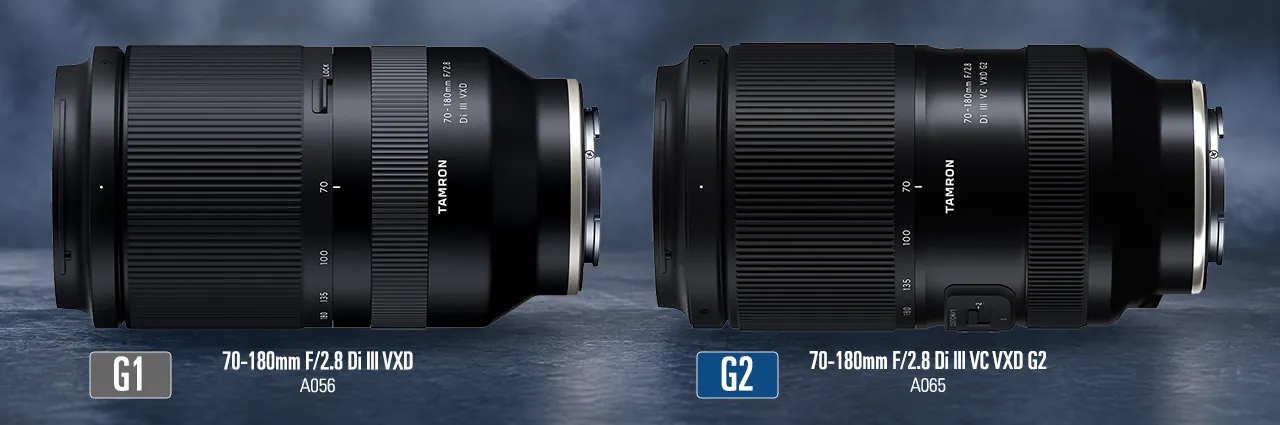
In the Tamron 70-180mm G1 vs G2 comparison, the G2 adds three main changes: VC image stabilization, autofocus close focusing at 70mm, and a Nikon Z version. Both generations keep VXD autofocus, a constant F2.8 aperture, and 67mm filters. The G2 is slightly larger and heavier, and a 2024 firmware update improved Sony E autofocus while zooming.
For Sony E-mount photographers who already own the original lens, these differences help determine what an upgrade would change in everyday shooting. For new buyers, the comparison explains how the two generations differ and why mount compatibility matters.
Table of Contents
- What Changed Between the Tamron 70-180mm G1 and G2?
- Tamron 70-180mm G1 vs G2: Full Specifications
- What Does VC Add on a 70-180mm?
- How Much Closer Does the G2 Focus?
- What the G2 Costs in Size and Weight
- Should You Upgrade From the 70-180mm G1?
- Which Tamron 70-180mm Should You Buy?
What Changed Between the Tamron 70-180mm G1 and G2?
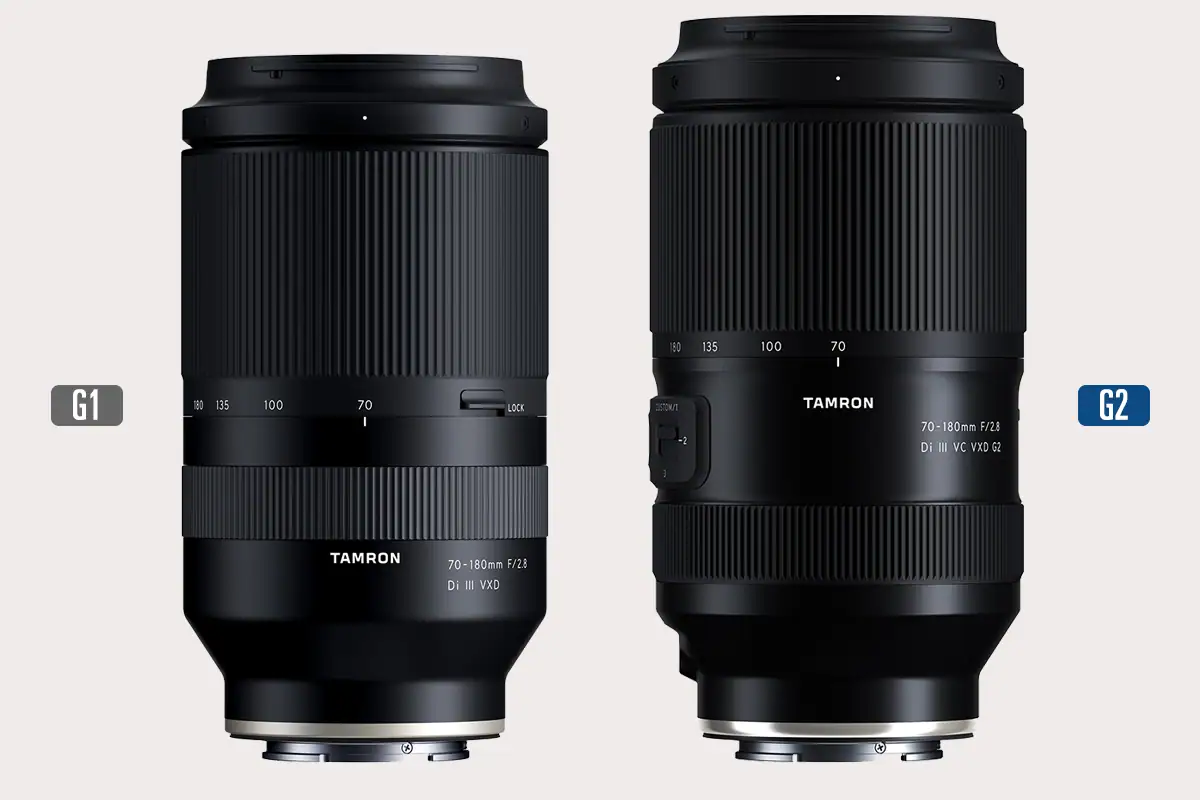
The G2 introduces Tamron’s VC (Vibration Compensation) system, closer autofocus focusing at the 70mm end, and Nikon Z availability. Both lenses use a VXD linear autofocus motor, maintain a constant F2.8 aperture, and feature nine circular aperture blades, an F22 minimum aperture, and a 67mm filter thread.
The first-generation Tamron 70-180mm F/2.8 Di III VXD (Model A056), released in May 2020, established a compact, lightweight option for Sony E-mount full-frame photographers.
The Tamron 70-180mm F/2.8 Di III VC VXD G2 (Model A065), introduced in October 2023 for Sony E, builds on that foundation with several mechanical and optical changes.
Both generations use Tamron’s VXD linear autofocus motor. In November 2024, a firmware update for the Sony E-mount G2 improved autofocus while zooming, for both video and stills in AF-C (continuous autofocus) mode.
Focus stays more responsive when you change focal length mid-shot. That matters most to videographers and anyone tracking subjects while zooming.
Unlike the 28-75mm generation change, which included a move from RXD to VXD autofocus, the 70-180mm G2 builds on the VXD technology already found in the original lens.
The G2 also introduces a redesigned optical construction, increasing from 19 elements in 14 groups to 20 elements in 15 groups.
It adds compatibility with TAMRON Lens Utility™, giving users access to supported lens customization functions and computer-based firmware updates through its USB-C Connector Port.
Which Mount Are You On?
Nikon Z photographers have only one native Tamron 70-180mm generation to consider: the G2. The original A056 was released exclusively for Sony E-mount cameras. Tamron introduced the Nikon Z version of the G2 on October 23, 2025, extending the same F2.8 telephoto zoom concept to Nikon full-frame mirrorless users.
For Sony E-mount photographers, both generations exist, so the comparison comes down to features, performance requirements, and the lens they already own.
Is the Original 70-180mm Still Available?
No. Tamron discontinued the original 70-180mm F2.8 Di III VXD (A056) for Sony E, and the G2 replaced it in the current lineup. You can still find the G1 on the used market, and owners can keep using it as is.
Tamron 70-180mm G1 vs G2: Full Specifications
The most important specifications in the Tamron 70-180mm G1 vs G2 comparison are VC stabilization, minimum focusing distance, and weight. The G2 adds optical stabilization and substantially closer autofocus focusing at 70mm, while the G1 remains smaller and lighter. Both share the F2.8 maximum aperture and 67mm filter size.
Specifications are based on Tamron’s published data for Models A056 and A065. Filter diameter is expressed in millimeters, the standard filter sizing convention.
The table demonstrates that the G2 retains the original lens’s fundamental telephoto range and F2.8 aperture while introducing stabilization, a different close-focusing capability, and updated functionality.
Photographers considering longer focal lengths can also explore Tamron’s telephoto zoom lineup, which includes the 70-300mm, 50-300mm, 50-400mm, and 150-500mm models.
What Does VC Add on a 70-180mm?

The original Tamron 70-180mm G1 does not include lens-based optical stabilization, while the G2 incorporates Tamron’s proprietary VC (Vibration Compensation) system. At longer telephoto focal lengths, small camera movements become more noticeable. VC reduces blur caused by camera shake, especially when shooting handheld at slower shutter speeds.
At 180mm, even slight hand movement can affect image sharpness. The G2’s integrated stabilization keeps handheld framing steadier, so you can put off reaching for a tripod or monopod.
For video, VC reduces minor camera movement in handheld footage. It matters most when maintaining steady framing during a portrait sequence, event recording, or travel video.
Some Sony camera bodies provide in-body image stabilization, which also steadies the G1. However, the G2 adds stabilization within the lens itself.
It is also important to distinguish camera shake from subject movement. VC compensates for camera movement, but a sufficiently fast shutter speed is still necessary to freeze moving people, athletes, or other active subjects.
When Stabilization Matters Most at 180mm
VC matters most when shooting handheld at or near 180mm in low light, where camera movement is more difficult to control. Wedding, event, portrait, and travel photographers gain the most indoors, in evening light, or where a tripod isn’t practical.
For example, an event photographer working at 180mm F2.8 can drop to a slower shutter speed to keep available light on a relatively still subject, and VC reduces the blur from camera shake.
For photographers who routinely use a tripod or consistently shoot at very fast shutter speeds, the benefit is small.
How Much Closer Does the G2 Focus?
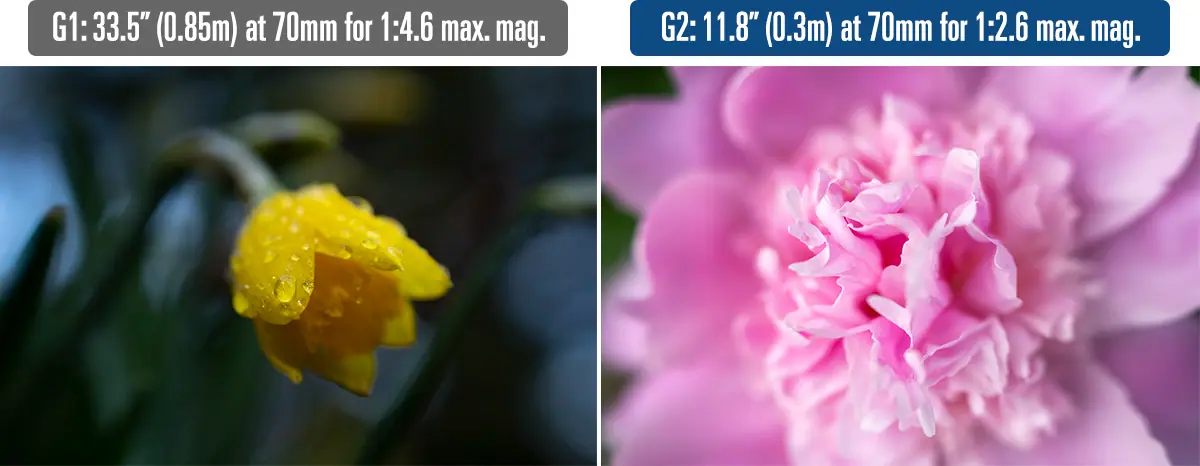
The G2 focuses as close as 11.8″ (0.3m) at 70mm with autofocus, delivering a maximum magnification ratio of 1:2.6. By comparison, the G1’s minimum autofocus distance is 33.5″ (0.85m) throughout its zoom range, with maximum autofocus magnification of 1:4.6. That puts close-up work within autofocus range on the G2.
The difference matters most for flowers, food, tabletop subjects, travel details, and smaller objects without switching to manual focus.
With the G2, photographers can move closer to their subjects while maintaining autofocus functionality. This provides more flexibility when working quickly or photographing details that require precise focus placement.
At the 180mm telephoto end, both generations maintain a minimum focusing distance of 33.5″ (0.85m). The G2’s close-focusing gain is at the wide end only. At 180mm, the G1 is slightly stronger, at 1:4.6 versus 1:4.7.
Why the G1’s 1:2 Magnification Figure Needs an Asterisk
The original G1 can achieve 1:2 magnification at 70mm, which is greater than the G2’s 1:2.6 maximum ratio. However, the G1 reaches that figure only through manual focusing at 10.6″ (0.27m). Tamron also notes that image quality decreases toward the edges of the frame at this unusually close distance.
This distinction is important when comparing specification sheets.
- G1: 1:2 magnification at 70mm, requiring manual focus.
- G2: 1:2.6 magnification at 70mm, available during normal autofocus operation.
The G1’s manual-focus close-up mode still works well for subjects near the center of the frame.
However, the G2 makes close-up autofocus photography more straightforward. Its advantage is not a larger numerical magnification ratio, but the ability to achieve strong close-up magnification without switching out of autofocus.
Neither lens provides true 1:1 macro magnification.
What the G2 Costs in Size and Weight
The Sony E-mount G2 weighs 30.2 oz. (855g), compared with the G1’s 28.6 oz. (810g), an increase of 1.6 oz. (45g). It is also 0.3″ (7.5mm) longer and 0.08″ (2mm) wider. Both lenses retain the same 67mm filter thread.
The G1 measures 5.9″ (149mm) long and has a maximum diameter of 3.2″ (81mm). The Sony E-mount G2 measures 6.2″ (156.5mm) long, with a maximum diameter of 3.3″ (83mm).
The Nikon Z version of the G2 is slightly heavier at 30.5 oz. (865g) and measures 6.2″ (158.7mm) long.
Unlike some generational lens updates that prioritize reducing size and weight, the G2 introduces additional technology while staying close to the original dimensions. That added size holds the VC system and the redesigned 20-element, 15-group optics.
The unchanged 67mm filter size is a practical advantage. Photographers moving from the G1 to the G2 keep their existing filters and front lens cap. The same filters also fit the 16-30mm F2.8 G2 and the 28-75mm F2.8 G2, the other two zooms in Tamron’s G2 F2.8 trinity.
For photographers who prioritize the lightest possible telephoto setup, the original G1 retains a measurable advantage in weight and compactness.
Should You Upgrade From the 70-180mm G1?
Upgrade if you shoot handheld at 180mm in low light, need autofocus close-ups at 70mm, or are moving to Nikon Z. Sony E owners who zoom while tracking in AF-C also gain the G2’s firmware-improved autofocus. Keep your G1 if you shoot on a tripod or at fast shutter speeds and value its lighter 28.6 oz (810g) build.
The most relevant question for an existing Sony E-mount G1 owner is how often those differences would affect their photography.
Photographers who frequently shoot handheld at longer focal lengths get the most from the G2’s built-in VC stabilization.
Those who photograph small objects, flowers, details, or other close-range subjects gain 1:2.6 magnification with autofocus.
Photographers and videographers who frequently zoom while tracking subjects in AF-C mode gain from the G2’s firmware-improved autofocus while zooming.
The G2 also introduces Lens Utility compatibility and a revised optical design, adding customization options and redesigned optics.
On the other hand, G1 owners already have a constant F2.8 aperture, VXD autofocus, the same 70-180mm zoom range, and a smaller, lighter lens.
These are functional differences rather than a universal reason to replace the original model. How much they matter depends on shooting style, subjects, camera equipment, and workflow.
For photographers comparing broader lens categories rather than generations of the same lens, our guide to when a dedicated zoom wins explains the trade-offs between fast-aperture dedicated zooms and more versatile all-in-one lenses.
Which Tamron 70-180mm Should You Buy?

Buy the G2 if you’re purchasing new, shoot Nikon Z, or want VC stabilization and autofocus close focusing at 70mm. It’s the only generation still sold new. If you already own the G1 on Sony E, keep it unless handheld low-light telephoto work or close-up detail shots are a regular part of how you shoot.
For a quick decision:
- Choose the G2 if you want the current model with VC stabilization, closer autofocus performance, updated optical design, and Sony E or Nikon Z compatibility.
- Keep the G1 if you already own it, shoot mostly on a tripod or at fast shutter speeds, and don’t need autofocus closer than 33.5″ (0.85m).
For Nikon Z users, the decision is simpler because Tamron never released a native Nikon Z version of the G1.
Ultimately, the Tamron 70-180mm G1 vs G2 decision centers on whether the G2’s stabilization, close-focusing functionality, autofocus enhancements, and updated features provide a meaningful benefit for your shooting needs.
Find the Tamron 70-180mm G2 for Your Camera
If the G2’s additional stabilization, autofocus close-focus performance, and updated design align with your needs, explore the Tamron 70-180mm F/2.8 Di III VC VXD G2 product page for complete specifications, camera mount options, and additional sample images.
Where to Buy Tamron Lenses
When you’re ready to purchase, find an authorized Tamron dealer near you to check current availability and pricing for the Sony E or Nikon Z version, or shop directly at the official TAMRON Store.
Frequently Asked Questions About the Tamron 70-180mm G1 vs G2
These answers cover the questions buyers ask most: stabilization, autofocus, close-up magnification, sharpness, weight, and mount compatibility. They also clarify two specs that are easy to misread: the G1’s manual-focus 1:2 magnification and the G2’s added VC.
What Is the Main Difference Between the Tamron 70-180mm G1 and G2?
The main difference is that the G2 adds VC image stabilization and much closer autofocus focusing at 70mm. It also introduces Nikon Z availability, TAMRON Lens Utility compatibility, and a revised optical construction. Both generations use VXD autofocus and provide a constant F2.8 maximum aperture throughout the 70-180mm zoom range.
Does the Tamron 70-180mm G1 Have Image Stabilization?
The original Tamron 70-180mm F2.8 G1 does not feature built-in VC optical stabilization. Photographers using it with compatible Sony cameras may benefit from the camera’s in-body image stabilization system. The G2 adds Tamron’s VC mechanism within the lens, helping reduce handheld camera shake, especially at longer focal lengths.
Does the Tamron 70-180mm G2 Focus Closer Than the G1?
Yes. At 70mm, the G2 focuses to 11.8″ (0.3m) using autofocus, compared with the G1’s 33.5″ (0.85m) autofocus minimum. The G1 can focus as close as 10.6″ (0.27m) at 70mm using manual focus, but this special close-up mode has limitations in peripheral image quality.
Is the Tamron 70-180mm G2 Sharper Than the G1?
Tamron designed it to be. The G2’s redesigned optics use 20 elements in 15 groups, compared with 19 elements in 14 groups in the G1, to improve image quality and aberration correction. The G2 also adds VC, which reduces blur from camera shake when shooting handheld.
Is the Tamron 70-180mm G2 Heavier Than the Original?
Yes. The Sony E-mount G2 weighs 30.2 oz. (855g), compared with 28.6 oz. (810g) for the G1. This represents an increase of 1.6 oz. (45g). The G2 is also slightly longer and wider, although both generations retain a 67mm filter thread.
Is the Tamron 70-180mm G1 Available for Nikon Z Cameras?
No. Tamron produced the first-generation 70-180mm F2.8 (A056) only for Sony E-mount cameras. The second-generation 70-180mm F2.8 VC VXD G2 (A065) is available for both Sony E and Nikon Z. The Nikon Z version launched in October 2025.
Does the Tamron 70-180mm G2 Work With TAMRON Lens Utility?
Yes. The G2 includes a USB-C Connector Port and supports TAMRON Lens Utility for compatible lens-function customization. It also supports TAMRON-LINK for compatible mobile controls. Lens firmware updates require the computer version of Lens Utility and cannot be performed through the mobile application. The original G1 does not support Lens Utility.
Is the Tamron 70-180mm G2 Good for Portraits and Events?
Yes. Its constant F2.8 aperture, 70-180mm focal range, VXD autofocus, and VC stabilization make the G2 well suited for portrait sessions, weddings, events, and indoor photography. The telephoto range provides flattering portrait perspectives and subject separation, while optical stabilization helps manage handheld camera shake during available-light shooting.
About the Author
 Stacie Errera is Vice President of Marketing and Communications for Tamron Americas, where she has been with Tamron for more than 36 years. She is also a photography educator who teaches new camera users how to better understand their cameras and photography basics. She leads weekend photography workshops for women. Read Stacie’s full bio >>