Instant Savings
 Rebate Claims
 Support
 Find a Dealer


A wide-angle zoom covers short focal lengths for a broad field of view, which suits landscapes, architecture, and interiors. A standard zoom covers focal lengths close to natural human vision, often extending into short telephoto for portraits and everyday shooting. This guide compares six Tamron zooms across both categories: the full-frame 16-30mm F2.8 G2, 17-50mm F4, 20-40mm F2.8, and 28-75mm F2.8 G2, and the APS-C 16-50mm F2.8 A and 17-70mm F2.8 VC.
Sony E full-frame photographers have four options, while Nikon Z full-frame users have three. The APS-C 16-50mm F2.8 A and 17-70mm F2.8 VC support Sony E, Nikon Z, Canon RF, and Fujifilm X mounts.
Although several of these lenses have overlapping focal ranges, each offers a different balance of wide-angle coverage, telephoto reach, maximum aperture, portability, and stabilization.
Some emphasize expansive perspectives for landscapes, architecture, and interiors. Others extend into standard and short-telephoto focal lengths for portraits, events, travel, and everyday photography.
Understanding the differences in sensor compatibility, focal range, size, autofocus technology, and close-focusing performance will help you choose the Tamron zoom that best matches your camera and shooting needs.
Table of Contents
- Which Tamron Wide or Standard Zoom Fits Your Camera?
- Tamron Wide and Standard Zooms Compared: Full Specifications
- Tamron 20-40mm vs 28-75mm: Which Standard Zoom Should You Buy?
- Tamron 16-30mm G2 vs 20-40mm: How Wide Do You Need to Go?
- Tamron 17-50mm vs 17-70mm: Why These Two Aren’t Alternatives
- Which Tamron Wide or Standard Zoom Should You Buy?
- Find the Right Tamron Zoom for Your Camera
- Where to Buy Tamron Lenses
- Frequently Asked Questions About Tamron Wide and Standard Zooms
Which Tamron Wide or Standard Zoom Fits Your Camera?
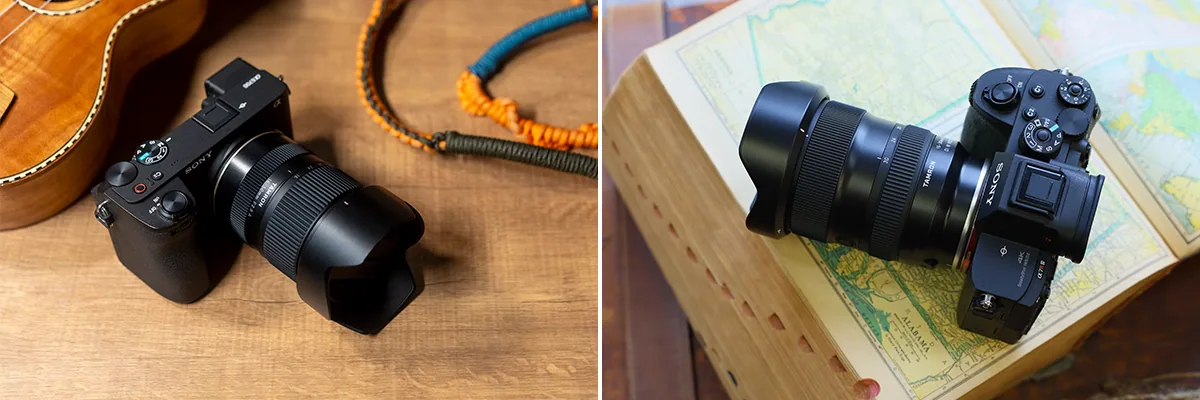
Your camera’s sensor format and lens mount determine which Tamron wide or standard zooms you can use. The APS-C 16-50mm and 17-70mm come in Sony E, Canon RF, Fujifilm X, and Nikon Z mounts. The full-frame 16-30mm G2, 20-40mm, and 28-75mm G2 support Sony E and Nikon Z, while the 17-50mm is Sony E only.
If You Shoot Sony E Full-Frame
Sony E full-frame photographers have four Tamron options. Choose the 16-30mm G2 for ultra-wide landscapes, interiors, and astrophotography, or the 17-50mm F4 for ultra-wide through standard focal lengths in one internal-zoom lens. The 20-40mm is the most compact F2.8 option, and the 28-75mm G2 reaches farthest for portraits and events.
Your options include:
- Tamron 16-30mm F/2.8 Di III VXD G2 (Model A064) — Dedicated ultra-wide-angle coverage for landscapes, architecture, interiors, and astrophotography.
- Tamron 17-50mm F/4 Di III VXD (Model A068) — Ultra-wide through standard focal lengths in a single lens with an internal zoom design.
- Tamron 20-40mm F/2.8 Di III VXD (Model A062) — A compact wide-to-standard zoom for travel, street photography, environmental portraits, and video.
- Tamron 28-75mm F/2.8 Di III VXD G2 (Model A063) — A versatile standard zoom for portraits, events, travel, and everyday photography.
All four lenses use Tamron’s VXD linear autofocus motor, but their focal ranges and handling characteristics distinguish them.
If You Shoot Nikon Z Full-Frame
Nikon Z full-frame photographers have three Tamron options. Choose the 16-30mm G2 for ultra-wide landscapes, architecture, and astrophotography, the compact 20-40mm for travel, street photography, and video, or the 28-75mm G2 for portraits and events. The 17-50mm F4 is not available for Nikon Z.
- Tamron 16-30mm F2.8 G2
- Tamron 20-40mm F2.8
- Tamron 28-75mm F2.8 G2
Each serves a distinct purpose, from dedicated ultra-wide photography to compact everyday shooting and versatile standard zoom coverage.
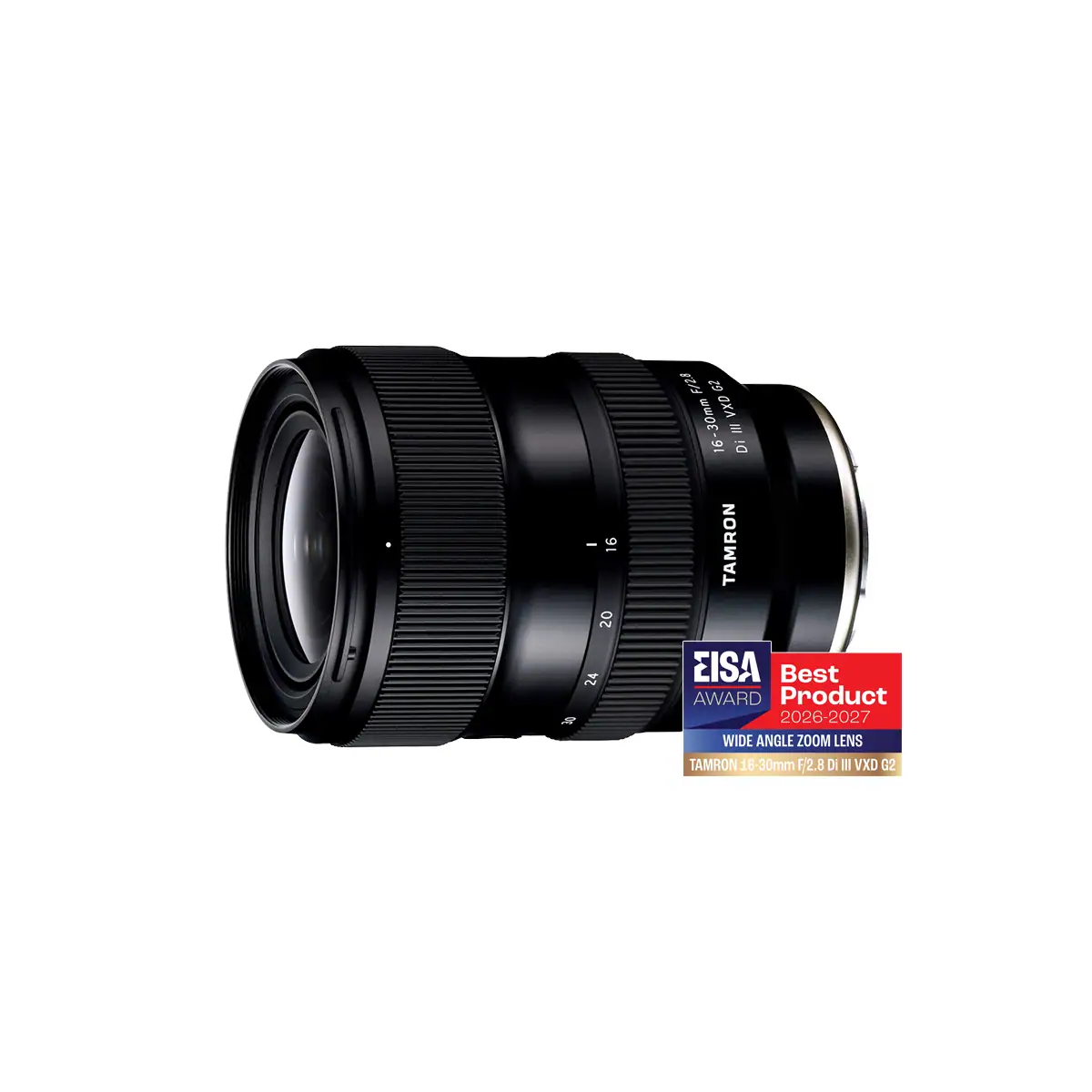
The 16-30mm G2 emphasizes expansive perspectives and is particularly useful for landscapes, architecture, interiors, and astrophotography.
The 20-40mm F2.8, newly introduced for Nikon Z mount, provides a compact wide-to-standard range suited to travel, street photography, and video. The Nikon Z version is scheduled for release on October 22, 2026.
The 28-75mm G2 extends farther into the short-telephoto range, making it useful for portraits, events, and tighter compositions.
The 17-50mm F4 is available only for Sony E mount.
If You Shoot APS-C on Sony E, Canon RF, Fujifilm X, or Nikon Z
APS-C photographers on Sony E, Canon RF, Fujifilm X, or Nikon Z have two constant F2.8 Tamron zooms. Choose the 16-50mm for a wider 16mm start and the lightest build, at 10.8 oz (305g) in Sony E mount. Choose the 17-70mm for 20mm more reach and built-in VC stabilization.
- Tamron 16-50mm F2.8 A
- Tamron 17-70mm F2.8 Di III-A VC
The 16-50mm emphasizes compact size and wider starting coverage, while the 17-70mm offers greater reach and built-in stabilization.
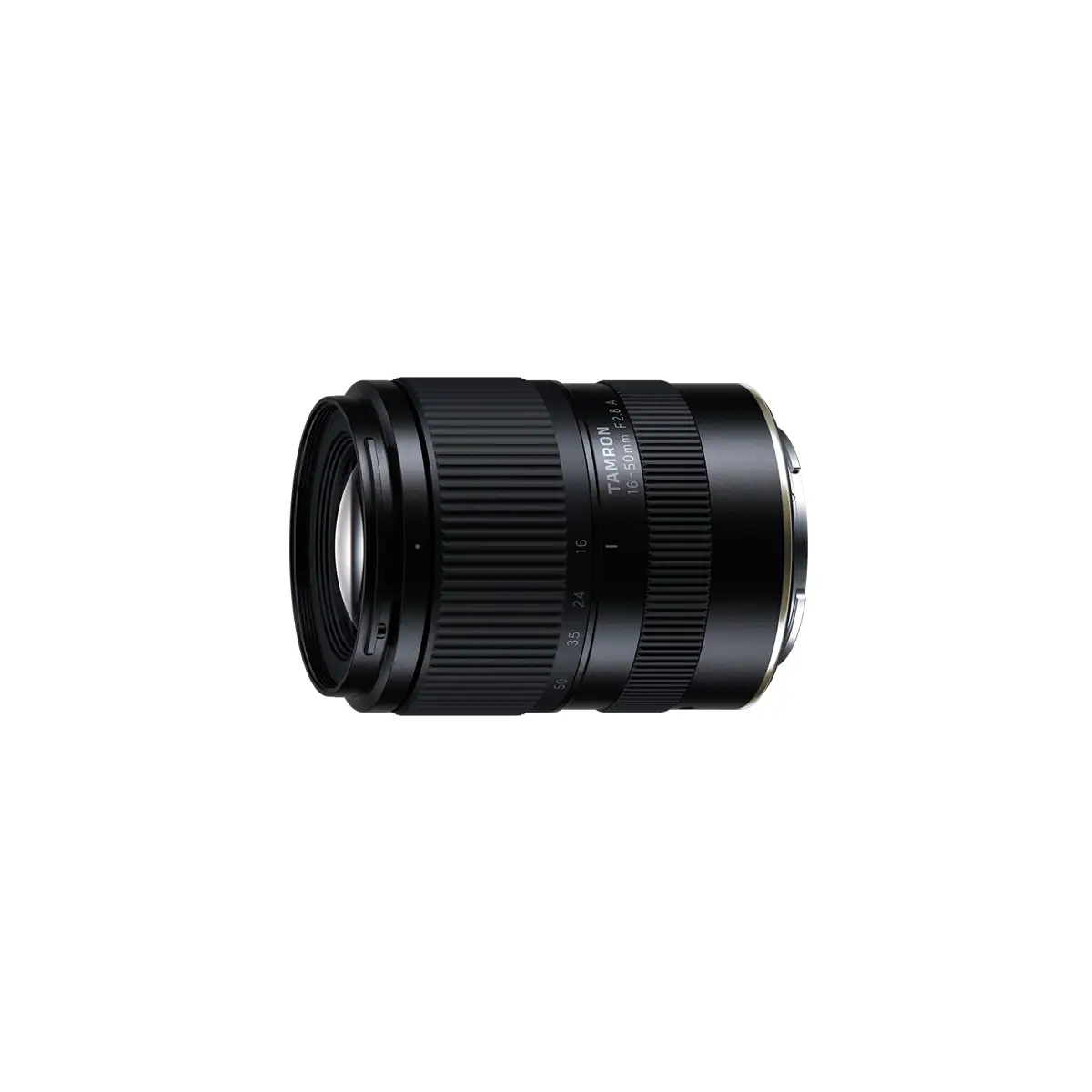
The Tamron 16-50mm F2.8 A (Model B091) starts at 16mm, providing slightly wider coverage for landscapes, architecture, interiors, and group photographs. Its constant F2.8 aperture, compact construction, and VXD linear autofocus motor make it a practical choice for everyday photography, travel, and video.
Weighing just 10.8 oz (305g) and measuring 3.2″ (79.6mm) long in Sony E mount, the 16-50mm is the lightest lens in this six-lens comparison.
Its full-frame-equivalent field of view is approximately:
- Sony E, Nikon Z, and Fujifilm X: 24-75mm
- Canon RF: 25.6-80mm
The Tamron 17-70mm F/2.8 Di III-A VC RXD (Model B070) combines a constant F2.8 aperture, versatile 4.1x zoom ratio, and built-in VC image stabilization. Its extended focal range covers everyday wide-angle scenes, standard perspectives, and short-telephoto compositions without changing lenses.
Its full-frame-equivalent field of view is approximately:
- Sony E, Nikon Z, and Fujifilm X: 25.5-105mm
- Canon RF: 27.2-112mm
Both lenses provide constant F2.8 brightness, but their differences are significant.
*Length and weight are for Sony E
The 16-50mm is 7.7 oz (220g) lighter and approximately 1.6″ (39.7mm) shorter than the 17-70mm in Sony E mount. Its compact dimensions make it especially appealing for photographers who carry their cameras throughout the day.
The 17-70mm provides an additional 20mm of focal length at the telephoto end, making it useful for portraits, events, and subjects photographed from greater distances. Its built-in VC also helps reduce blur from camera shake during handheld shooting.
The 16-50mm offers impressive close-focusing capability, with a minimum object distance of 6.0″ (0.15m) at 16mm, while its VXD autofocus is designed for high-speed, precise, and quiet operation.
The choice comes down to whether you prioritize the 16-50mm’s wider coverage and portability or the 17-70mm’s extended reach and stabilization.
Photographers who prefer a substantially longer zoom range can also explore Tamron’s all-in-one zooms for APS-C, including the 18-300mm.
Can You Use a Full-Frame Zoom on an APS-C Camera?
Yes. A compatible full-frame Tamron zoom can be used on an APS-C camera with the same lens mount, but the smaller sensor captures a narrower field of view. This changes the practical coverage of the lens, particularly at the wide end, where an ultra-wide full-frame lens may no longer provide an ultra-wide perspective.
For Sony E and Nikon Z APS-C cameras, the approximate 1.5x crop factor produces these full-frame-equivalent fields of view:
- 16-30mm becomes approximately 24-45mm.
- 20-40mm becomes approximately 30-60mm.
- 28-75mm becomes approximately 42-112.5mm.
The lens’s actual focal length does not change, but the smaller sensor records a narrower portion of the image.
The reverse situation is different. The 16-50mm and 17-70mm are designed for APS-C coverage and are not intended to illuminate an entire full-frame sensor.
Some full-frame cameras offer an APS-C crop mode, which records a smaller image area at a lower resolution.
For more information, read our APS-C vs. full-frame camera comparison.
Tamron Wide and Standard Zooms Compared: Full Specifications
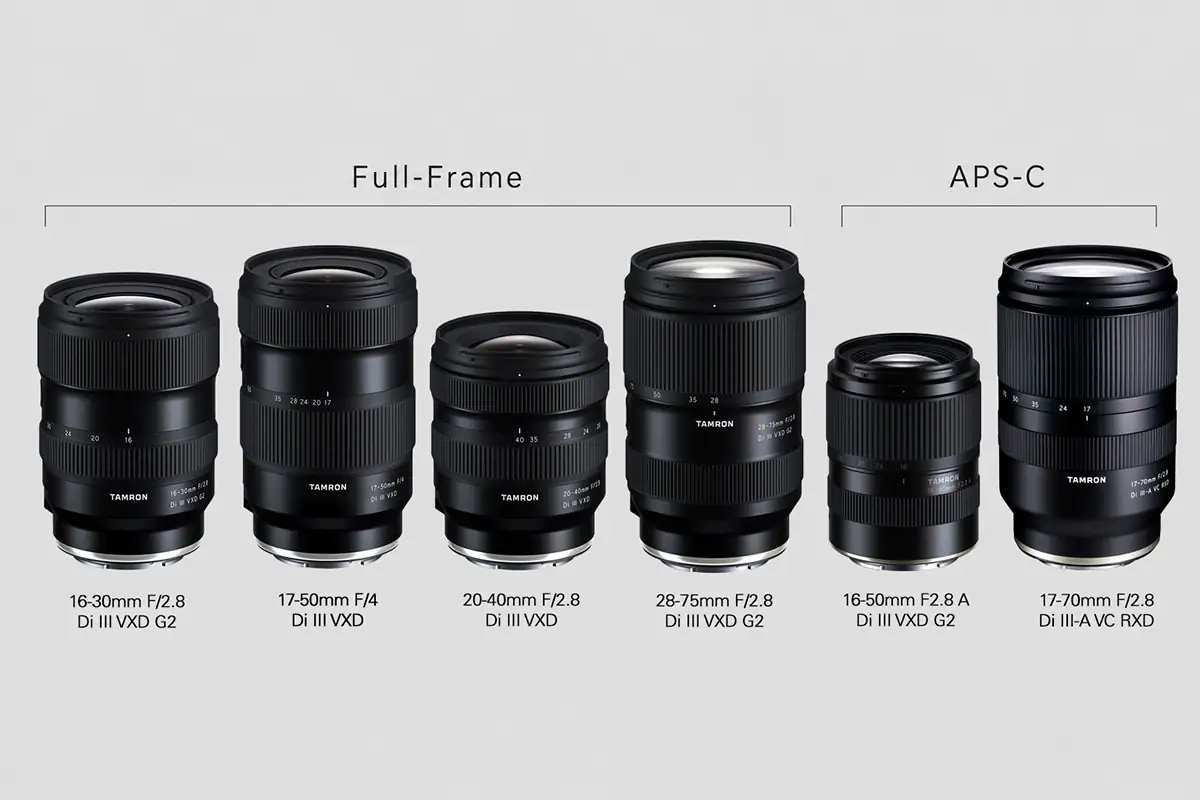
Sensor format, mount availability, focal range, and maximum aperture are the most important specifications to compare first. Weight, stabilization, autofocus motor, close-focusing capability, and zoom-barrel design further distinguish these six lenses. The table below uses Sony E-mount measurements for consistency, with additional mount-specific dimensions listed afterward.
*APS-C equivalent focal lengths shown are for Sony E, Nikon Z, and Fujifilm X. For Canon RF, the 16-50mm provides approximately 25.6–80mm equivalent coverage, while the 17-70mm provides approximately 27.2–112mm.
**Length and weight are for Sony E
Five of the six lenses use 67mm filters, providing convenient filter compatibility across much of Tamron’s mirrorless zoom lineup. The 16-50mm F2.8 A uses a smaller 55mm filter thread, contributing to its compact dimensions.
Five lenses also use Tamron’s VXD (Voice-coil eXtreme-torque Drive) linear motor, designed for high-speed, precise, and quiet autofocus.
The 17-70mm uses RXD (Rapid eXtra-silent stepping Drive), a stepping motor designed to provide smooth, accurate, and quiet autofocus for still photography and video.
Both technologies support reliable focusing performance, using different motor mechanisms to meet their respective lens designs.
Learn more in VXD autofocus explained.
Which of These Lenses Have Image Stabilization?
Only the Tamron 17-70mm F2.8 VC includes built-in Vibration Compensation image stabilization. The 16-30mm G2, 17-50mm, 20-40mm, 28-75mm G2, and 16-50mm F2.8 A do not have optical stabilization. With those five lenses, stabilization comes from the camera body if it offers in-body image stabilization (IBIS).
The 17-70mm’s VC is particularly useful for handheld photography at slower shutter speeds and video.
Tamron 20-40mm vs 28-75mm: Which Standard Zoom Should You Buy?

The Tamron 20-40mm F2.8 prioritizes wider starting coverage, compact size, and lighter weight, while the 28-75mm F2.8 G2 offers a traditional standard zoom range with additional reach for portraits and details. Both have constant F2.8 apertures and are designed for full-frame Sony E and Nikon Z cameras.
Their differences become clearer when comparing specifications.
*Length and weight are for Sony E.
The 20-40mm weighs 6.1 oz (175g) less and measures approximately 1.2″ (31.1mm) shorter than the 28-75mm G2 in Sony E mount.
That difference matters when carrying a camera throughout the day, working with a compact video rig, or packing light for travel.
The 28-75mm G2 offers a substantially longer focal range, making it useful when compositions require tighter framing without physically moving closer to the subject.
Both lenses feature VXD autofocus and 67mm filter compatibility.
What 20mm at the Wide End Actually Changes
The difference between 20mm and 28mm is significant for wide-angle photography. At the same shooting distance on a full-frame camera, 20mm captures approximately 40% more scene width than 28mm. This provides greater flexibility when photographing interiors, architecture, expansive landscapes, and environmental portraits.
In a small room, the 20-40mm lets you include an entire scene without moving backward. For architectural photography, the wider angle helps incorporate building facades and surrounding structures.
For landscapes, 20mm includes more foreground and sky, creating a stronger sense of depth and scale.
The 28-75mm begins at 28mm, a versatile wide-angle setting for many everyday scenes, but it cannot reproduce the same broad coverage from an identical camera position.
The trade-off is the 20-40mm’s shorter long end. It stops at 40mm, so if you often shoot tighter portraits, product photographs, or distant details, the 28-75mm’s 75mm long end is the better fit.
What the 28-75mm Gives You at the Long End
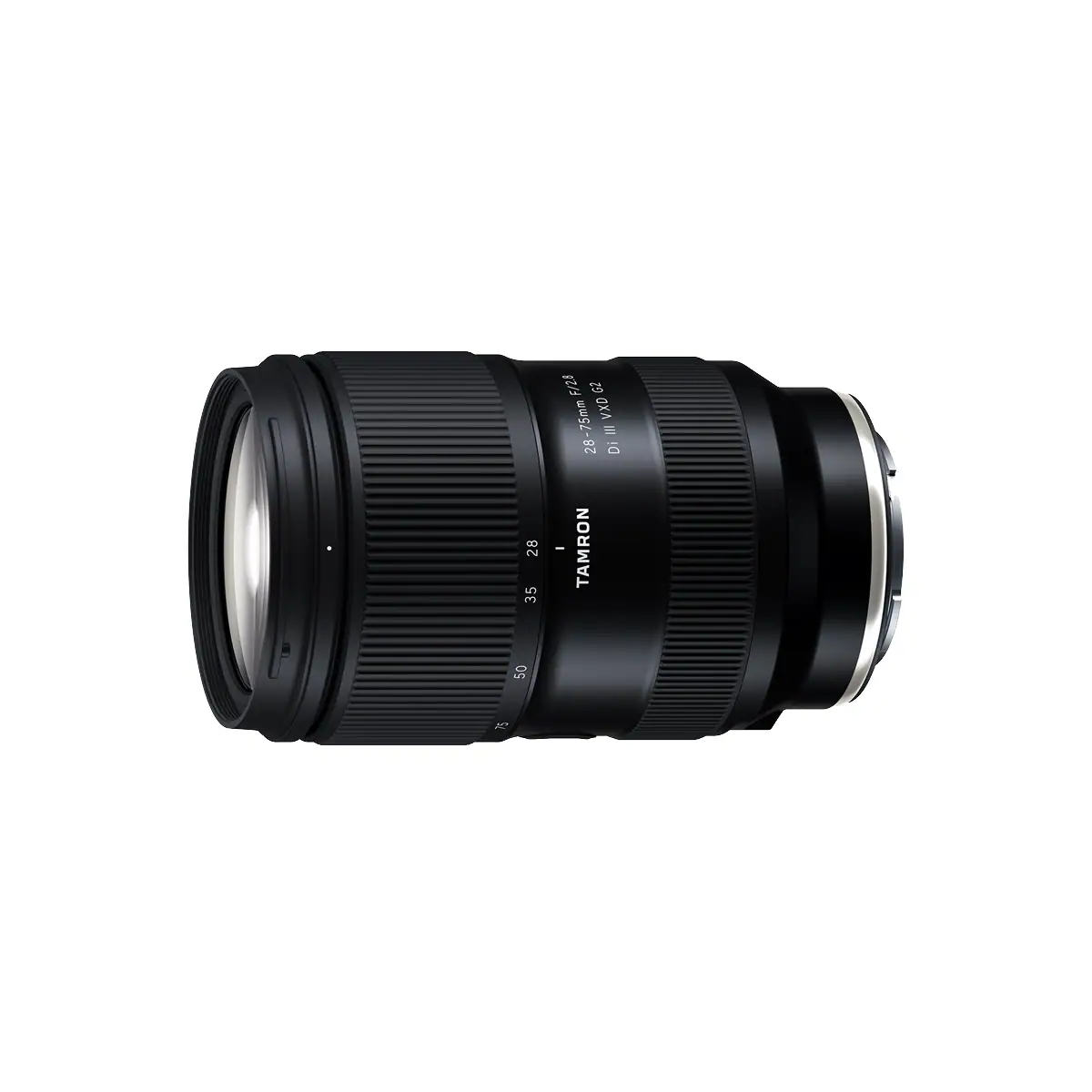
The 75mm long end of the Tamron 28-75mm G2 extends into short-telephoto territory, making it useful for portraits, products, details, and tighter compositions. Compared with 40mm, it produces narrower framing from the same camera position and allows photographers to maintain greater distance from their subjects.
The 28-75mm G2 also provides notable close-focusing performance:
- At 28mm, minimum focus distance is 7.1″ (0.18m), with maximum magnification of 1:2.7.
- At 75mm, minimum focus distance is 15.0″ (0.38m), with maximum magnification of 1:4.1.
At its closest focusing distance at 28mm, the working distance is approximately 1.7″ (4.4cm) from the front of the lens to the subject.
This allows photographers to capture detailed close-up images with a wide-angle perspective, while the 75mm setting provides tighter framing at a greater working distance.
For subjects requiring even more reach, explore where Tamron’s telephoto zooms pick up.
Photographers considering the earlier model can also learn what changed between the two generations of the 28-75mm.
Tamron 16-30mm G2 vs 20-40mm: How Wide Do You Need to Go?

The Tamron 16-30mm F2.8 G2 is a dedicated ultra-wide-angle zoom, while the 20-40mm F2.8 bridges ultra-wide and standard focal lengths. Both maintain a constant F2.8 aperture, but the primary decision is whether you need the broader 16mm perspective enough to give up the 30–40mm range provided by the 20-40mm.
Photographers who regularly work in tight interiors, photograph architecture, or capture astrophotography may appreciate the additional coverage at 16mm.
For travel, street photography, and everyday shooting, the 20-40mm provides a broader range of standard perspectives in a smaller package.
When 16mm Earns Its Place
A 16mm focal length is especially useful when a scene requires more coverage than 20mm can provide. Interiors, architectural photography, astrophotography, and landscapes with prominent foreground elements benefit most from this wider perspective, especially when you can’t step farther back.
The 16-30mm G2 provides a 107° diagonal angle of view at 16mm on a full-frame camera.
Its constant F2.8 aperture is useful for nighttime landscapes and astrophotography, while the 30mm long end can handle environmental portraits and everyday scenes.
Despite being a dedicated ultra-wide zoom, the Sony E-mount version weighs 15.5 oz (440g), measures 4.0″ (101.8mm) long, and accepts 67mm filters.
By comparison, the Sony E-mount 20-40mm weighs just 12.9 oz (365g) and measures 3.4″ (86.5mm).
That makes the 20-40mm the lightest and shortest of the four full-frame lenses in this comparison, while the 16-30mm provides wider coverage.
For a separate comparison with its predecessor, explore how the 16-30mm G2 compares to the 17-28mm.
Why a Non-Extending Barrel Matters for Video and Gimbals
The 16-30mm G2 uses an internal zoom mechanism, meaning its physical barrel length stays constant throughout the zoom range. This helps maintain consistent balance on gimbals, video rigs, and tripod-mounted setups, where changes in lens length and center of gravity can affect handling.
A non-extending design also simplifies lens positioning in compatible underwater housings.
The 16-30mm G2 includes a Connector Port and Focus Set Button and supports TAMRON Lens Utility, allowing compatible functions to be customized for still photography and video.
The 20-40mm also supports TAMRON Lens Utility™ but its barrel extends slightly when zooming toward 20mm.
For handheld still photography, the difference is minor. For those using carefully balanced video equipment, a fixed barrel length can be a practical advantage.
Tamron 17-50mm vs 17-70mm: Why These Two Aren’t Alternatives
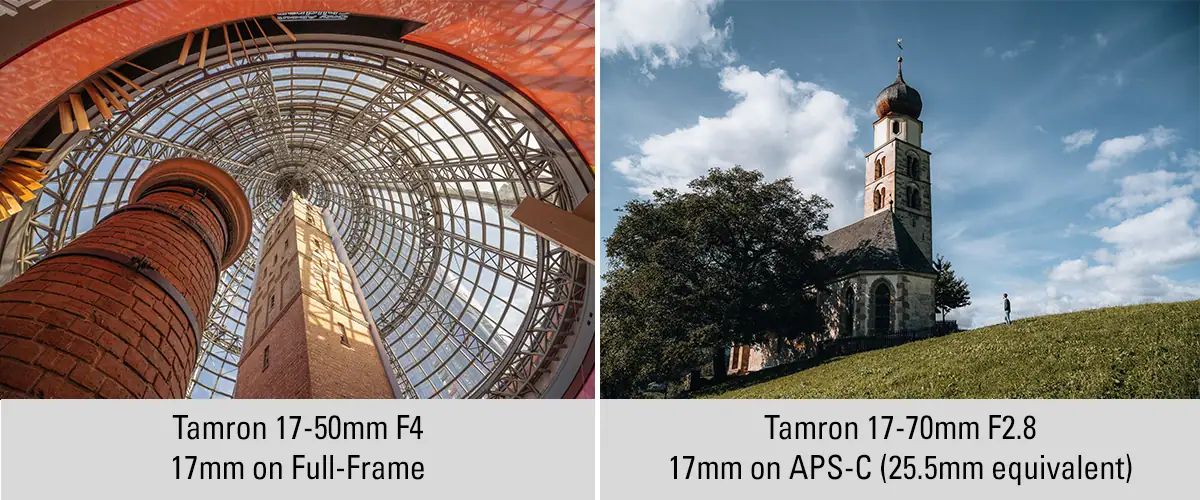
The Tamron 17-50mm F4 and 17-70mm F2.8 have similar starting focal lengths but are designed for different sensor formats. The 17-50mm is a full-frame Sony E-mount lens with a constant F4 aperture, while the 17-70mm is an APS-C lens with F2.8, built-in VC, and four mount options.
Comparing their printed focal-length ranges alone overlooks the most important distinction: the angle of view each lens provides on its intended camera format.
- The 17-50mm is designed to capture ultra-wide through standard perspectives on a full-frame camera.
- The 17-70mm is designed to deliver a flexible standard zoom range on APS-C cameras, extending from moderately wide coverage to short-telephoto perspectives.
Although both can be mounted on compatible Sony E APS-C cameras, they are not directly equivalent when comparing their intended full-frame and APS-C uses.
The new 16-50mm F2.8 A introduces another APS-C alternative, but it should not be confused with the full-frame 17-50mm F4. The 16-50mm is designed for APS-C cameras, maintains a constant F2.8 aperture, and is available in four mount versions.
Doing the Equivalence Math
The Tamron 17-70mm on a Sony E, Nikon Z, or Fujifilm X APS-C camera delivers a field of view equivalent to approximately 25.5–105mm on full-frame. The full-frame 17-50mm provides its actual 17–50mm field of view when used on a full-frame Sony camera, making its wide-angle coverage substantially broader.
The differences are:
On their intended camera formats, the full-frame 17-50mm starts considerably wider, while the APS-C 17-70mm delivers much more reach at the long end.
On the same Sony APS-C camera, however, both lenses begin at the same equivalent field of view, and the 17-70mm extends farther.
The new APS-C 16-50mm starts slightly wider than the 17-70mm on the same camera format, while its 50mm long end provides less reach.
The determining factor is compatibility and sensor coverage. The 17-50mm supports full-frame capture on Sony E cameras, while the 16-50mm and 17-70mm are specifically designed for APS-C image coverage.
F/2.8 vs F/4 — What the Aperture Difference Means
The 17-50mm is the only F4 lens in this six-lens comparison; the other five maintain a constant F2.8 maximum aperture. At the same shutter speed and ISO, F2.8 allows twice as much light to reach the sensor as F4, providing more low-light flexibility and shallower depth of field.
For the two APS-C options, the 16-50mm and 17-70mm maintain F2.8 brightness throughout their zoom ranges. The 17-70mm also includes VC image stabilization, which reduces blur from camera shake during handheld shooting. The other five lenses can benefit from in-body stabilization when used with compatible cameras.
The 17-50mm takes a different approach. Its F4 design covers an exceptionally broad full-frame range, from 17mm ultra-wide to 50mm standard, while maintaining a fixed barrel length through its internal zoom mechanism.
This allows photographers to move from wide architectural scenes to natural-looking everyday compositions without changing lenses.
Neither aperture specification tells the complete story. The full-frame 17-50mm emphasizes ultra-wide-to-standard flexibility and consistent physical length, while the APS-C 16-50mm and 17-70mm provide brighter F2.8 apertures with different balances of portability, reach, and stabilization.
Which Tamron Wide or Standard Zoom Should You Buy?

The right Tamron wide or standard zoom depends first on your camera’s sensor format and mount, followed by how much wide-angle coverage, telephoto reach, portability, and stabilization you need. Each of these six lenses serves a different combination of priorities, making the best choice the one that fits your most frequent subjects.
- 16-30mm F2.8 G2: For full-frame Sony E and Nikon Z photographers who prioritize ultra-wide landscapes, architecture, interiors, astrophotography, and video requiring a non-extending barrel.
- 17-50mm F4: For Sony E full-frame photographers who want ultra-wide through standard focal lengths in one constant-length zoom.
- 20-40mm F2.8: For full-frame Sony E and Nikon Z photographers seeking a compact F2.8 zoom for travel, street photography, environmental portraits, and video.
- 28-75mm F2.8 G2: For full-frame Sony E and Nikon Z photographers who need a versatile standard zoom for portraits, events, travel, close-ups, and everyday shooting.
- 16-50mm F2.8 A: For APS-C photographers using Sony E, Canon RF, Fujifilm X, or Nikon Z who want a lightweight, compact standard zoom with a wider 16mm starting point and VXD autofocus.
- 17-70mm F2.8 VC: For APS-C photographers using Sony E, Canon RF, Fujifilm X, or Nikon Z who prioritize an extended 4.1x zoom range, constant F2.8 aperture, and built-in stabilization.
Find the Right Tamron Zoom for Your Camera

Once you know which focal range and features matter most, compare the complete specifications for your camera mount before making a purchase. Even when lenses share an optical design, their weight and dimensions can vary between Sony E, Nikon Z, Canon RF, and Fujifilm X versions.
Explore the individual product pages for the 16-30mm F2.8 G2, 17-50mm F4, 20-40mm F2.8, 28-75mm F2.8 G2, 16-50mm F2.8 A, and 17-70mm F2.8 VC to review their features, compatibility, and technical details.
Where to Buy Tamron Lenses
When you’re ready to buy, visit an authorized Tamron dealer near you or shop directly at the official TAMRON Store.
Frequently Asked Questions About Tamron Wide and Standard Zoom Lenses
What is the difference between a wide-angle zoom and a standard zoom lens?
A wide-angle zoom emphasizes shorter focal lengths and a broader field of view, making it useful for landscapes, interiors, and architecture. A standard zoom typically extends farther into normal or short-telephoto focal lengths, providing greater flexibility for portraits, events, travel, and everyday photography. Some lenses, such as the Tamron 20-40mm and 17-50mm, bridge both categories.
What is the difference between the Tamron 16-50mm and 17-70mm for APS-C cameras?
Both are constant F2.8 zoom lenses designed for APS-C cameras, but the 16-50mm emphasizes portability and wider starting coverage, while the 17-70mm offers greater reach and built-in stabilization. The 16-50mm weighs just 10.8 oz (305g) in Sony E mount and uses VXD autofocus. The 17-70mm provides a longer 70mm telephoto end and features VC stabilization with RXD autofocus.
Which Tamron zoom lens is best for landscape photography?
The Tamron 16-30mm F2.8 G2 is an excellent option for full-frame photographers who want ultra-wide 16mm coverage for expansive landscapes, dramatic foregrounds, and tight shooting locations. The 17-50mm F4 also offers ultra-wide coverage for Sony full-frame cameras. For APS-C photographers, the 16-50mm F2.8 A provides a wide 16mm starting point, equivalent to approximately 24mm on Sony E, Nikon Z, and Fujifilm X cameras.
Is the Tamron 20-40mm or 28-75mm better for travel photography?
The 20-40mm F2.8 is lighter and smaller, making it especially attractive for travel photographers who prioritize portability, landscapes, city scenes, and environmental portraits. The 28-75mm F2.8 G2 provides additional reach for portraits and details, making it more versatile when photographing subjects at different distances.
Which Tamron standard zoom lens has image stabilization?
The Tamron 17-70mm F2.8 Di III-A VC RXD is the only one of these six lenses with built-in Vibration Compensation. It is designed for APS-C cameras and supports Sony E, Canon RF, Fujifilm X, and Nikon Z mounts. The other five lenses rely on in-body stabilization when used with compatible cameras.
Can I use Tamron full-frame zoom lenses on an APS-C camera?
Yes, provided the camera and lens share a compatible mount. A full-frame lens on APS-C produces a narrower field of view because of the crop factor. For example, a 28-75mm zoom provides approximately 42–112.5mm full-frame-equivalent coverage on Sony E or Nikon Z APS-C cameras.
Are Tamron F2.8 zoom lenses good for video?
Yes. Tamron’s constant F2.8 zoom lenses provide a consistent maximum aperture throughout their zoom ranges, helping maintain exposure while zooming. VXD and RXD autofocus technologies support quiet, precise focusing, while additional features such as internal zoom, lens customization, and stabilization vary by model. Choose based on camera compatibility, focal-range needs, and filming setup.
Which Tamron standard zoom is the lightest?
The newly introduced Tamron 16-50mm F2.8 A is the lightest of these six lenses, weighing just 10.8 oz (305g) in Sony E, Canon RF, and Fujifilm X mounts. Among the full-frame models, the 20-40mm F2.8 is the lightest at 12.9 oz (365g) for Sony E mount.
Do all six Tamron zoom lenses use the same filter size?
No. Five of the six lenses use 67mm filters: the 16-30mm G2, 17-50mm, 20-40mm, 28-75mm G2, and 17-70mm. The new 16-50mm F2.8 A uses a smaller 55mm filter thread, contributing to its compact, lightweight design.
About the Author
 Stacie Errera is Vice President of Marketing and Communications for Tamron Americas, where she has been with Tamron for more than 36 years. She is also a photography educator who teaches new camera users how to better understand their cameras and photography basics. She leads weekend photography workshops for women. Read Stacie’s full bio >>