Instant Savings
 Rebate Claims
 Support
 Find a Dealer

Capturing the ‘Spirit of Adventure’
From fiery volcanoes in Guatemala to remote waterfalls in Indonesia, Ivan Chan’s Tamron lenses help him photograph scenes that feel otherworldly.
Author: Jenn Gidman
Images: Ivan Chan
Share Article
From fiery volcanoes in Guatemala to remote waterfalls in Indonesia, Ivan Chan’s Tamron lenses help him photograph scenes that feel otherworldly.
When Ivan Chan was growing up, his parents often took him and his sister on trips around the globe. While most kids might have been hyper focused on sightseeing, Ivan was just as fascinated by his family’s point-and-shoot camera, which helped him document what he was witnessing on his worldwide adventures. “I remember reading the camera manual cover to cover trying to figure out all of the settings,” he says.
That early photographic interest resurfaced years later during a university exchange program in Switzerland, where Ivan received his first dedicated camera as a gift from his dad. It wasn’t until 2020, however, after moving from Toronto to Vancouver for a remote software engineering job, that photography truly became part of Ivan’s everyday life. “I really got into hiking around that time and saw all the mountains around Vancouver and thought, ‘I have to explore this more,'” he says. “I started bringing my DSLR on every hike, and during the pandemic, I had a lot of time on my hands to really learn and improve at my craft.”
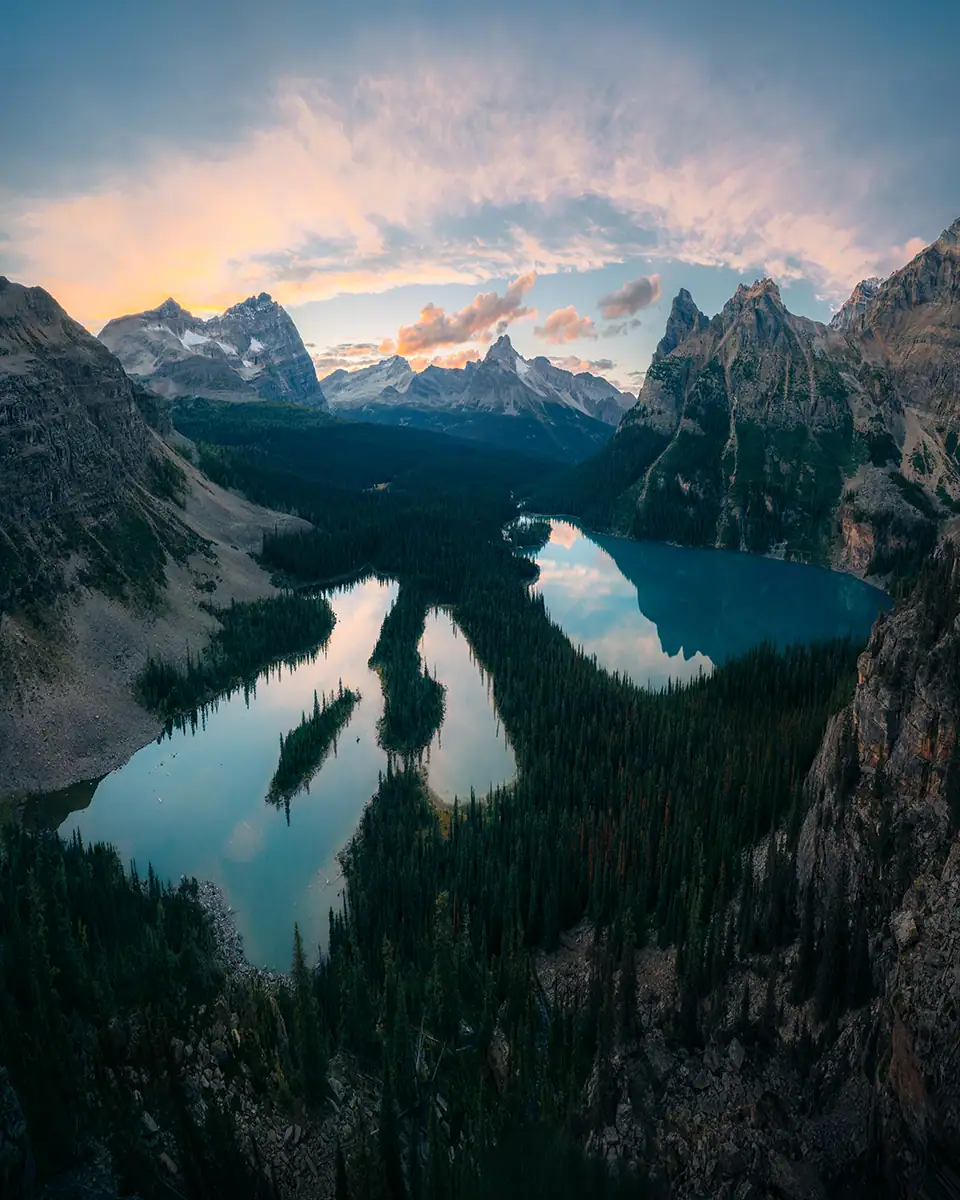
As travel reopened post-COVID, Ivan embraced the freedom of remote work, spending nearly two years traveling the world as a digital nomad. Today, his portfolio spans Icelandic waterfalls, Guatemalan volcanoes, Canadian alpine lakes, and the remote corners of Southeast Asia. Throughout it all, one idea ties his work together. “I’m always looking for places that feel otherworldly, showcasing the most exotic adventures I can find,” he says. “If I had to describe my photography in one phrase, it would be ‘capturing the spirit of adventure.’”
For those off-the-beaten-path expeditions, Ivan packs a Tamron wide-angle lens (the Tamron 17-28mm F/2.8 Di III RXD has been a tried-and-true partner) and the Tamron 28-200mm F/2.8-5.6 Di III RXD lens for his Sony mirrorless camera system. “Those two types of lenses cover almost every focal length I need, and they’re compact enough that I never feel weighed down while hiking,” he says.
The versatility of the 28-200mm allows Ivan to move seamlessly between expansive vistas and distant mountain details without changing lenses. Meanwhile, using a wider-angle Tamron lens like the 17-28mm has proven invaluable for emphasizing the sheer size of a landscape. “I love shooting at, say, 17mm with a person in my frame, close to the camera,” he says. “Even though my subject is nearby, they still look tiny compared to the landscape behind them. It really emphasizes how massive these places are.”
IVAN’S QUICK TIPS
Use the human element to tell a story.
Many landscape photographers add a person simply to show scale, but I try to go a step further and make that person part of the story. I want viewers to wonder what my subjects are experiencing or how they reached that spot.
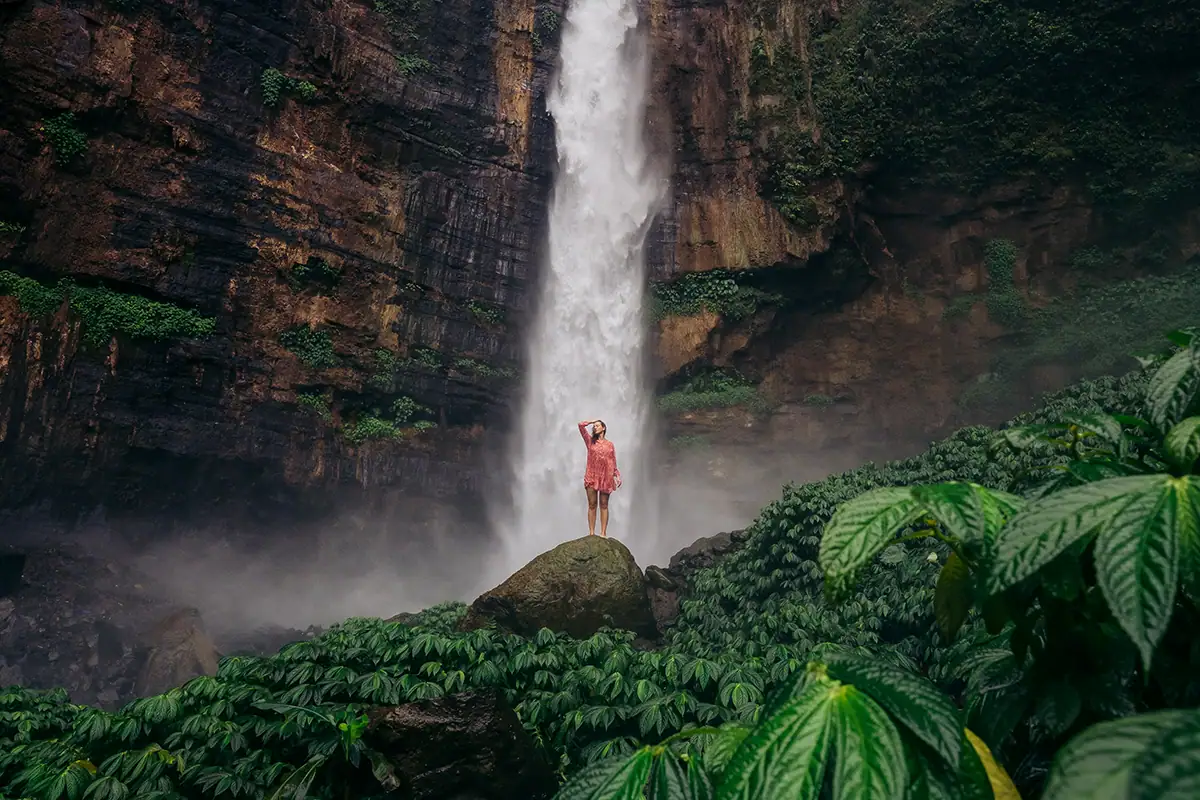
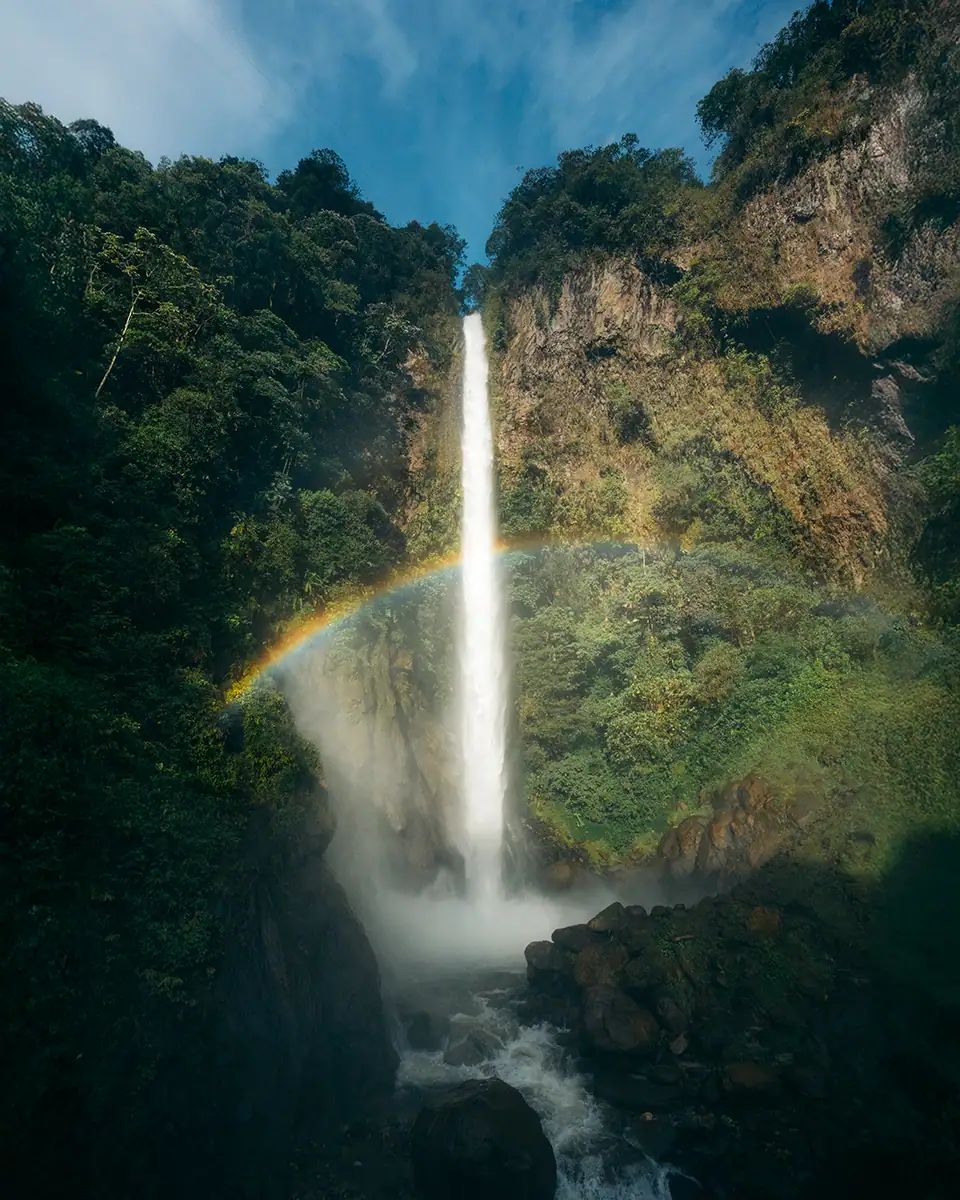
The waterfall photo seen here, taken in Java, Indonesia, is probably the best example of this. We had hiked well off the beaten path to reach this secluded spot, and my friend stood in exactly the right place in front of that huge cascade. The biggest challenge wasn’t in composing the image, though—it was the mist. I was constantly wiping spray off the front of my lens to keep things from getting too blurry.
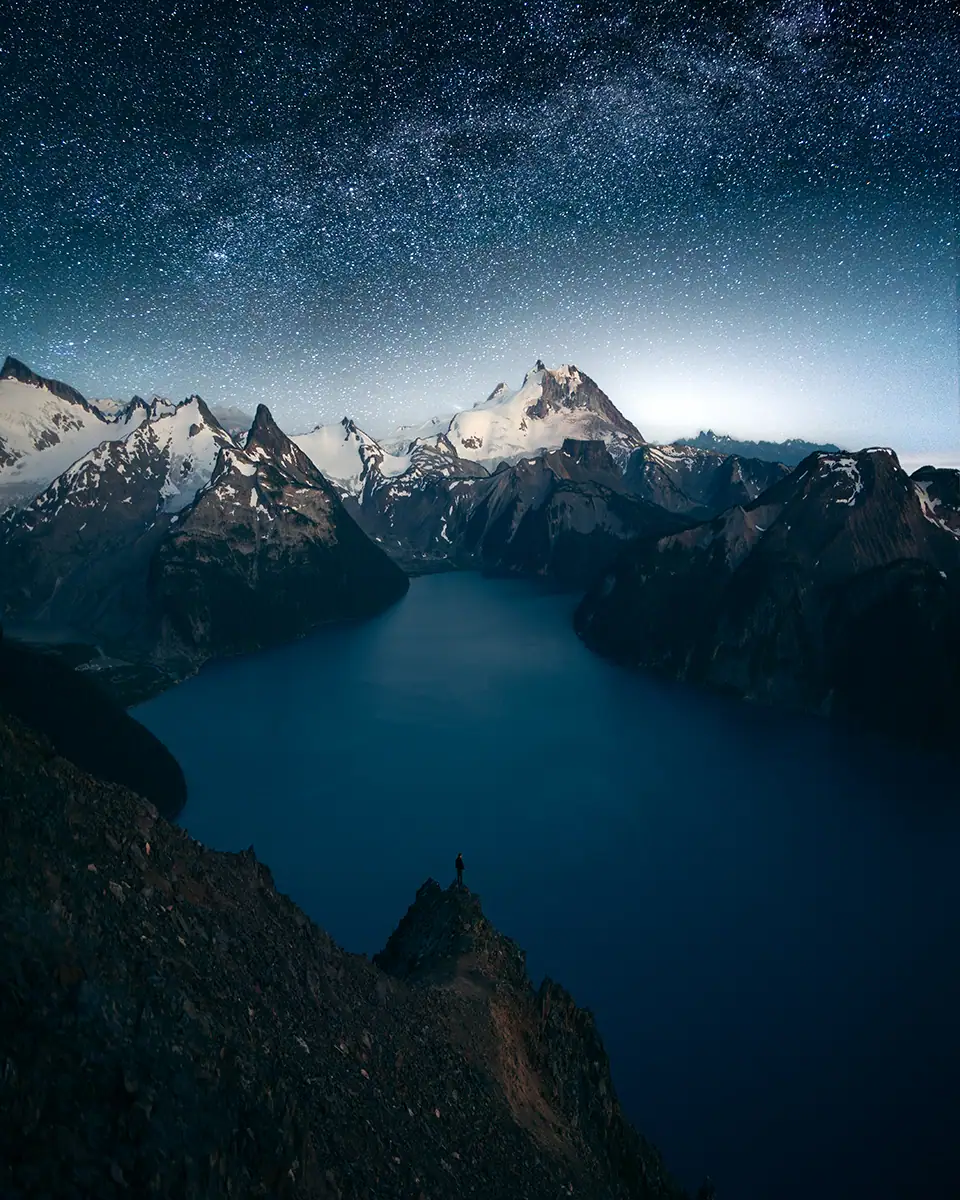
The same philosophy applies to my Milky Way image from British Columbia’s Panorama Ridge. Seeing that tiny person at the bottom of the frame (look closely!), beneath a sky full of stars, immediately makes you imagine what it would feel like to spend the night in a place like that.
Look for layers, and contrast.
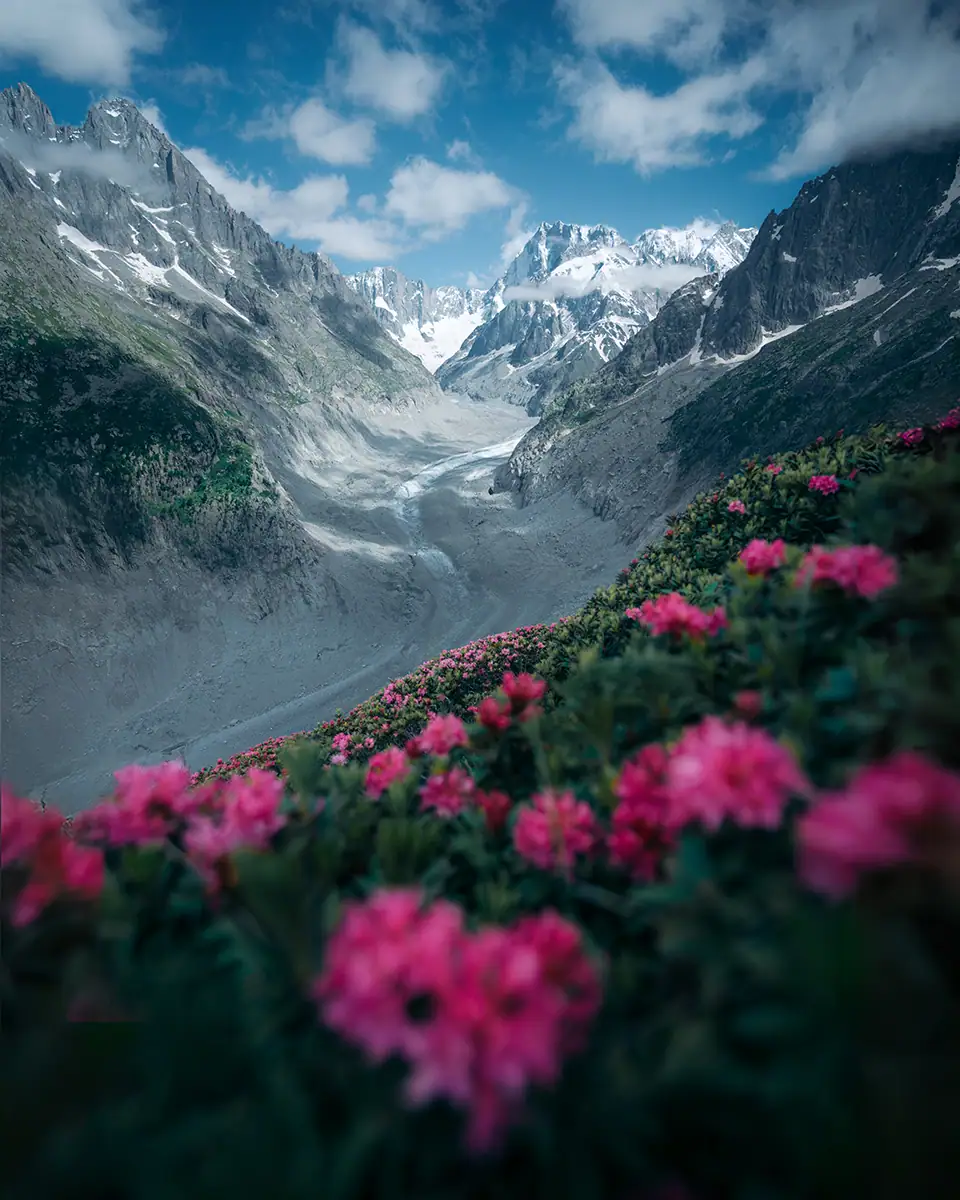
To capture the photo in Chamonix, situated in the French Alps, I had to ride the Aiguille du Midi gondola, which can take you to altitudes of nearly 13,000 feet. From there, you can hike about 6 miles to this viewing spot, where you’re able to take in the glacial scene below.
I spent about 30 minutes trying to get the composition just right with those vibrantly colored wildflowers, making sure they were arranged just so and waiting for the light to come in over the clouds so that it was more consistent. If the light had hit the foreground too strongly, it would’ve been too bright in the foreground and too dark in the background, so this one took a bit of work and patience to pull off.
Stay out when you think you should head home.
Golden hour is still my favorite time to shoot, especially because I love photographing into the light to create a soft atmosphere that packs some glow. Some of my favorite images, however, happen after sunset, when most hikers have already packed up their gear.
The Milky Way image is one I’ve wanted to make since my very first hike there in 2020. Five years later, everything finally aligned—clear skies, good weather, and a chance to camp there overnight. Hiking in the dark wasn’t easy, but those extra hours gave me images I wouldn’t have been able to capture otherwise.
In Ecuador, meanwhile, it had been cloudy and rainy for most of our bike ride through the mountains, but just before we reached the final stop, where you can hike down to the base of this waterfall, the sun broke through the clouds just long enough to create a perfect rainbow. Moments like that can’t be planned—you simply have to remain patient and be ready when nature decides to cooperate.
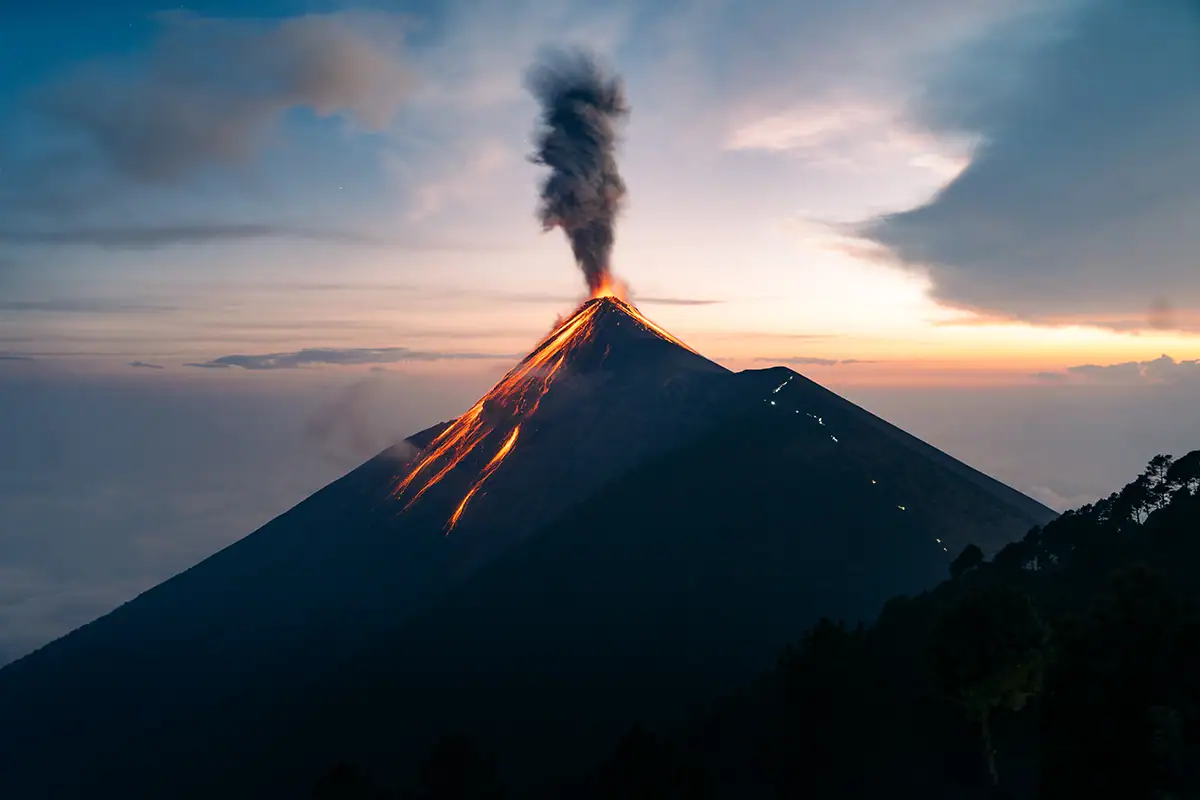
One of my favorite images is the one here of Volcan de Fuego, an active stratovolcano in Guatemala that’s seen erupting in the distance after an overnight hike up a neighboring volcano. Every 15 minutes or so, lava burst into the night sky. It was an intense, steep hike over loose volcanic sand to reach our vantage point, but this photo ended up being one of my favorite images from Guatemala.