Instant Savings
 Rebate Claims
 Support
 Find a Dealer
A Day in the Life of a Cowboy
Lisa Langell pardners up with her Tamron 50-400mm VC and 150-500mm VC ultra telephoto lenses to capture life on a working ranch.
Author: Jenn Gidman
Images: Lisa Langell
Share Article
Lisa Langell pardners up with her Tamron 50-400mm VC and 150-500mm VC ultratelephoto lenses to capture life on a working ranch.
For Lisa Langell, cowboy photography is an invitation into a way of life that feels both timeless and increasingly rare. Through her workshops held on working ranches in the American Southwest, Langell offers photographers the chance to document authentic moments of ranch life, from thundering cattle drives to quiet, dusty pauses at sunrise and sunset. Over several days, participants in her workshops shoot in all different lighting scenarios while navigating fast-moving scenes, all while gaining insight into a culture built on resilience, tradition, and deep connections between humans, animals, and the land.
The workshop experience is intentionally immersive. Mornings and evenings are devoted to action photography, while midday sessions shift into instruction and hands-on portrait work. “When I first started taking lessons on portraiture, I had some poor experiences, so I wanted to add something to my cowboy workshops to make portraiture fun,” she says. Then comes dinner, magic hour, and a chance to capture those iconic “riding off into the sunset” silhouettes that epitomize cowboy photography.
To keep up with the unpredictability, Lisa relies on what she calls her go-to lenses for this type of gritty photography: the Tamron 50-400mm Di III VC VXD and Tamron 150-500mm Di III VC VXD ultra telephoto lenses, both of which allow her to quickly adapt on the fly, and both of which feature Tamron’s Vibration Compensation technology to help keep her images sharp. Lisa also taps into her Tamron 35-150mm F/2-2.8 Di III VXD all-in-one zoom for cowboy portraits
“Things are very fast-moving on the ranch,” Lisa explains. “One minute the cowboys are right next to you, the next they’re riding off to lasso some longhorns. I especially appreciate the compression I’m able to achieve with these two Tamron lenses. It creates such a density of feeling by offering the optical illusion that the cactuses, mountains, and landscapes behind my subjects are much closer than they really are.”
For Langell, the appeal of cowboy photography runs deep. “I’ve adored horses since I was a kid,” she says. “I also love how textural these kinds of photos are, and the classic themes that people can envision when they view them. I enjoy creating moments in that atmosphere, working closely with the folks on the ranch, for people in my workshops to photograph.”
More below on how Lisa created some of her favorite shots from a workshop she recently held on the D Spur Ranch in Gold Canyon, Arizona.

Just after sunrise, I set the scene and positioned myself to make the most of the changing light as the cowboys moved the cattle back and forth, allowing photographers to capture a range of lighting looks. You have the parts of the scene that are backlit, but if you look carefully, you can tell that the sun is rising somewhere to the right of the horse on the right. Then you get a little sidelight on that longhorn, as well as some front light when the subjects move to the left.
Keeping control of longhorn cattle is risky business. As a cowboy, you want to make sure you and your horse don’t get injured by those horns. The timing that’s involved when you’re riding a horse and trying to get a rope around those hind legs while the cattle are also running is challenging, but the cowboys are incredibly skilled at using their lassos.

Rycke is the longest-running cowboy we’ve worked with in our workshops, and is also one of the most photogenic. Right before I took this photo, we’d been running a herd of horses back and forth. There was still a bit of dust in the air, and Rycke was patrolling the desert perimeter as a safety rider to make sure the horses didn’t stray too far. When the light hit him right where he was standing and backlit the saguaro cacti behind him, it was magical.
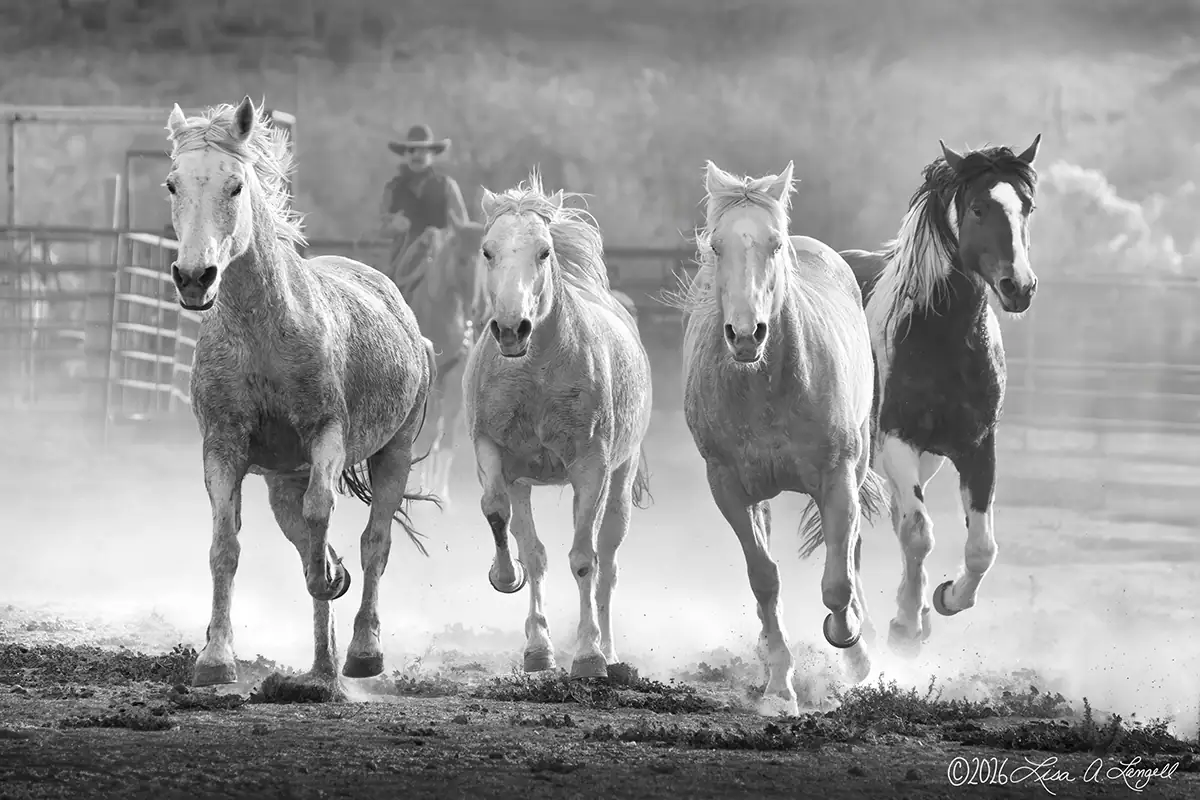
Converting an image to black and white is a great technique when you want your viewers to focus on the elements of an image, not necessarily the colors. In this case, there was sage green in the background due to the mesquite trees, brown dirt, and then you had the horses themselves: three light-colored horses and then that one pinto on the far right. Black and white made the photo feel unified and more strongly emphasized the subjects.
I also look at how contrast plays into a photo like this. If you try to take a black-and-white photo without much contrast, it’s not going to be as effective. Here, the dust that’s getting kicked up provides that contrast so you can better see the structure of the horses’ legs.

I captured this image at the end of the day as this cowgirl named Jenna was riding back in along a dusty ranch road, that cattle dog trotting beside her. We had set this scene up with our photographers lined along the path, ready to photograph the riders as they moved toward us in that soft, late-day light.
What I love most about this image is the sense of partnership. It’s fascinating what these cattle dogs do, and how the horses, thanks to training, are able to stay calm with the dogs running around underfoot. I honestly don’t know how the dogs manage to avoid getting run over, but they literally take it all in stride, making it look easy and effortless!

We try to capture different scenes in some of the same spots as the sun gets lower in the sky, so I took this photograph later that evening, on the same road that Jenna rode in on. There’s a lot that goes into a photo like this, including making sure the horses are trained, as mentioned earlier, so that they’re not spooked by the large American and Arizona flags the riders are holding. Those flags, by the way, are a little detail that offers a sense of place in a photo—you can tell immediately that they’re not in, say, New Zealand.

I was pleased to be able to incorporate the covered wagon in this shot, after cowboys visiting from Montana brought it down with them. What I love about this scene is that we were in a place with a lot of history to it, where what was happening here could just as easily have been happening in the exact same place in the late 1800s. With the mountains in the background, and my silhouetted subjects riding off into the sunset—it’s a timeless photo.

Rycke has such a wonderful, classic cowboy face. It’s rugged, tells a story, and infers that he’s seen some things in his years as a cowboy! Low-key-style photography is one of my favorite styles in which to capture portraits of cowboys. It showcases the mood and mystery of the cowboy lifestyle, along with the textured faces of these incredible men. I used two strobes to light Rycke properly for this look.
To see more of Lisa Langell’s work, check out her website or her Instagram. For more information on Lisa Langell’s upcoming cowboy photography workshops, click here.