 Instant Savings
 Rebate Claims
 Support
 Find a Dealer
A Workhorse for the Wild
Alyce Bender documents tiny creatures in Costa Rica with her Tamron 50-400mm VC ultra-telephoto lens.
Author: Jenn Gidman
Images: Alyce Bender
Share Article
Alyce Bender documents tiny creatures in Costa Rica with her Tamron 50-400mm VC ultra-telephoto lens.
When Alyce Bender first got her hands on the Tamron 50–400mm Di III VC VXD ultra-telephoto zoom a few years back, she knew instantly it was going to be a game-changer. Today, the Las Vegas photographer says that lens has become a workhorse for her close-up photography.
“I absolutely adore the 50-400mm, both for my macro-style work and in general,” Bender says. “With the range it offers, its sharpness, its Vibration Compensation (VC) technology, and its macro capabilities, I’m able to achieve such variety in my images.”
That versatility proved especially valuable during Bender’s recent trip to Costa Rica, celebrated for its staggering biodiversity and intimate wildlife encounters. Bender found no shortage of small, visually arresting subjects, and the 50-400mm VC lens allowed her to keep a safe distance from some of the more eyebrow-raising creatures, all while still achieving compression and edge-to-edge sharpness at the long end of the zoom. “I don’t want people to think I photographed those vipers at 50mm,” she says.
Read on to see how Bender composed each of her Costa Rica creations with the Tamron 50-400mm VC ultra-telephoto lens.
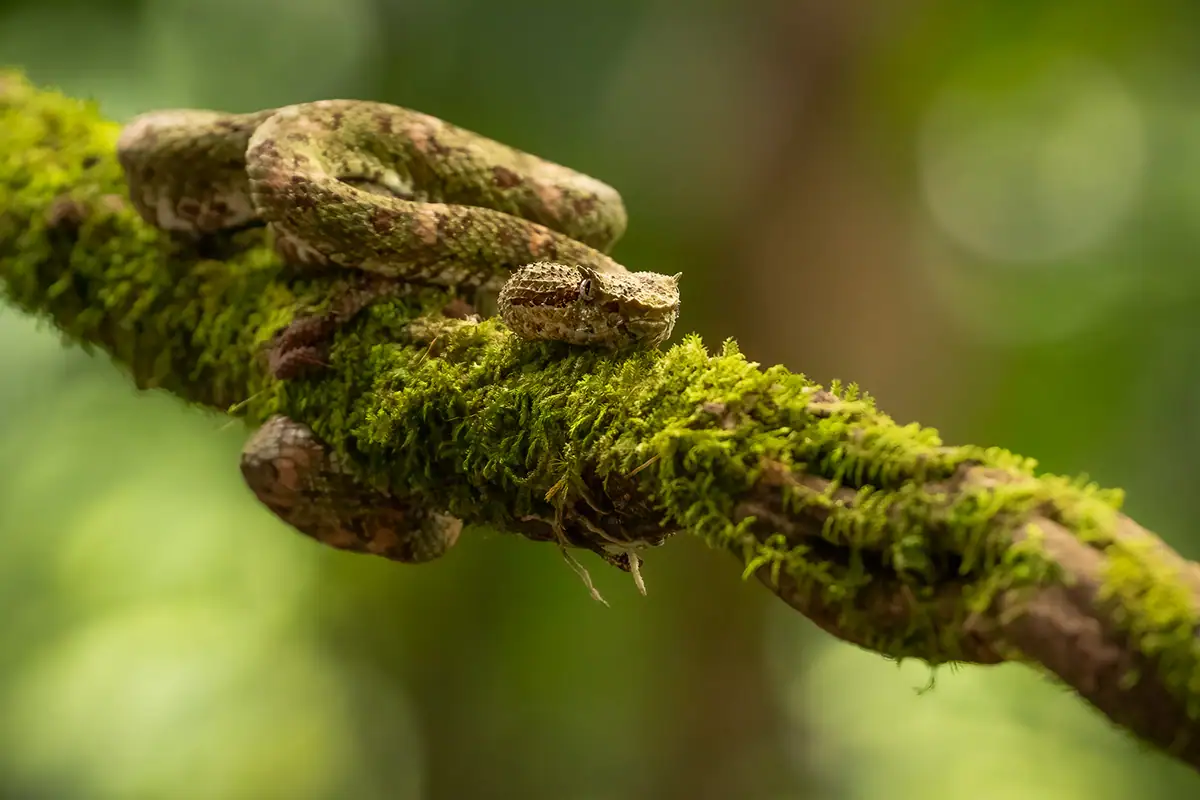
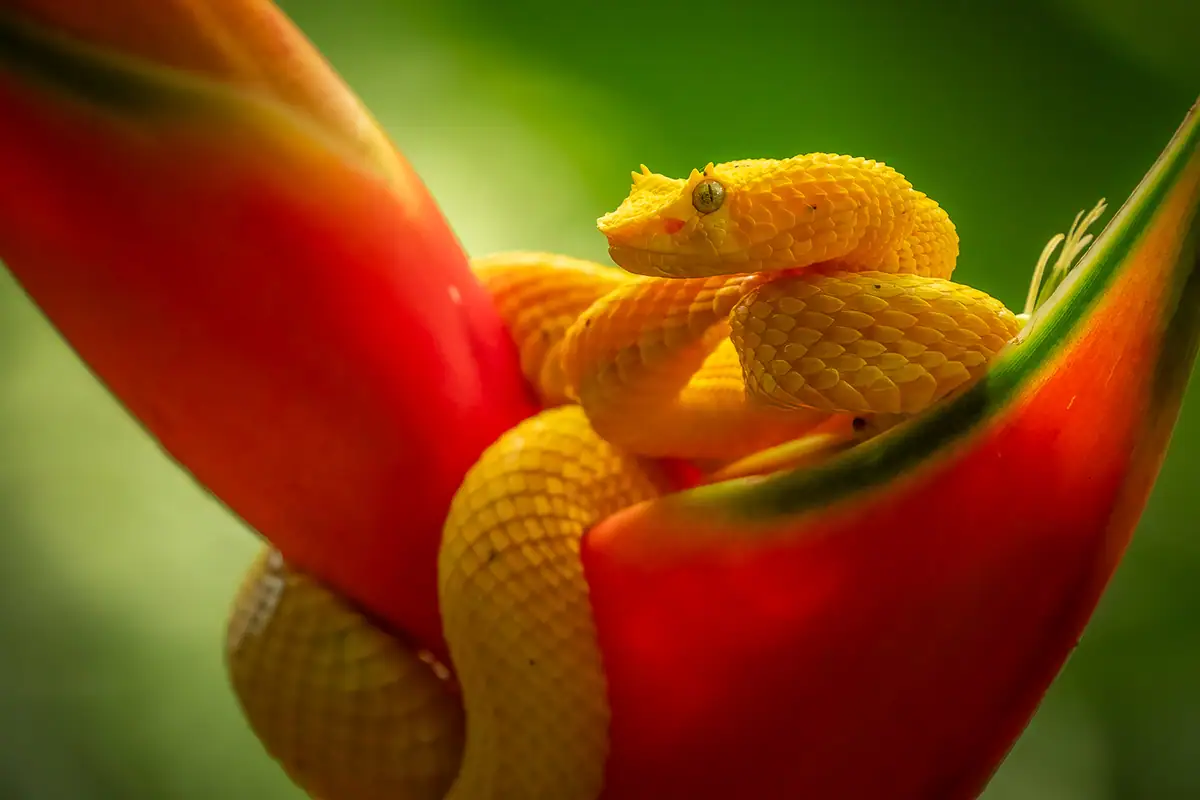
The two eyelash vipers you see here, as well as the glass frog, were captive; the hairy caterpillar and red-eyed tree frog were in the wild. So these vipers are seen in staged, carefully handled scenes. Just to give you an idea of how quickly they can strike—their main prey is the very fast-moving hummingbirds.
The first viper is curled up in a heliconia plant, which is exactly the type of plant a hummingbird is attracted to. The second viper is in a scenario that’s similar to how it might exist in nature, using a moss-covered vine to transit between trees in a quest for food. I shot these in a covered, open-shade area, with no glass between myself and them.
When shooting larger species like this, I focus on the eye first. My style is usually a shallower depth of field, but especially so in jungle-like situations where there’s a lot going on in the background. The Tamron 50-400mm VC lens does a beautiful job of capturing bokeh, so I can get really sharp detail around the eyes set against a nice, creamy background that doesn’t detract from my subject.
Although I try to minimize how many leading lines there are in any given situation, I like to make sure there’s a line somewhere in the image, so that my subject has somewhere to go—because we know they’re usually going somewhere. Even with the viper on the flower, there’s that leading line through the image that’s created by how the flower is positioned.
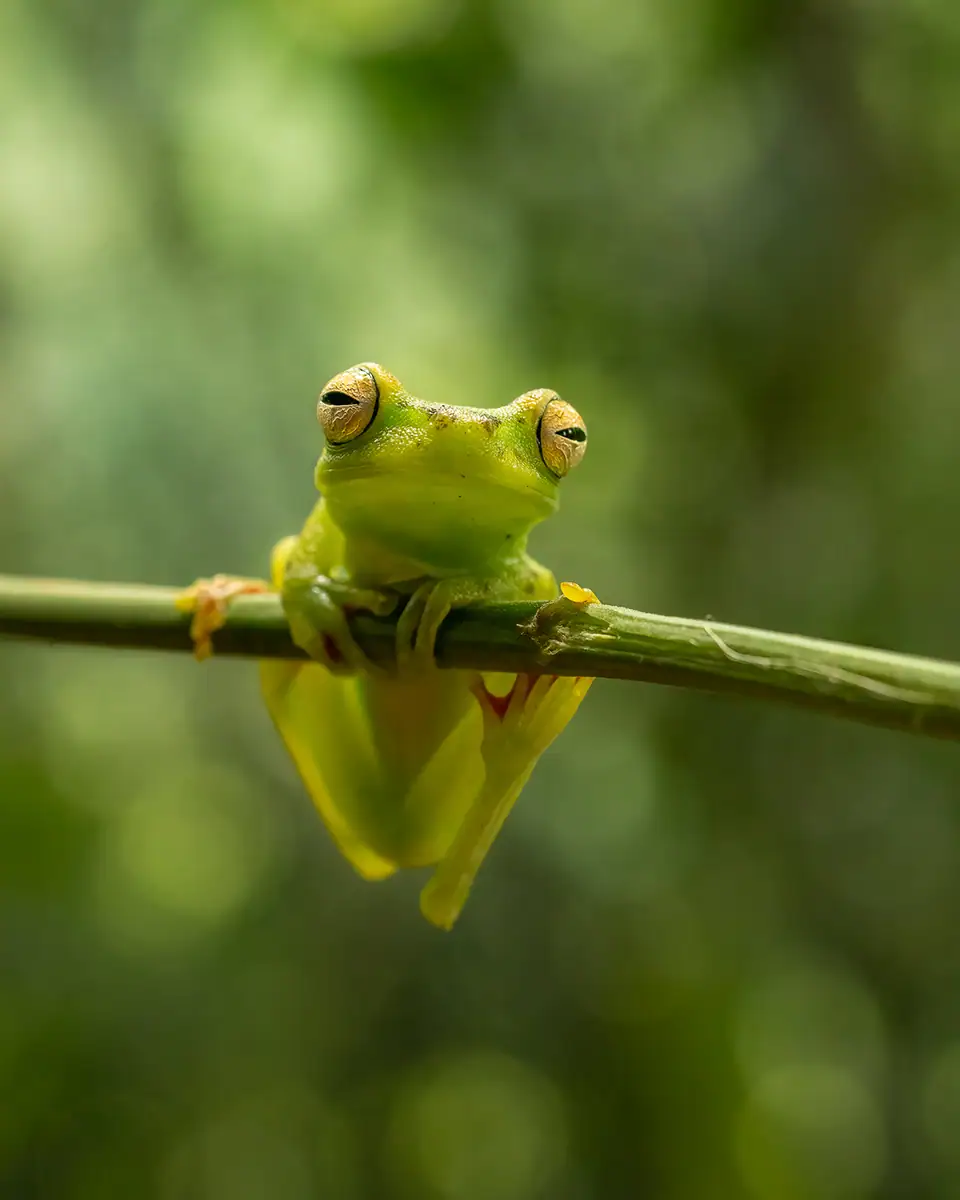
Part of the power of the Tamron 50-400mm VC lens is that you can zoom in and bring out all of the details of your subjects, even the tiniest ones. This glass frog, which is only about an inch and a half long, had worked its way along the branch and found itself in a place it didn’t want to be in. So it had flipped itself around to retreat, causing its back end to fall partly off the branch. You can’t see it here, but the herpetologist I was working with had his hands outstretched just out of frame to catch the frog in case it couldn’t hang on.
Make sure you’re working with knowledgeable, ethical handlers when photographing amphibians like this, because they can be sensitive species to work with. It can be incredibly dangerous for your subject if it’s handled too long, put under the wrong lighting conditions, or not misted down enough to prevent dehydration.
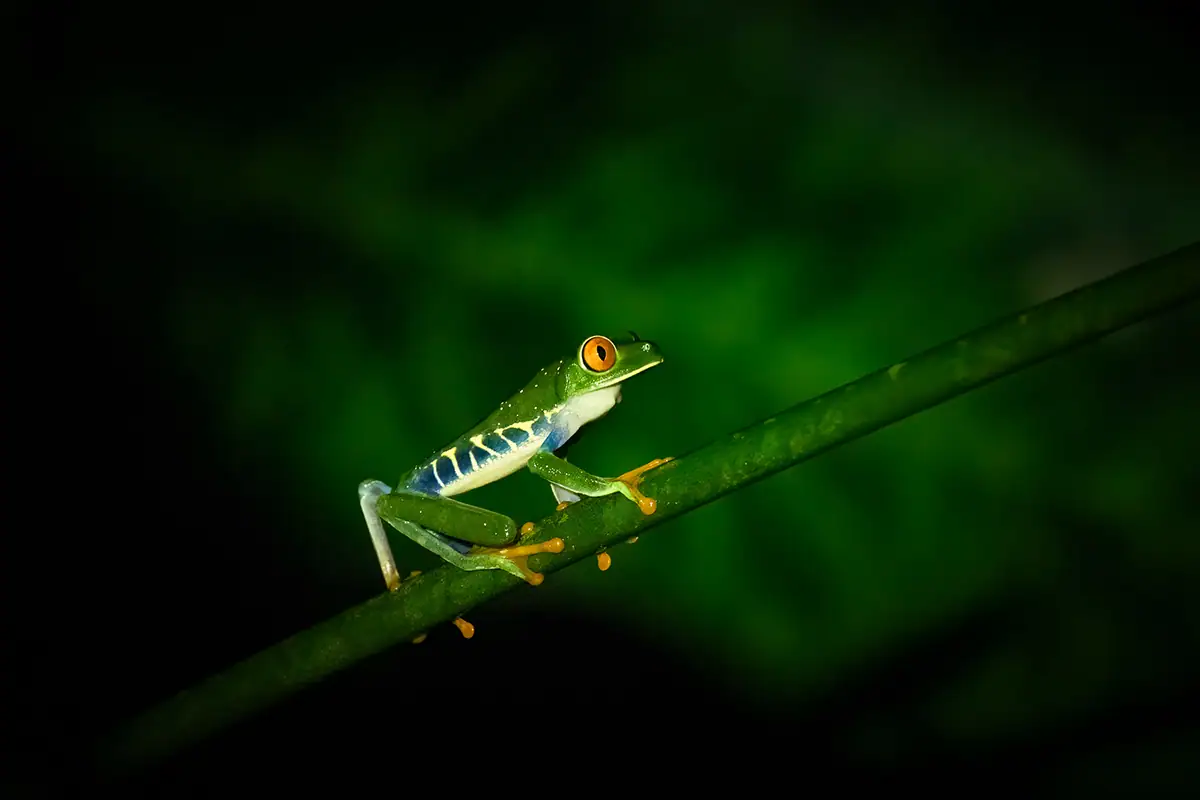
Learn as much as you can about your subject, their life cycles and habits, and where to find them—especially for tiny wildlife. I knew that the hotel I was staying at featured a small pond that was the ideal habitat for red-eyed tree frogs, so I went out with my local guide to see if we could find any.
This male frog was climbing up to get a better perch. To take his photo, I used an LED light panel smaller than a cellphone that allowed me to adjust both the intensity of the light, as well as the temperature of the lighting. Because these nocturnal animals can be so sensitive to light, I don’t use the light panel at full power. Instead, I’ll normally set it at just 25% to 35% capacity, so I don’t overwhelm my subject’s eyes. This type of tree frog also has a light white/yellow coloration on its sides, so I didn’t want to blow that detail out, either.
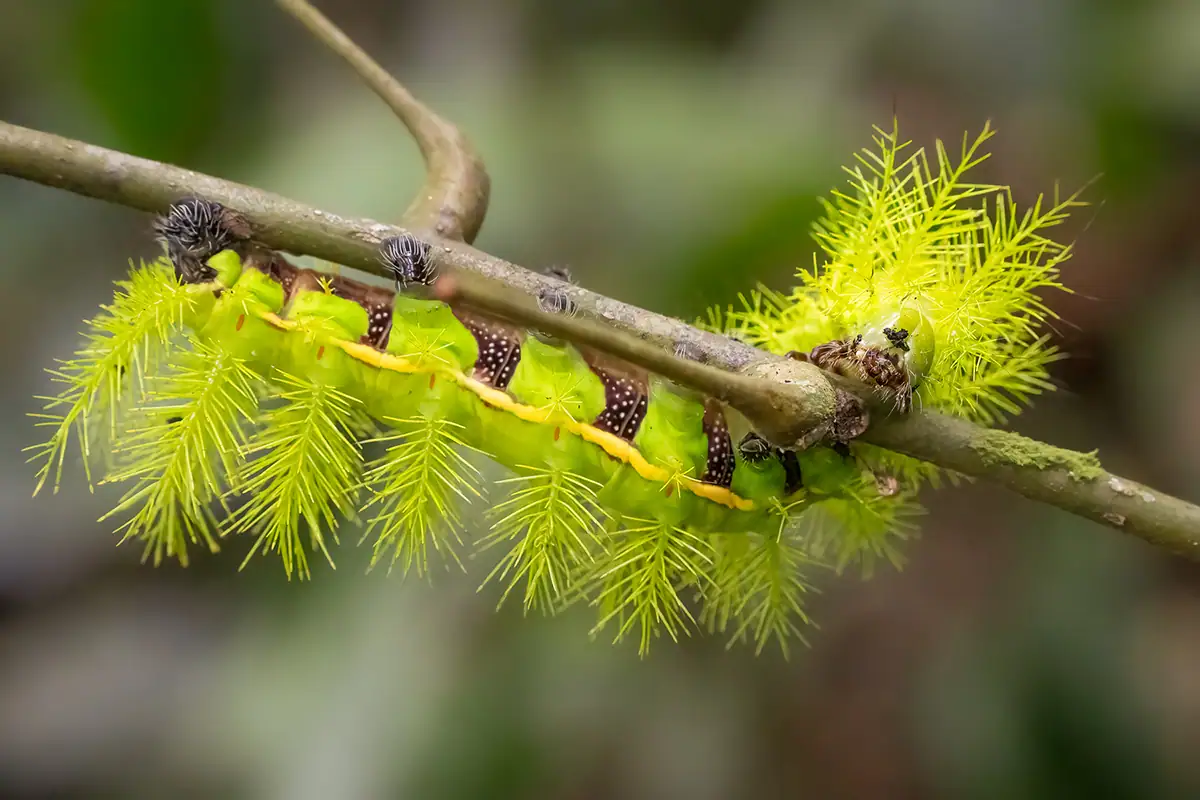
I stumbled upon this hairy caterpillar while on a hike looking for birds. That’s the beauty of a lens like the Tamron 50-400mm VC, because I can be looking for larger subjects like trogons and spectacled owls, but also be able to switch gears and do some macro-style shooting of something like this caterpillar, which was about 4 inches long.
It’s all about working those angles when taking a shot like this. If you look at the image closely, you’ll see there’s actually a second branch coming toward the viewer. I had to line things up with the two branches to minimize that distraction and keep the focus on the caterpillar. It helps that the caterpillar is the brightest element in the frame. Whether I’m deep in the Costa Rican jungle or deep underwater on one of my dives, I’m always finding amazing-looking creatures like this, which makes me wonder: How did this emerge along the evolutionary chain? What made it decide this was the route to take?
To see more of Alyce Bender’s work, check out her website and Instagram.
 English
  Spanish
  French
  Portuguese