Instant Savings
 Rebate Claims
 Support
 Find a Dealer
Where Sand Meets Sky
Nick Spooner-Rodie captures the sweeping dunes, shimmering lagoons, and changing light of one of Brazil’s most extraordinary landscapes using the Tamron 35-150mm.
Author: Jenn Gidman
Images: Nicholas Spooner-Rodie
Share Article
Nick Spooner-Rodie captures the sweeping dunes, shimmering lagoons, and changing light of one of Brazil's most extraordinary landscapes using the Tamron 35-150mm.
About a decade ago, while studying accounting at college. Nick Spooner-Rodie decided to pick up a camera. “Photography started as a creative escape, but it quickly became the thing that connected me most with the outdoors,” he says. “Looking back, I don’t think I fell in love with photography as much as I fell in love with where it could take me. The camera simply became my reason to keep exploring, and that’s still what drives my work today.”
Fascinated by places that, according to Nick, “feel a little off the map,” the Canadian photographer can spend hours peering at satellite imagery or maps. “I wonder what’s out there and what it would feel like to stand there,” he says. “Landscape photography gives me a reason to chase that curiosity and hopefully bring people along for the journey. More than anything, I want my images to tell a story. I want someone to look at a photo and wonder what happened before or after the moment it was taken.”
For a recent trip to Brazil’s Lencois Maranhenses National Park, Nick brought his Tamron 35-150mm F/2-2.8 Di III VXD all-in-one zoom lens. “The 35-150mm has become one of those lenses I naturally reach for, because it’s incredibly versatile,” he says. “I shoot almost exclusively with zoom lenses, so I’m always trying to simplify my kit without giving up creative flexibility. In Lencois Maranhenses, not having to constantly swap lenses was a huge advantage. Fine sand blown around by the wind has a way of getting everywhere, so keeping the camera sealed while still having an ample focal range made a real difference.”
Not counting his astrophotography, almost everything Nick shoots is handheld, so he needs to be able to move quickly, especially when the light is changing. “Modern image stabilization and fast lenses have made that much easier, and being able to shoot the Tamron 35-150 wide open while retaining excellent sharpness gives me a lot of freedom,” he says. “I spotted the little bird shown here, for example, while having lunch at a local restaurant. It kept darting between tables for scraps, and I loved how expressive it was. The biggest challenge was the low light indoors, but having the lens open to F2.8 made it easy to keep the shutter speed high without sacrificing image quality.”

As for the park itself, Nick calls it one of the most unique landscapes he’s ever visited. “It’s a vast field of white sand dunes that fills with thousands of rain-fed lagoons during the wet season, creating these incredible blue and green pools,” he says. “Like a lot of my trips, it started by staring at a map and wondering what was out there. Once I learned more about the park, I knew I wanted to experience it on foot. My goal wasn’t just to photograph the landscape, but to show the scale of it and what it feels like to move through such an unexpected place.”
NICK’S QUICK TIPS
Don’t get attached to just one type of light.
Golden hour will probably always be my preferred time of day to shoot, but this trip reminded me not to become too attached to one type of light. Some of my favorite images were actually made in the middle of the day. Afternoon thunderstorms would roll across the horizon, creating dramatic shadows over the dunes, while the overhead sun made the lagoons glow with these incredible colors. It was a good reminder that every kind of light has something to offer if you’re open to it.
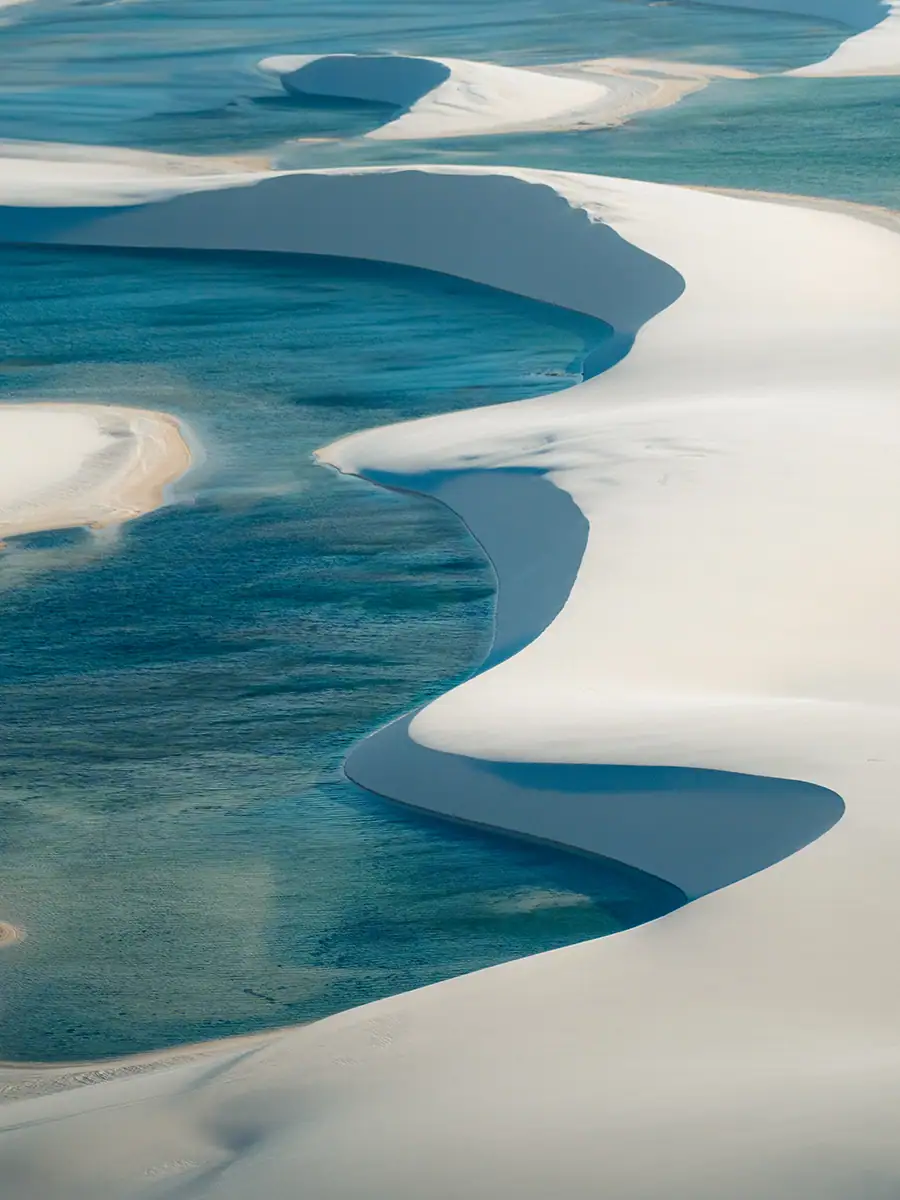
For instance, take my photo of the close-up of the lagoon, taken from a doors-off helicopter flight over the park. Seeing the landscape from above completely changed my perspective. The midday sun brought out the color of the lagoons in a way that simply isn’t possible at sunrise or sunset. It’s also a great example of why I love the 35-150mm F2.8. During helicopter flights, the last thing I want to do is change lenses, so having that focal range in one lens lets me react quickly without missing any moments.
Let the landscape lead.
I’m usually looking for depth and layers when I’m setting up my compositions. It could be light cutting across a landscape, repeating shapes, or a small human element that lends scale to a huge scene. Those little moments are often what make me stop.
For me, composition is really about simplifying a scene. Landscapes can be overwhelming, so I try to strip away distractions and focus on one strong idea. Sometimes that’s using leading lines, sometimes it’s negative space, and other times it’s simply waiting for someone to walk into the frame and give the landscape a sense of scale.
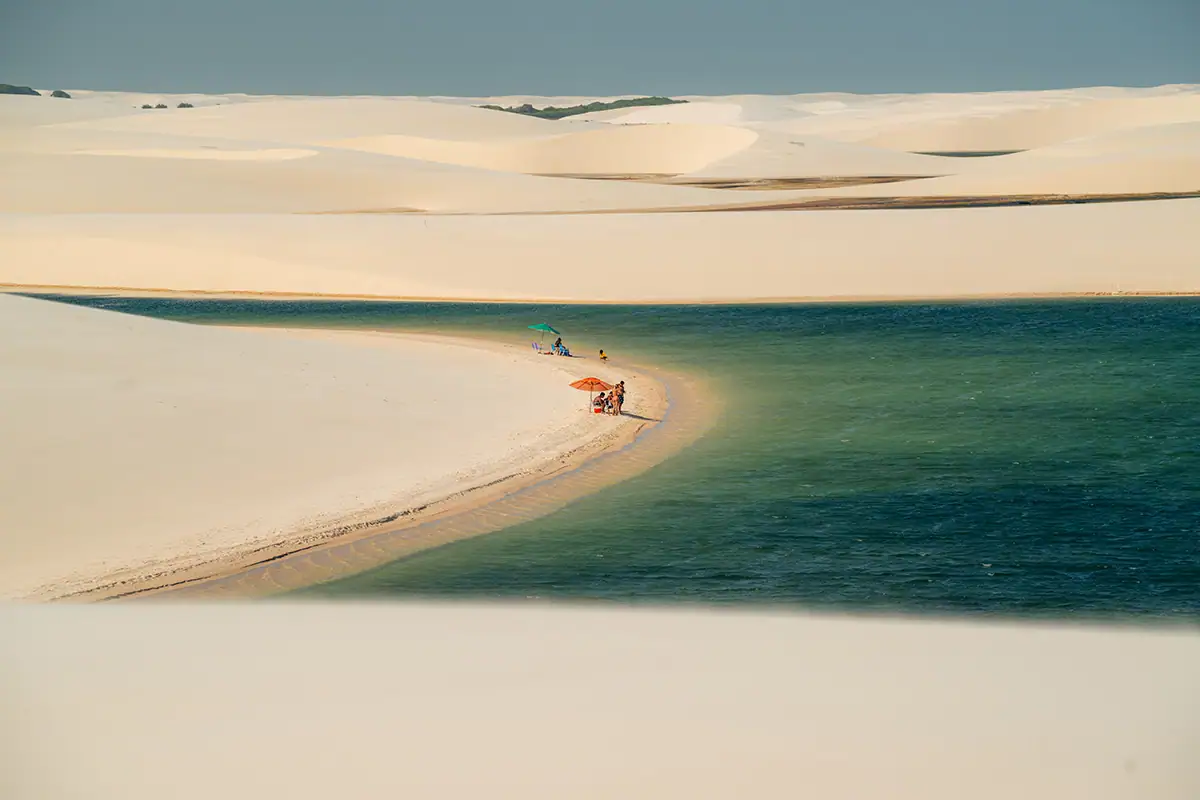
I took the photo here of that beachgoer’s oasis in the middle of the desert during a midday scouting hike. I was drawn to the simple layers—the white sand, the blue lagoon, and the tiny people scattered throughout the frame. It felt like a clean, minimalist way to show the scale of the landscape.
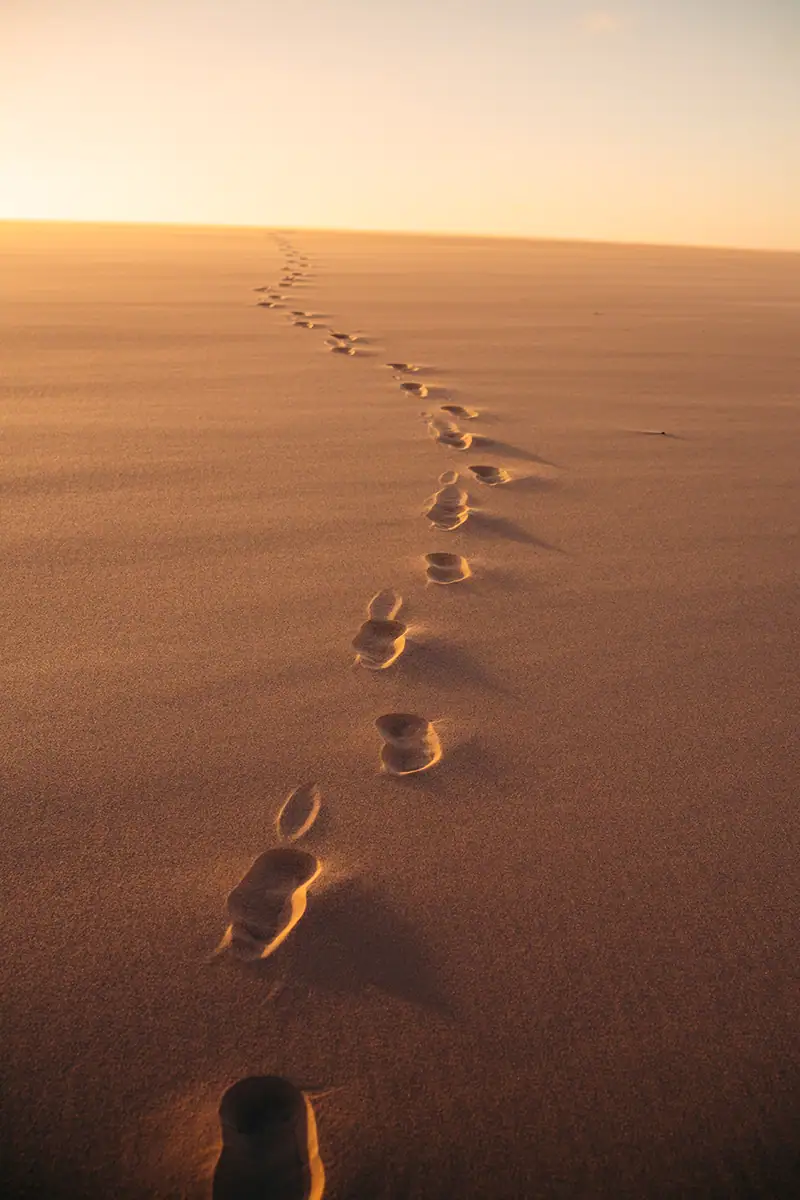
Sometimes elements in the environment will directly drive the direction of your image, like the photo of footsteps in the sand taken during one of my many desert hikes. Don’t they make the most pleasant leading lines?
Stick around for late-day magic.
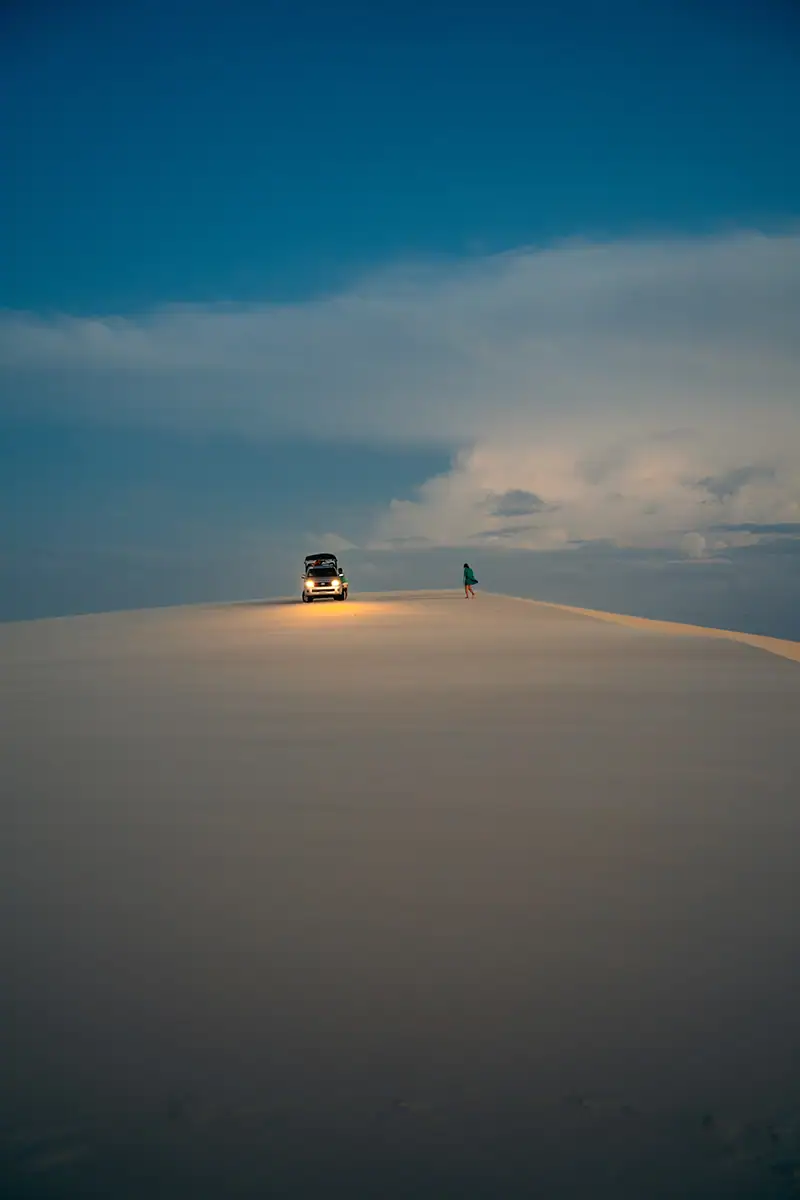
You can achieve some truly dramatic shots that you wouldn’t capture otherwise; this type of landscape can look so different at different times of the day. For the first evening shot you see here, with that lone vehicle with its headlights on perched at the top of a sand dune, it was the end of a long day hiking through those dunes. Every evening, these massive storm clouds would build on the horizon, creating incredible light. I waited until the last vehicles were leaving so their headlights would add a small focal point against the vast landscape. One thing the photo doesn’t show: the two-and-a-half-hour walk back to town in the dark afterward.
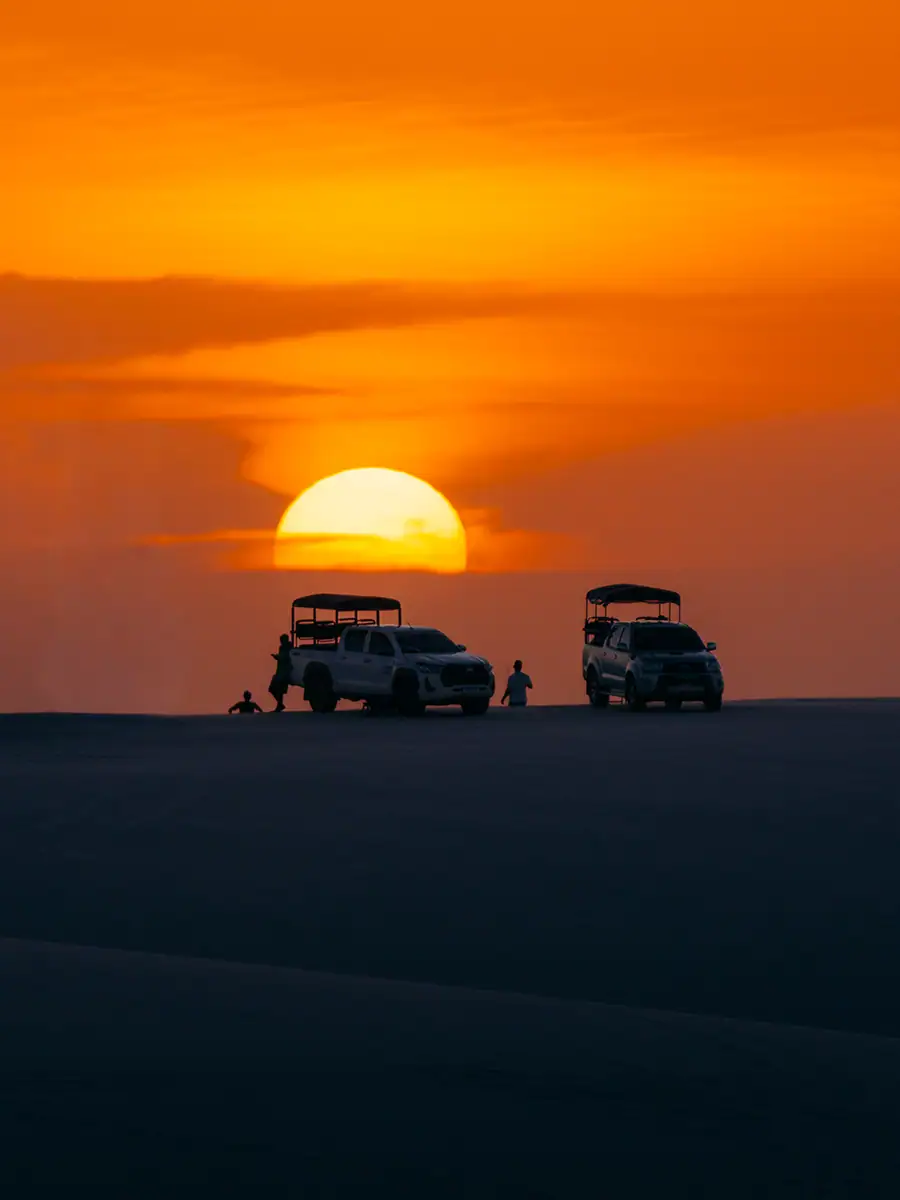
For the final image of the vehicles at sunset, I should note that this is how almost every day would end. It almost felt ritualistic. I loved photographing the silhouettes of the drivers standing quietly on the ridge, taking it all in. It wasn’t about action or adventure in that moment—it was about slowing down and taking it all in.
To see more of Nick Spooner’s work, check out his Instagram.