 Instant Savings
 Rebate Claims
 Support
 Find a Dealer
Chasing Sparks and Salt Flats
Casey Horner captures the thrill of the motorcycle ride with his suite of Tamron lenses.
Author: Jenn Gidman
Images: Casey Horner
Share Article
Casey Horner captures the thrill of the motorcycle ride with his suite of Tamron lenses.
Eight years ago, Casey Horner longed for a hobby to escape the daily grind. “I wanted something that would get me outside and challenge my mind,” the California photographer says. “I bought a camera and started exploring, mainly through landscape photography. The switch to motorcycle photos happened fairly recently. I have friends in the motorcycle community, and I wanted to put my photography skills to the test in faster-paced scenarios.”
Assisting Casey in capturing this adrenaline-surged action are a variety of Tamron lenses for his mirrorless camera system—including the 17-28mm F/2.8 Di III RXD and 17-50mm Di III VXD wide-angle lenses, 28-75mm F/2.8 Di III VXD G2 standard zoom, and 70-180mm F/2.8 Di III VC VXD G2 telephoto zoom. “When choosing lenses, I look at a variety of criteria,” he says. “The cost versus quality aspect is very important to me, and Tamron’s product line has always excelled in that regard.”
Casey notes that another major reason he chooses Tamron lenses for his motorcycle imagery is the size and weight variable. “I travel with my photography kit on my motorcycle, so I’m limited on physical space when packing for a shoot,” he says. “Being able to carry fast F2.8 zoom lenses that have such a small form factor helps me maximize the space required for my equipment.”
When choosing what lens he’ll tap into for a specific shoot, Casey analyzes the location and where he thinks he’ll be positioned. “I do a lot of shooting while I’m riding my motorcycle, and those scenarios tend to work much better with an ultra-wide-angle lens, where I’m able to stay in close proximity to the rider,” he says. “If I’m on foot and the location offers options where I can be farther away, I’ll usually choose a longer lens, as I find lenses like that offer me better opportunity to pan at lower shutter speeds, which creates a nice separation of the subject against the background.”
Casey’s overriding goal when shooting these types of photos: “I want someone to look at my pictures and see the motion involved. I grew up reading skateboarding magazines, and I think the imagery in those heavily influenced my artistic aspirations. Shooting very wide, low, and close provides a visually striking image.”
CASEY’S QUICK TIPS
Pay attention to shutter speed.
That’s the most important setting when you’re trying to achieve the correct amount of motion blur for a shot that’s still sharp but obviously moving. I mostly shoot in Shutter Priority mode. My shutter speed changes based on my focal length and whether I’m panning on foot or traveling in a vehicle. If I’m panning with a 70mm or longer, I try to shoot for a starting point of 1/125 sec. and can go down to 1/20 sec., depending on the amount of background blur I’m aiming for.
When panning using a wide-angle lens, it’s much less forgiving; your shutter speed has to be quite a bit faster than it would be with a long lens, due to the field-of-view curvature. I’ve found that 1/320 sec. is about the limit I can have, where I’ll capture some movement while still getting a sharp image. Shooting from a moving vehicle is the easiest scenario, as it allows much more latitude in shutter speed due to both you and your subject traveling through space at the same speed.
Understand the action, and the riders.
This is more important than having top-notch technical photography skills. Observe and learn the riders’ movements and maneuvers, and how to anticipate the action, before you even start to worry about capturing decent photos. Then make sure you’re in the best position you can be in, and have your camera settings dialed in prior to the action starting.
Incorporate the landscape.
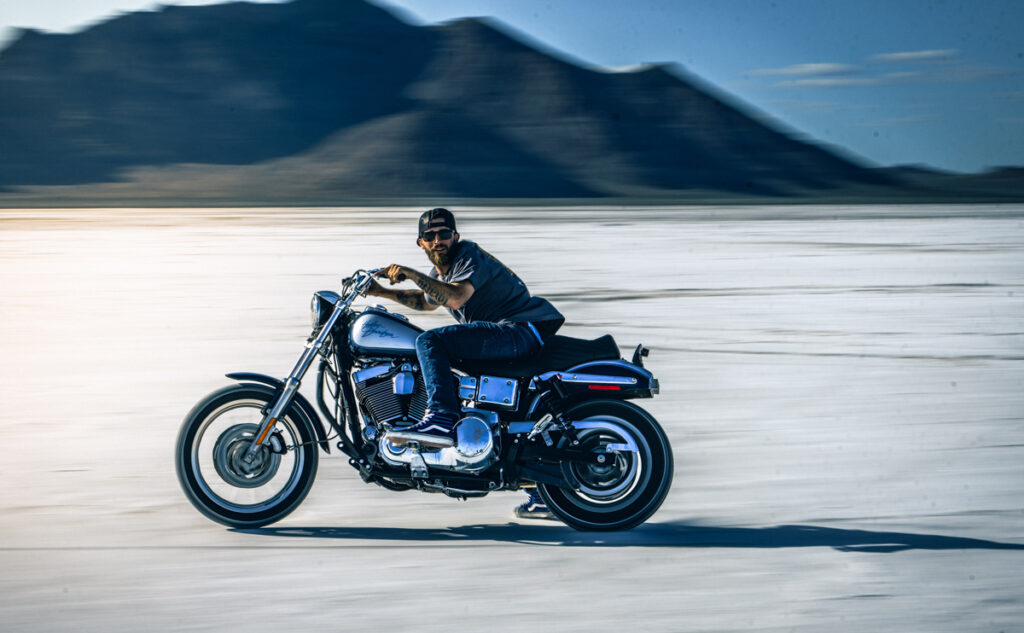
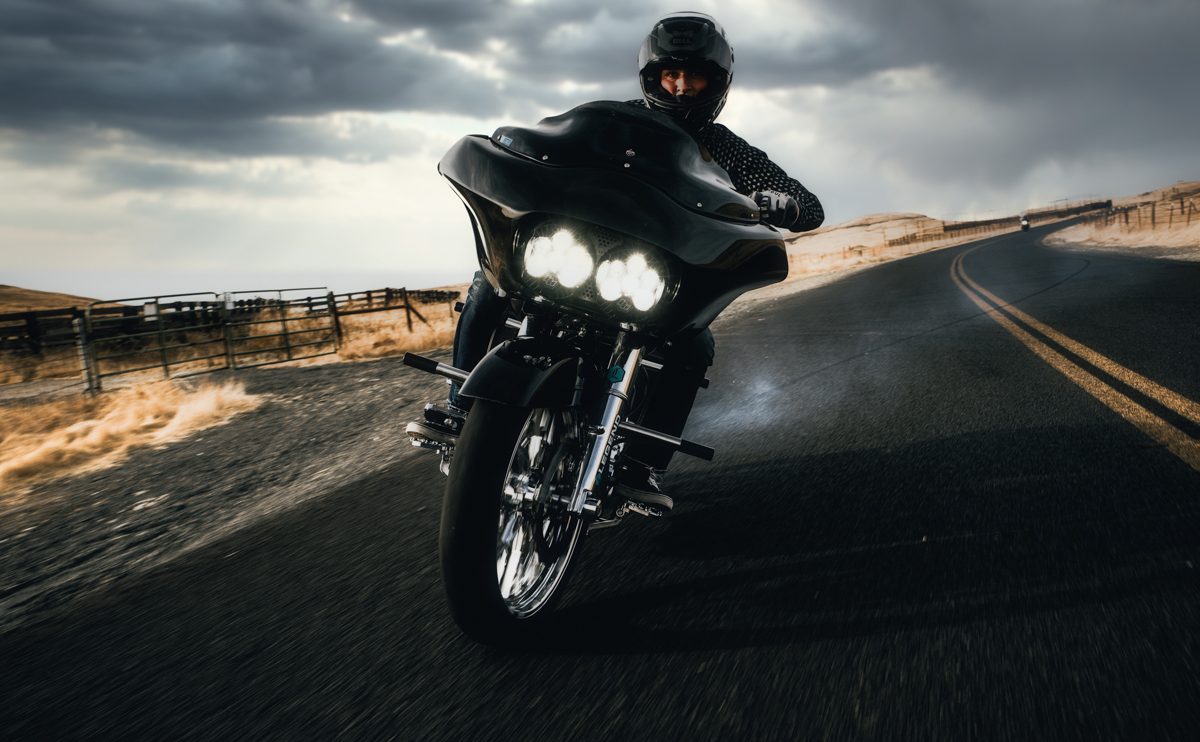
Including some of the background scenery in your motorcycle photos can elevate them. I’d always dreamed of shooting motorcycles on the salt flats of Utah, and on a drive home one afternoon from an event, I was lucky enough to have some friends willing to do some riding out there. Shooting with the 70-180mm F2.8 G2, I was able to use the open terrain to highlight the rider’s presence against an epic backdrop. Same for the photo of the rider cruising down the open road. I took this shot from the back of an SUV. The rider started drifting across the road, and I felt a head-on shot with that open country scenery would make for a strong image.
Seek out some drag.
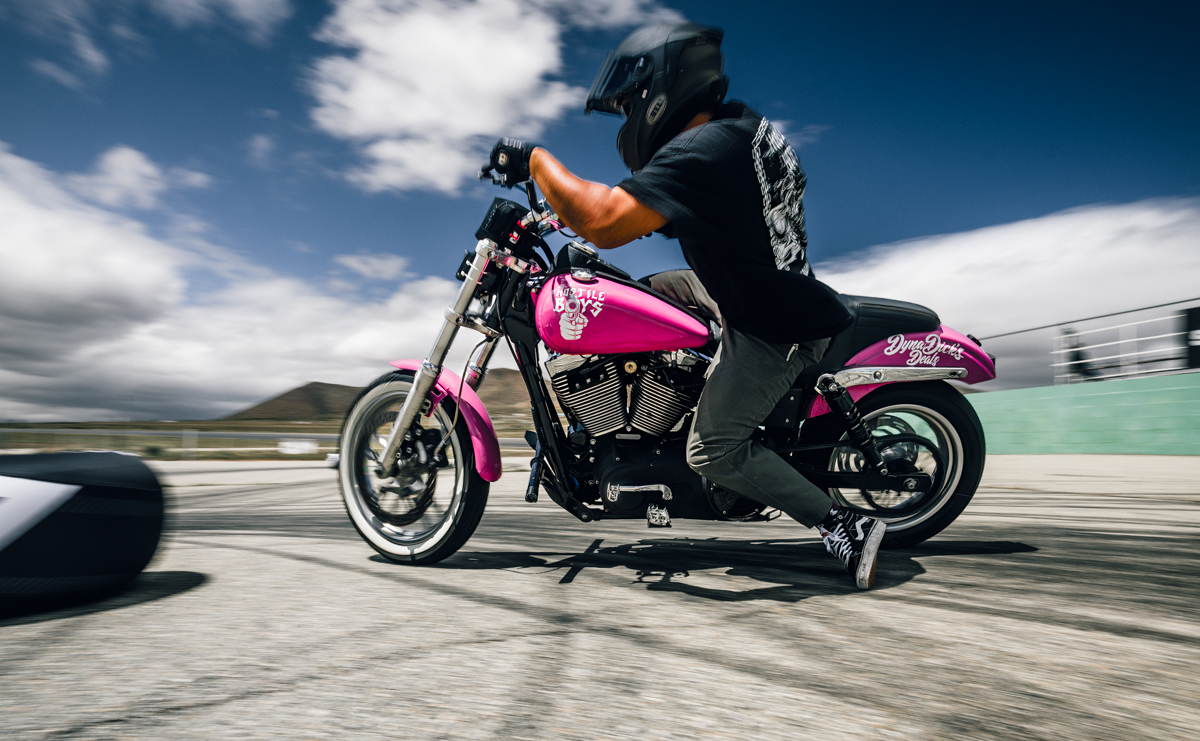
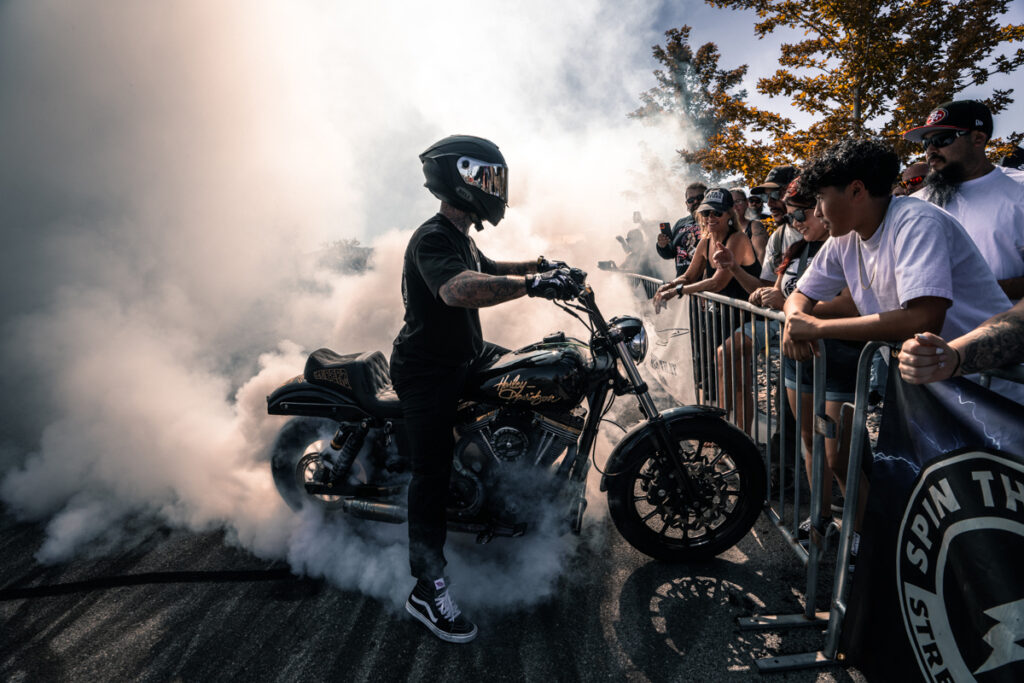
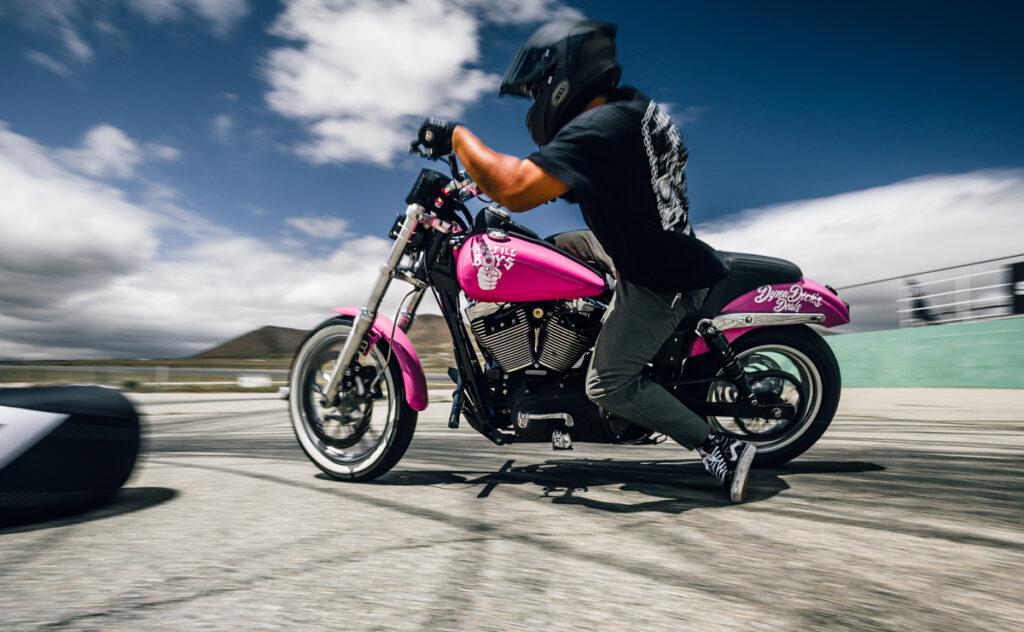
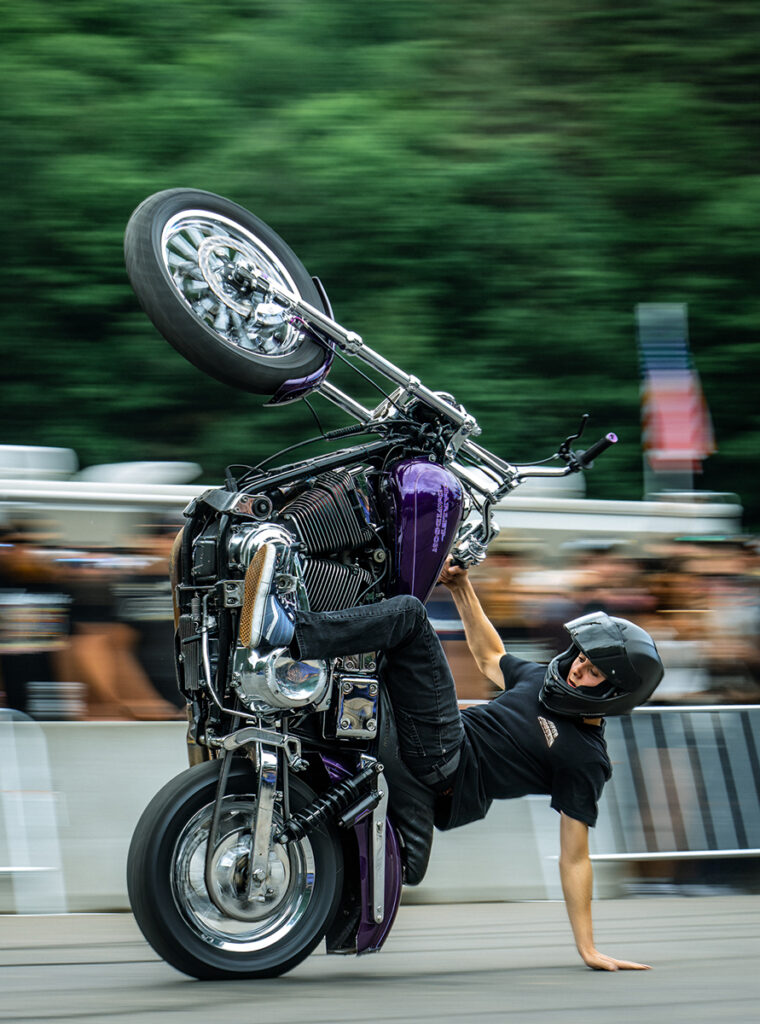
Highlighting a rider purposely dragging their foot or hand can showcase the rider’s skill, as well as their connection to the bike and to the ground, adding a sense of movement. For the photo shown here of the guy on the hot-pink bike, taken from a motorcycle drifting race, I wanted to capture this particular corner very low and wide to give it scale, so I used the Tamron 17-28mm F2.8 at its widest end. The combination of steering angle and the foot drag help convey the energy of the rider. For my shot of the guy popping a wheelie on the purple bike, taken at a New Hampshire stunt show, I opted to position myself a little further away with the 70-180mm F2.8 G2 to capture his hand drag.
Don’t forget an occasional face.
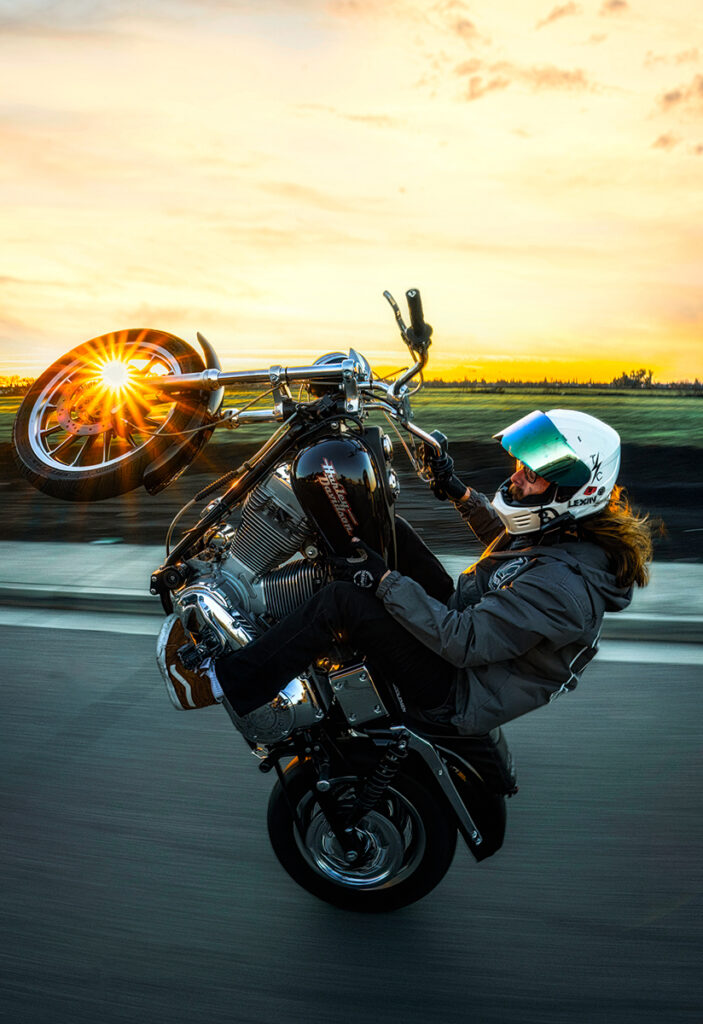
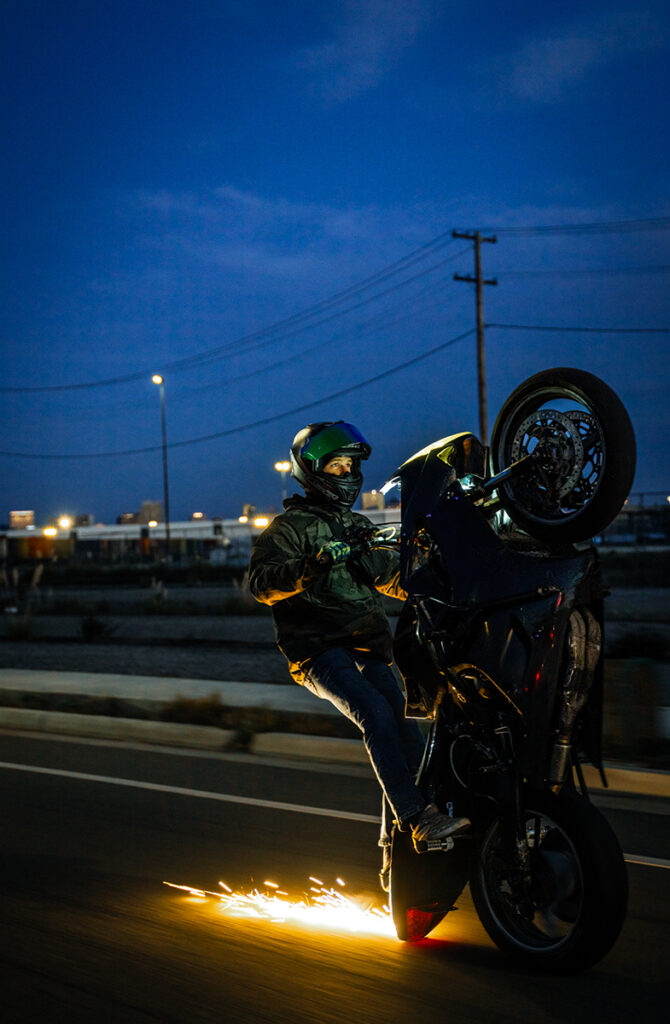
Most of the time the riders are wearing their helmets, so their facial expressions tend to be less of a focal point, but sometimes if their visor is up, you can capture a shot like the evening photo seen here. I shot it from the rear hatch of an SUV, my first attempt at shooting motorcycle stunts at night. I wanted to catch this rider with the sparks from doing a scrape. I was happy to see his face illuminated by the bike’s gauges upon reviewing it on my camera screen.
To see more of Casey Horner’s work, check out his Instagram.
 English
  Spanish
  French
  Portuguese